


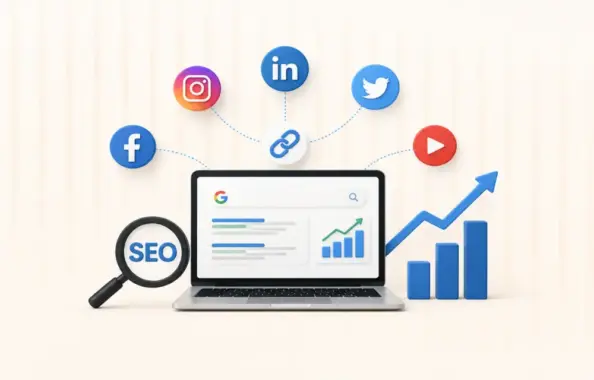
Many clients and readers often ask whether social media really helps with Google search. Since this is a question many people are searching for, this article clearly explains how social media can support SEO in practical, meaningful ways. Social media does not directly improve Google rankings, but it can support SEO in several important indirect ways. When used well, it can increase brand visibility, drive traffic, earn backlinks, and make your content easier to discover, which can all contribute to better search performance over time.
Social media and SEO
A lot of people assume likes, shares, and comments are direct ranking signals. They are not. Google has repeatedly indicated that social engagement itself is not a core ranking factor, but the effects of social media can still help your SEO in practical ways.
That means social media should not be treated as a magic ranking hack. Instead, it should be treated as a distribution channel that amplifies your content, strengthens your brand, and helps your website earn more meaningful signals across the web.
How social media helps indirectly
1. It increases content reach
When you share a blog post, tool page, or service page on social platforms, more people see it. That extra exposure can drive visitors to your site, which gives your content a better chance to be read, linked, and remembered.
For TheTechHacker, this is especially useful because posts about SEO, software, AI, and troubleshooting can be repurposed into short-form content, threads, reels, and carousels. That creates multiple entry points to the same content.
2. It helps build branded search
If people keep seeing your name on social platforms, they are more likely to search for your brand later. Branded searches are valuable because they show demand for your company and often lead to stronger trust in Google’s eyes.
For example, if TheTechHacker regularly posts useful insights on LinkedIn, X, and Instagram, readers may later search for “TheTechHacker SEO tools” or “TheTechHacker guest post.” That kind of branded demand supports long-term search visibility.
3. It can lead to backlinks
One of the biggest SEO benefits of social media is that great content gets shared more widely. When more people see your content, there is a better chance that bloggers, journalists, and site owners will reference it and link back to it.
That matters because backlinks remain one of the strongest signals in SEO. Social media does not create rankings directly, but it can help your content reach the people who do create links.
4. It improves engagement signals
Traffic from social media can improve on-site engagement if the content is relevant and useful. If people stay longer, read more pages, and interact with your site, that can support the overall quality picture around your content.
This works best when the social post and the landing page match the same intent. If your post promises a quick solution but the page is vague, users leave fast. If the content delivers exactly what the post promised, engagement goes up.
5. It supports local and profile visibility.
For brands with a local or service-based focus, social profiles can appear in search results for branded queries. That gives your business more visibility on the SERP and makes your brand look more established.
This is useful for TheTechHacker if you are promoting services like digital marketing, SaaS development, AI agents, websites, or consulting. A strong social presence helps fill the trust gap before someone contacts you.
What social media cannot do
Social media is not a replacement for SEO fundamentals. It cannot fix weak content, poor site structure, bad page speed, weak keyword targeting, or thin pages. If your website does not satisfy search intent, social traffic alone will not make it rank well.
It also should not be treated as a substitute for technical SEO. You still need proper indexing, internal linking, meta optimization, content depth, and a clear site structure.
TheTechHacker example
For TheTechHacker, the smartest approach is to use social media as a content multiplier. A single blog post can become:
-
a LinkedIn post for professionals,
-
an Instagram carousel for quick learning,
-
a short X thread,
-
a YouTube Short,
-
and a newsletter mention.
That kind of distribution helps your content reach more people without changing the core article. Over time, that can lead to more direct visits, more branded searches, and more backlinks from people who discover your content on social platforms.
TheTechHacker digital services
You can also position your services around this combined SEO + social model:
-
Social media strategy and brand building,
-
SEO content planning,
-
Content repurposing,
-
Authority building for founders and brands,
-
Guest post publishing,
-
Digital growth strategy,
-
SaaS marketing support.
-
AI-assisted content systems.
This makes TheTechHacker look like a full-funnel growth partner, not just a publishing site.
Conclusion
So, does social media help with Google SEO? Yes, but indirectly. It helps by increasing reach, improving brand recognition, supporting backlink opportunities, and driving more qualified traffic to your website.
The best strategy is not choosing between SEO and social media. It is using both together so that social media multiplies discovery and SEO utilises long-term search demand.
FAQ
Does social media directly affect Google rankings?
No, social signals like likes and shares are not direct Google ranking factors.
Why do marketers still use social media for SEO?
Because it helps content reach more people, build brand awareness, and create backlink opportunities that support SEO indirectly.
Which social platform is best for SEO?
It depends on your audience, but LinkedIn, X, Instagram, Facebook, and YouTube are commonly used for content distribution and branded visibility.
Can social media improve branded search?
Yes. Strong social visibility can make more people search your brand name directly on Google.
Should I focus on SEO or social media first?
The best approach is to use both, but SEO should remain the foundation if your goal is long-term organic traffic.