


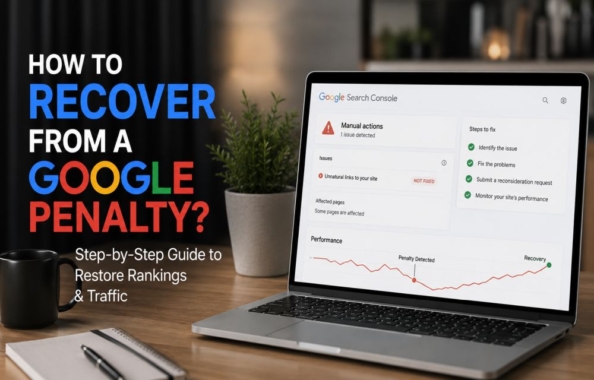
Google penalties are a nightmare for website owners.
When I started TheTechHacker in 2013, I wrote in my own style and made many mistakes. Over time, traffic grew into the thousands of visits per day, but then it suddenly dropped to just a few hundred. That was the moment I realized the site had likely been hit by a Google penalty, and from there I had to learn the hard way what went wrong, what Google was looking at, and how recovery actually works.
If you have seen a sudden traffic drop, a ranking collapse, or a page that once performed well but has now disappeared from search, this article will help you understand the full picture. You will learn how Google algorithm updates affect websites, what kinds of penalties exist, how to identify the cause, and what remedies can help you recover and protect your site in the future.
What a Google penalty really means
A Google penalty is not always a direct punishment in the dramatic sense people imagine. Sometimes it is a manual action taken by Google’s team. Other times it is an algorithmic loss, where your site is affected because it no longer matches Google’s quality expectations after an update. In both cases, the result feels the same: traffic drops, rankings fall, and pages that used to perform stop bringing in visitors.
The key difference is this:
-
Manual penalty means Google has reviewed your site and flagged a violation.
-
Algorithmic penalty means your site lost visibility because an update changed how Google evaluates quality.
That distinction matters because the recovery path is different.
Major Google updates and why they matter
Google has released many important updates over the years, and some have changed SEO forever. The most well-known families of updates include the following:
-
Panda: focused on content quality and thin pages.
-
Penguin: targeted manipulative backlinks and spammy link building.
-
Hummingbird: improved Google’s understanding of search intent.
-
Mobile-friendly updates: rewarded pages that worked well on phones.
-
Core updates: broad quality adjustments across many ranking signals.
-
Helpful content updates: prioritized content written for people, not just search engines.
-
Spam updates: targeted low-value, manipulative, or automated content.
-
Product reviews updates: rewarded genuine, useful review content.
-
Page experience updates: emphasized usability and speed-related signals.
Each update has one thing in common: Google wants better answers for users. If your content becomes too thin, too repetitive, too over-optimized, or too disconnected from search intent, you can lose visibility.
How updates impact your site
A Google update can affect your site in different ways depending on what you publish and how you publish it. For example:
-
A content-heavy site with shallow pages may lose traffic after a quality-focused update.
-
A site with unnatural backlinks may be hit by link-related filters.
-
A page written for keywords instead of users may drop because it fails intent.
-
A slow or poor mobile experience can weaken performance in competitive SERPs.
For TheTechHacker and similar editorial sites, the biggest risks usually come from content quality, structure, topical relevance, and internal optimization. If the site starts publishing too many repetitive posts or low-value pages, Google may stop trusting it as much.
Step one: identify the type of penalty
Before fixing anything, you need to know what kind of problem you are dealing with. Start by checking Google Search Console. If there is a manual action, Google will usually tell you directly. If there is no manual action, the issue is more likely algorithmic.
Then compare your traffic drop with known update dates. If the drop lines up closely with a major update, that is a strong clue. You should also look at:
-
which pages lost traffic,
-
which keywords dropped,
-
whether the loss was sitewide or page-specific,
-
whether backlinks changed,
-
whether content quality changed.
That diagnosis tells you where to focus.
Step two: audit content quality
If the issue is content-related, start with a full content audit. Ask simple but brutal questions:
-
Does this page actually help the user?
-
Is the content original?
-
Is it thin or repetitive?
-
Does it cover the topic deeply enough?
-
Is it written for readers or just for rankings?
Remove, merge, or rewrite pages that are weak. In many cases, a site recovers not by publishing more content, but by improving the content it already has. This is especially important for pages that have little value, duplicated sections, or overly generic writing.
Step three: review backlinks carefully
If your site has a backlink problem, do not panic and disavow everything blindly. First, review your link profile. Look for patterns such as:
-
lots of spammy domains,
-
irrelevant foreign sites,
-
unnatural anchor text,
-
sudden spikes in low-quality links,
-
link schemes or paid placements without context.
If you can remove toxic links, do so. If you cannot, use the disavow process carefully. The goal is not to chase every bad-looking link. The goal is to clean up clearly manipulative patterns that may be harming trust.
Step four: fix technical issues
Sometimes the penalty feeling is actually a technical SEO problem. Check for:
-
slow pages,
-
mobile usability issues,
-
poor internal linking,
-
duplicate titles,
-
indexing problems,
-
broken pages,
-
weak sitemap structure,
-
crawl waste on low-value URLs.
A site can lose visibility even if the content is good, simply because the technical foundation is weak. Google needs to crawl and understand your pages cleanly.
Step five: improve search intent matching
One of the fastest ways to recover visibility is to align your content with search intent. A page should match what the searcher wants. If the query is informational, give explanations. If the query is commercial, provide comparisons. If the query is a fix, give a step-by-step solution.
For example:
-
A troubleshooting article should start with the cause and the fix.
-
A comparison article should include a table and practical takeaways.
-
A listicle should clearly state why each option belongs on the list.
This is one of the biggest lessons I learned while building TheTechHacker. Good writing is not enough. The page must satisfy the searcher immediately.
Step six: submit reconsideration if needed
If you received a manual action, fix the issue completely and then submit a reconsideration request. Be honest. Explain what happened, what you changed, and how you will prevent the issue from returning. Do not try to sound defensive or vague.
Google is more likely to trust a clear and transparent explanation than a polished excuse.
What recovery usually looks like
Recovery is not instant. Manual actions may take a few weeks to be reviewed. Algorithmic recovery may take longer because it depends on the next evaluation cycle. In some cases, you will see gradual improvement. In others, you may need to wait until Google reprocesses the site after major fixes.
The important thing is consistency. One good cleanup does not fix years of weak SEO habits. But a focused recovery plan can absolutely bring a site back.
TheTechHacker digital and lab services
At TheTechHacker, this is exactly the kind of work we understand deeply because we sit at the intersection of content, growth, and product thinking. Our Digital services can help with:
-
SEO audits,
-
content strategy,
-
branded search growth,
-
technical optimization,
-
traffic recovery planning,
-
social media presence building.
Our Labs services can support:
-
SaaS development,
-
LLM and agentic AI workflows,
-
voice agents,
-
automation systems,
-
website builds and product prototypes.
That combination matters because recovery is not just about fixing a page. It is about rebuilding trust, structure, and long-term visibility.
Prevention going forward
Once your site starts recovering, protect it by:
-
publishing people-first content,
-
avoiding over-optimization,
-
checking backlinks regularly,
-
improving old pages instead of only adding new ones,
-
keeping your site technically clean,
-
monitoring update-related traffic shifts,
-
building topical authority over time.
Google changes often, but the core principle stays the same: create useful, trustworthy content and make it easy to access.
FAQ
What is the first step in recovering from a Google penalty?
Check Google Search Console for manual actions and compare traffic drops with known algorithm updates.
How do I know if my site has a manual penalty?
Google Search Console will usually show a manual action notice if your site was directly flagged.
Can algorithmic penalties be removed?
There is no direct request for algorithmic recovery. You need to fix the underlying issues and wait for Google to reevaluate the site.
How long does recovery take?
Manual actions may take weeks. Algorithmic recovery can take longer, depending on when Google reprocesses the site.
Should I disavow all bad backlinks?
No. Only disavow clearly toxic or manipulative links after reviewing the profile carefully.
What content problems cause penalties?
Thin content, duplicate content, keyword stuffing, low-value pages, and content that does not meet search intent.
Can TheTechHacker help with recovery work?
Yes. TheTechHacker can support SEO recovery through Digital services and technical builds through Labs.