


Tech entrepreneurs require tools for designing that allow them to operate quickly, without waiting on a complete creative team. The best tools in 2026 will utilise speed; enable collaboration; include AI support; and provide sufficient polish to support branding, launch products, and develop materials for investors.
Why Founders Need Design Tools
Creating pitch decks, designing landing pages, producing social graphics, generating product mockups, and developing simple brand assets are often needed by founders on tight timelines. Therefore, now, design tools that support collaboration, include templates, provide AI generation capabilities, and allow for rapid publication have become vital to startup operations.
The purpose of these design tools is to give founders the option of testing their concepts without requiring substantial amounts of time or resources; communicating efficiently with their audiences; and delivering products at an accelerated pace.
1.FIGMA:
One of the best tools for tech founders is Figma because it allows the rapid transformation of early stage product concepts into wireframes, prototypes and design systems.
Additionally, it has many collaboration capabilities that help provide efficiency in founder/designer/developer workflows, especially when teams need to collaborate and give/receive feedback in real-time.
AI features within Figma assist with layout recommendations, copy assistance and first drafts; thus speeding up the overall initial product development process.
2. CANVA:
For non-designers who want to create brand collateral, marketing graphics, social media posts, and pitch presentations, Canva is by far the quickest way to do so and provides a drag-and-drop interface along with thousands of templates that will not take you a lifetime to learn how to use.
Additionally, Canva now has AI features that can assist in both creating and adapting marketing content faster for early-stage startups.
3. ADOBE FIREFLY:
Adobe Firefly’s AI art generator is a strong choice for commercial-safe AI image generation and editing, trained on licensed Adobe Stock and public domain content rather than scraped web data. It works well for concepts, brand testing, campaign graphics, and final assets you can later refine in Photoshop or Illustrator.
Firefly provides early-stage startups with both licensing clarity and enterprise-ready workflows.
4. Midjourney:
Midjourney is a top choice for founders needing striking concept art, mood boards for their brands, and visually appealing direction.
This is particularly helpful in the early stages of brand or product development when exploring styles as opposed to producing files ready for production is the objective.
Numerous startup teams use this service to develop visuals that appear more unique than typical stock photos.
5. Recraft:
Recraft is another premier solution for founders looking to produce scalable, clean-looking vector graphics, logos, icons, and visual assets to use in association with their brands.
Use Recraft when you need native SVG output, because it fits startups building brand systems or low-cost marketing assets. It can also save your team time because it produces vectors that are easy to convert into usable formats.
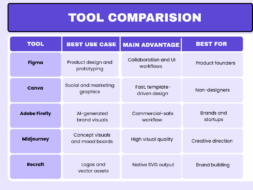

How do founders make their choice
Use Figma if your main product is built for users, because it lets you design, collaborate, and iterate in one platform. Use Canva when you need to create marketing content quickly and get started fast.
If your primary desire is to create AI-generated images for your marketing campaigns, the Adobe Firefly and Midjourney applications offer the best variety and ease of use as creative options.
Anytime you need new logos or scalable brand designs, Recraft is the most sensible way to get started.
The bottom line
As a technology founder, the key to selecting the right design stack is determining which tools you want to use to eliminate roadblocks.
Figma is for product visualisation, Canva is for fast production.
Firefly is for secure artificial intelligence (AI) image creation, Midjourney is for artistic image creation, and Recraft is for scalable branding and graphic design.
Together, these tools give founders enough creative control to move fast without waiting for design work to finish.