


Keyword research continues to be the foundation of search engine optimisation (SEO). The 2026 objective will not only be to find popular keywords. The greatest achievement is finding out about low competition keywords, competitor shortages, long tail phrases and any untapped search opportunities your competitors have.
Using the right tools, you can turn standard content planning into a mechanism for tracking pages that are easier and more likely to generate qualified traffic.
Why hidden opportunities are valuable
Hidden ranking opportunities are typically found in the longtail, question queries and competitive keyword deficiencies.
These keywords tend to generate quicker wins due to lower competition and higher search intent.
For SEO teams, this means less assumption and more content capable of moving the needle.
What to search for
Good keyword tools should show the following; search volume, search difficulty, search intent, keyword variations, competitor overlap.
In addition, they will help you find keyword clusters, keyword related questions and keywords that can be ranked with a different angle of content.
If you are searching for hidden keyword opportunities, look for a tool that reveals gaps not just obvious keywords.
1. Semrush
Semrush is one effective method for identifying hidden keyword opportunities due to its ability to combine keyword research, keywords gap analysis, competitor intelligence and content creation planning all in one place.
Additionally, Semrush’s Keyword Magic Tool allows you to discover additional keywords by searching for similar keywords, variations and long-tail keyword ideas, all of which may have been overlooked during your manual research.
Agencies and SEOs seeking to create valuable content around broad topics will benefit from the depth of keyword data found within Semrush’s software program because it provides an easy way to generate content clusters.
Semrush also allows you look at the keywords your competitors rank for and determine where you have the opportunity to create new landing pages or optimize existing ones.
2.Ahrefs
Ahrefs is another great tool for discovering keyword opportunities by analyzing your competitors’ websites and utilizing click-based metrics as well as discovering content gaps.
Ahrefs’ Keyword Explorer can be used to generate ideas for related keywords, assess potential website traffic from those keywords, and see which keywords your competitors currently rank for.
If you are an SEO looking to generate a list of keyword opportunities based on what is missing from their competitors’ websites, Ahrefs provides one of the best sources for finding these hidden gems.
Ahrefs has an advantage over other keyword research tools in that it goes beyond the pure volume of keywords and instead focuses on the commercial value of a keyword and the potential ranking for that keyword.
Thus, Ahrefs is ideal for content strategists who are concerned with getting a positive return-on-investment (ROI) from the content they create rather than simply having a long list of keywords.
3.Moz Keyword Explorer
Moz’s Keyword Explorer is a great way to find long-tail keywords and determine if a keyword will be worth pursuing. Moz also has a Priority Score that helps you weigh volume, difficulty, and click-through rate to prioritize your time effectively on keywords that have the most potential.
This makes Keyword Explorer especially beneficial for teams who would like to see their keywords organized by priority instead of spending time on spreadsheets with tons of keywords.
Moz’s Keyword Explorer is especially good for creating detailed content and mapping out topics, particularly when you are focusing on creating content based on intent rather than chasing after keywords with large volumes of searches.
If you would like to use a simple tool to show you good opportunities, then Moz’s Keyword Explorer is an excellent choice.
4.Keyword Tool
When searching for keywords or keyword ideas, Keyword Tool is an essential tool because it lets you see keyword suggestions that Google Keyword Planner frequently hides from view, which especially helps people who are creating SEO content and marketing advice.
So, if you need to find question-based terms, niche terms, and terms that are specific to certain platforms, Keyword Tool is an excellent choice.
Keyword Tool is particularly useful for content creators who are looking to identify less obvious search queries so they can expand their keyword pool.
Keyword Tool is also useful if you want to obtain keyword ideas or inspiration from other search engines besides Google.
If you create long-tail content based on unusual search queries, Keyword Tool can help you find ideas that are not available from most of the more popular keyword tools.
5.SE Ranking
SE Ranking has a keyword tool based on data analytics to find new keyword ideas and determine their potential for both SEO and PPC purposes.
For teams that need a balanced combination of keyword ideas, competitor research, and a means of planning for both; it is especially good.
Because SE Ranking is often easier to use than the heaviest duty enterprise suites, it also tends to be a good option for smaller agencies and teams.
SE Ranking is a great choice for keyword discovery and an entire SEO process without making the process too complicated.
This makes SE Ranking a good resource for turning certain hidden keyword ideas into actual content plans.
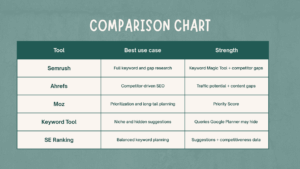

What to Think About When Choosing a Keyword Tool:
Choose Semrush if your goal is to find the most complete system for keyword discovery and opportunity maps. If you care most about competitor keyword gaps and traffic potential choose Ahrefs . Choose Moz if your priority is making long-tail keywords easier to rank and prioritize. If you want harder-to-find, less frequently searched keywords choose Keyword Tool. Choose SE Ranking if you want an inexpensive all-in-one keyword workflow tool.
FAQs
1. What are keyword research tools used for?
Keyword research tools help you find search terms, estimate demand, and identify ranking opportunities.
2. How do keyword research tools uncover hidden ranking opportunities?
They reveal long-tail queries, keyword gaps, and low-competition terms your competitors may have missed.
3. Which keyword research tool is best for competitors’ gaps?
Ahrefs and Semrush are especially strong for competitor gap analysis.
4. Which tool is best for long-tail keywords?
Moz Keyword Explorer and Keyword Tool are strong choices for long-tail discovery.
5. Are hidden keyword opportunities easier to rank for?
Usually yes, because they often have lower competition and clearer intent.
6. Can small businesses use these tools?
Yes. SE Ranking, Moz, and Keyword Tool are especially practical for smaller teams and budget-conscious marketers.
7. What should I look for in a keyword research tool?
Look for search volume, difficulty, competitor gaps, intent data, and long-tail suggestions.