


To build a high-performance e-commerce store by 2026, you should look for platforms that offer a combination of speed, scalability, usability, and features that drive conversion.
A platform will not simply be used as a shopping cart. Good e-commerce platforms will help merchants to grow faster, deal with rapid growth successfully, and provide good search engine optimization (SEO) support. An E-commerce platform will also help maintain a streamlined customer experience as more customers visit your store.
The Importance of Choosing the Right Platform
When building e-commerce, the only e-commerce platform you use has a direct impact on your site’s speed, checkout process, customization options, integrations with third-party tools and how easily (or not) your business can grow.
For e-commerce businesses to achieve high performance, your platform will need to be able to deliver fast page load times, mobile-friendly (responsive) designs, reliable infrastructure and/or hosting and tools that reduce friction from the customer’s experience during checkout.
What is High Performance?
In e-commerce, “high-performance” refers not just to delivering fast technical performance, but also to driving lower abandonment rates, better mobile experience, cleaner operations and being able to process more product orders, processing more orders or managing more marketing campaigns without impacting the customer experience.
This is why many businesses prefer to use an eCommerce platform that has a strong built in track record of producing high performance, easy access to technology that provides reliable scaling and/or a strong ecosystem of applications as opposed to creating a high performance business by using too many disconnected applications.
1.Shopify
Shopify offers merchants a robust platform with a fast launch and reliable performance. Its integrated features enable teams to spend more time selling and growing rather than managing independent systems for hosting, security, and core selling functionalities.
Shopify is a good choice if you require quick delivery to market or want operationally streamlined processes for your high-volume stores. Its ecosystem provides added flexibility for expansion through applications, themes, and automation, which can be scaled as the business expands.
2. BigCommerce
BigCommerce is a great alternative if your brand requires extensible scalability and more native E-commerce features. It typically positions itself between companies that require solid SEO support, comprehensive catalogue lists, and enterprise-level flexibility from their eCommerce solution without having to build everything from scratch.
When you require both performance and scalability, BigCommerce stands out as an option. It can provide support for rapidly growing storefronts by allowing for continued scalability without the need for custom development.
3. WooCommerce
If your business uses WordPress, then WooCommerce is a good option. WooCommerce is also an option for teams to use who have a need for flexibility, content integration, and control over SEO rather than the out-of-the-box simplicity of a solution.
When it is appropriately managed, meaning you use the best host, cache your pages, and have your site optimally tuned, WooCommerce is an option for high-performance websites. This platform provides a very high level of control over the site for merchants; however, it generally requires more technical support to manage than a fully hosted solution.
4. Adobe Commerce
Adobe Commerce (previously Magento) is an ideal option for businesses that have complex needs and operations on a larger scale.
If you need a very robust platform that has deep catalog management capabilities, advanced customization abilities, and enterprise-level capabilities, then this solution is for you.
Organizations that have the technical resources to maximize their performance architecturally will typically find that Adobe Commerce is their best option. Companies that expect their workflow to be complicated, have multiple storefronts, or need a lot of tailoring in commerce logic will be able to accomplish this level of complexity with Adobe Commerce.
5. Wix eCommerce
Wix E-commerce provides a very practical solution for smaller groups that are looking for an easy-to-use store creation system that has a polished look and high usability.
This is ideal for those businesses that wish to create their business easily and do not want to have limitations in terms of today’s design options and modern commerce-related capabilities.
Wix serves companies that prioritize quick implementation and easy management over extensive enterprise-level customization. Smaller catalogs, new brands, and businesses looking for a simple way to launch and grow can benefit from the platform.

How To Choose
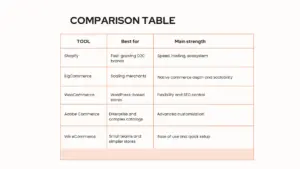
Choose Shopify for the fastest route to a dependable, high-quality E-commerce website with minimal technical overhead. BigCommerce is the better fit for companies growing quickly and needing stronger built-in commerce features. WooCommerce works best when you want maximum flexibility in WordPress and strong content-commerce integration. Adobe Commerce suits large, complex organizations that need extensive customization. Wix is a practical choice for a small store or a small team that wants a visually attractive, easy-to-build solution.
FAQs
1. Which E-commerce platform is best for high-performance stores?
Shopify and BigCommerce are often the strongest all-around choices, while Adobe Commerce is best for highly complex enterprise needs.
2. Is Shopify good for performance?
Yes, Shopify is widely used because it handles hosting, security, and store operations in one system, which helps merchants launch and scale efficiently.
3. Is WooCommerce good for large stores?
Yes, but it performs best when paired with strong hosting and technical optimization because it gives you flexibility rather than fully managed infrastructure.
4. Which platform is best for SEO?
WooCommerce and BigCommerce are often strong choices for SEO-focused teams, though Shopify also offers solid SEO-friendly foundations.
5. What should I prioritize when choosing an E-commerce platform?
Prioritize speed, scalability, integrations, checkout experience, ease of management, and long-term flexibility.
6. Is Adobe Commerce only for enterprises?
It is usually best for larger or more complex businesses, especially those that need advanced customization and technical control.
7. Which platform is easiest for beginners?
Shopify and Wix are typically the easiest to start with because they reduce setup complexity and handle many technical tasks for you.