


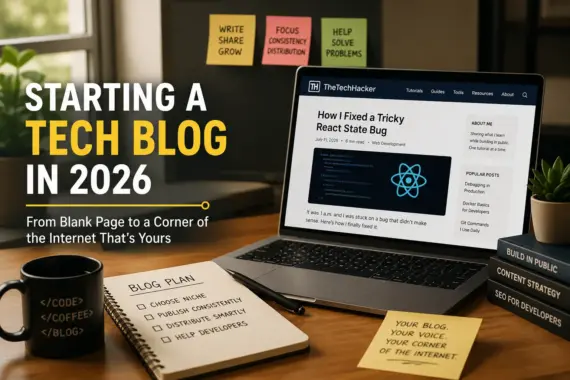
Somewhere out there right now, a developer is staring at a blank editor, cursor blinking, trying to decide if the thing they just fixed at 1 a.m. is “blog-worthy.” It almost never feels like it in the moment. And yet those exact posts — small, specific, slightly embarrassing to admit you struggled with — are usually the ones that end up ranking on Google two years later and bringing in a reader who had the exact same 1 a.m. problem.
That’s really the whole secret of blogging, if there is one: it was never about having something impressive to say. It was about writing down what you were already thinking, before you talked yourself out of it.
A Short, Slightly Messy History
Blogging didn’t start with a plan – it started as an accident of casual language. In the late 1990s, “weblogs” were just hand-updated link diaries. Then Blogger showed up in 1999 and let anyone publish without touching HTML, and the word got clipped down to “blog” almost overnight. WordPress arrived in 2003 and quietly ended up powering a huge share of the internet’s writing. Tech-focused sites like Slashdot proved a blog could cover real news, not just personal diaries.
The 2010s handed writers Medium’s clean interface, and 2017 brought Substack, which did something clever – it made people comfortable paying a monthly fee just to keep reading someone they liked. By 2026, AI writing tools and no-code publishing have made the technical barrier basically disappear. The real challenge left standing isn’t “can I publish this” – it’s “will this survive the scroll” in a feed already overflowing with content.
Forget the Word “Blog” for a Second
Strip away the label, and what you’re actually building is a habit with a URL attached. A static site is a storefront – people walk past, maybe glance in. A blog is more like a regular seat at a coffee shop; the barista starts recognizing you, and eventually other regulars do too. Nobody remembers a one-time visitor. Everybody remembers the person who kept showing up.
Three Things That Quietly Decide Whether It Works
I’ve noticed almost every tech blog that actually grows shares the same three ingredients, in different proportions:
A niche narrow enough that people can describe you in one sentence – “oh, that’s the person who writes about Kubernetes debugging” – instead of “someone who writes about tech stuff.”
Consistency that doesn’t depend on motivation. The blogs that last aren’t run by people who feel inspired every week; they’re run by people who show up whether they feel like it or not.
Distribution – because writing the post is maybe 30% of the job. The other 70% is making sure it lands somewhere a tired, distracted human might actually see it.
The wrong niche makes it hard to stand out. Irregular publishing makes it harder to stay relevant. And without distribution, even exceptional writing rarely finds its readers.
What This Looks Like If You Actually Sit Down to Do It
Pick one narrow, honest starting point – not “I’ll write about web development,” but “I’ll write about the specific mistakes I keep making in React state management.” Publish on a schedule small enough that you can’t talk yourself out of it – once every two weeks is more sustainable than a daily promise you’ll break by week three. And the moment you hit publish, don’t just leave the post sitting on your own URL – drop it into the one or two developer communities where the exact people who’d care about it are already hanging out.
A quick sense of where to actually build it in 2026:
WordPress — if you want full ownership and long-term SEO control
Substack — if you want a direct, newsletter-style relationship with readers
Ghost — if you eventually want memberships or paid subscriptions
Dev.to / Hashnode — if you want an instant, built-in developer audience from day one
Medium — if you just want to publish one piece with zero setup and see what happens
Somewhere in your notes app right now is a problem you already solved that somebody else is still stuck on. That’s not a blog post idea waiting to happen. That’s the first one, already written, just waiting for you to admit it counts.