


Think about a restaurant that serves genuinely excellent food but sits in a basement, down an unmarked alley, with a sign that fell off two years ago and was never replaced. The food isn’t the problem. Nobody’s finding the door.
That’s what’s happening to most “good content” that refuses to rank. Somewhere along the line, we started treating search rankings as a straightforward quality contest — write something better, and the internet rewards you for it. It’s a comforting theory. It’s also wrong often enough that it’s worth throwing out entirely. Google isn’t grading essays. It’s running a matching service, a trust ledger, and a technical inspection all at once, and your writing is only one input into that machine — often not even the loudest one.
So if you’ve published something you’re genuinely proud of and it’s sitting on page three gathering dust, this isn’t going to be another “just make better content” pep talk. Let’s actually take the machine apart.
Good Writing Stopped Being Rare a Long Time Ago
There was a stretch of the early internet — call it the wide-open years — when simply writing something coherent about a topic was enough to win. Competition was thin. Expectations were low. If you were the third person on the internet to explain a concept properly, you’d probably rank.
That window closed. For nearly any topic worth writing about today, you’re not competing against three other articles — you’re competing against a crowded shelf of well-researched, professionally edited, SEO-aware competitors who all cleared the “good content” bar years ago. Being good now buys you a seat at the table. It doesn’t win you the table.
Which means the real question isn’t “is this good?” It’s “what’s actually separating me from the twenty other good ones?” And the answer to that question usually has nothing to do with sentence quality.
The Mismatch Nobody Notices They’re Making
Here’s the one that catches the most thoughtful writers off guard, because it feels like it shouldn’t matter: you can answer a question *correctly* and still lose, because you answered a slightly different question than the one being asked.
Search intent is stubborn like that. Someone typing “best running shoes” isn’t browsing for a history lesson on cushioning technology — no matter how well-written that history lesson is. They want a list. Recommendations. Something scannable. If you hand them a beautifully crafted essay instead, you haven’t given them a worse answer to their question. You’ve given them a great answer to a question they never asked.
The way around this isn’t more effort at the desk — it’s five minutes of reconnaissance before you write a single word. Pull up whatever’s already ranking for your target phrase and just look at the shape of it. Listicle? Comparison piece? Step-by-step guide? Whatever format dominates the results is the format searchers are voting for with their clicks. You can absolutely out-research and out-example everyone else within that format. You just can’t fight the format itself and expect to win.
Your Domain Has a Credit Score, and It’s Judging You
Nobody enjoys hearing this part, but it explains more mysterious ranking gaps than anything else on this list: pages don’t rank in isolation. They rank inside the reputation of the site they live on.
Picture two nearly identical articles. One sits on a domain that’s been publishing consistently for years and has earned a stack of quality backlinks. The other sits on a three-month-old site with a thin backlink profile. Even if the newer site’s article is objectively the better piece of writing, the older domain’s article often wins — not because Google prefers it, but because that domain has already proven itself trustworthy, and trust is the one thing you genuinely cannot shortcut.
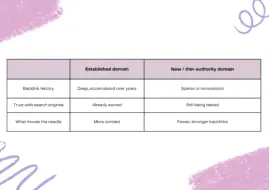

If you’re on the right side of that table, the fix isn’t publishing faster. It’s chasing a handful of genuinely earned backlinks from credible sites in your space — one strong link can outweigh a month of new posts.
The Technical Stuff You’ll Never Catch by Re-Reading Your Own Article
You can proofread a piece ten times and never once discover that it loads too slowly, breaks on mobile, or was accidentally excluded from Google’s index entirely. That’s the frustrating part about technical issues — they’re completely invisible from inside the writing process.
A few of the usual suspects:
-It’s slow. A sluggish load time bleeds visitors before they ever reach your first paragraph, and that early bounce becomes a signal against you.
-It’s clumsy on a phone. Most search traffic is mobile now, so tiny text, cramped buttons, and sideways scrolling aren’t cosmetic flaws — they’re ranking flaws.
-It’s not even being crawled. A stray noindex tag or a misconfigured robots file can hide a page from search engines entirely. Doesn’t matter how good the writing is if it’s never actually being read by the algorithm.
-The rest of your site is dragging it down. A pile of thin or duplicate pages elsewhere can lower how search engines trust your whole domain, dimming even your strongest work by association.
None of this shows up by reading your own article back. It shows up in a speed test, a mobile check, a crawl report — the unglamorous, ten-minute audits almost nobody bothers to run before blaming the writing.
What Happens After Someone Clicks Matters More Than You’d Think
Getting a click isn’t the finish line — it’s the start of a second test. If someone lands on your page from the search results and bounces straight back to try another link, that’s a quiet vote of no confidence, even if every sentence you wrote was accurate and well-argued.
And the reasons for that bounce are rarely about the writing itself. It’s the page that takes too long to load. The pop-up that ambushes someone before they’ve read a word. The wall of dense text with nowhere for the eye to rest. All of it chips away at engagement, and weak engagement puts a quiet ceiling on how far a page can climb, regardless of how strong the actual argument inside it is.
The fix is mostly architectural: shorter blocks, real subheadings that let skimmers navigate, the important stuff moved up instead of saved for a big reveal at the end. Structure isn’t decoration here — it’s half the ranking mechanism.
“Longer” and “Deeper” Are Not the Same Word
This one trips up a lot of careful writers, because it feels intuitive that more words should mean more value. It doesn’t. A 3,000-word piece that circles the same handful of points from six different angles isn’t deep — it’s padded. A tight 1,200-word piece that actually covers five distinct subtopics can out-rank it easily, because depth is measured in *ground covered*, not characters typed.
The cure is almost mechanical: open the top five ranking pages for your target keyword, list every subtopic and angle they touch, then hold your own draft up next to that list. Whatever’s missing is usually the fastest, highest-leverage edit you can make — faster than writing something new, and often more effective too.
Nothing Ranks Alone
One last thing worth sitting with: a page’s fate is never entirely its own. A great article with zero internal links pointing to it is quietly telling search engines that even *you* don’t think it’s worth referencing from anywhere else on your own site. External validation works the same way — a page with a few genuine outside references will consistently beat an equally strong page that exists in total isolation.
This is why some of the most effective ranking work doesn’t involve writing anything new at all. It’s going back through older, related pages and threading in a link to the newer one. It’s a single outreach email that earns one relevant backlink. Quiet, unglamorous, and often more effective than the article itself.
So What Do You Actually Do With All This?
Probably the hardest part of this whole picture is that these issues rarely show up alone. A page might have a slightly wrong format, sit on a domain that hasn’t earned much trust yet, load a beat too slowly, and have no internal links pointing to it — and none of those four things alone would sink it. Stacked together, they’re more than enough to keep something genuinely good stuck exactly where it is.
So the next time something you’re proud of refuses to move, resist the urge to rewrite it for the third time. Step back and ask the wider questions instead: does this match what people are actually searching for, does the site around it carry enough trust yet, is anything technical quietly working against it, does it hold someone’s attention once they arrive, and is it connected to the rest of your site in a way that says it matters? The writing was probably never the weak link. It’s just the easiest place to point the finger, because it’s the only part you can actually see.