


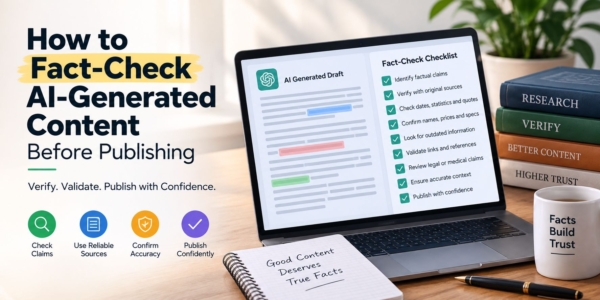
Think about a contractor who hands you blueprints that look flawless — clean lines, precise measurements, professionally rendered — except nobody’s actually checked whether the load-bearing walls can hold the weight of the building. That’s what publishing straight from an AI draft looks like from the outside. Polished, confident, structurally untested. And the building doesn’t announce it’s unsafe until something’s already resting on it.
AI tools can now draft an entire article in the time it takes to make coffee — research summarized, statistics cited, quotes attributed, sources listed. What they can’t do reliably is guarantee any of it is actually true. Researchers have a term for this now, because it happens often enough to need one: hallucination, or in more formal language, confabulation — a model generating false information and presenting it with total, unearned confidence. OpenAI itself has been upfront that its own systems can produce wrong dates, invented studies, and fabricated citations, all delivered in the same steady tone as everything accurate. Which means the honest way to think about AI is as a fast first draft, not a finished authority. If you’re publishing anything built on one, the fact-checking layer isn’t optional — it’s the actual job.
The Trap Is Believing Confidence Equals Accuracy
Most people’s fact-checking instinct is really just a gut check: does this sound right? That instinct fails here specifically because AI language models are optimized to produce fluent, plausible-sounding text — not to verify whether that text is true. Fluency and accuracy are two entirely separate skills, and a model can max out the first while quietly failing the second.
What slips through as a result is a long, unglamorous list: a wrong product launch date, a study that doesn’t exist, a real study with the wrong conclusion attached, a stale statistic dressed up as current, a quote nobody actually said, a dead or mismatched link, someone’s words attributed to the wrong person, a spec that changed six months ago, an outdated price, a regulation that’s since been amended. None of these announce themselves. They sit embedded in paragraphs that are otherwise completely accurate, which is exactly what makes a simple read-through such a weak defense.
Not Every Sentence Needs the Same Scrutiny
The first real skill here is triage — learning to separate a checkable fact from a passing opinion, because treating both identically wastes your time on the wrong sentences.
“Google introduced its AI Overviews feature in 2024” is a fact — verifiable, falsifiable, worth checking. “AI Overviews are changing how people search” is closer to interpretation, useful but softer, and worth supporting rather than stating outright. “AI Overviews are the future of search” isn’t a fact at all — it’s a prediction wearing a fact’s clothing, and it should read like one.
Once you can tell these apart, prioritize by consequence. A statistic, a quote, a research claim, anything touching legal or medical ground — these deserve the highest scrutiny, because getting them wrong costs you the most. A basic date or a technical spec sits a notch below. An opinion just needs honest framing, not a source.
Go Looking for Claims Instead of Waiting to Trip Over Them
Don’t start editing prose the moment a draft lands. Read it once specifically hunting for anything checkable — numbers, percentages, dates, names, prices, quotes, study findings, legal claims, market-share figures, and any sentence reaching for a superlative like “first,” “largest,” or “best.” These are where AI-generated errors like to hide, precisely because they look so specific and confident on the page.
There’s a genuinely useful trick here: don’t ask the model whether its own article is accurate — ask it to extract the claims that need checking instead. Something like, “pull every factual claim from this piece that needs outside verification, and sort them by type.” That turns a vague worry into an actual checklist you can work through, source by source, rather than trusting the model to grade its own homework.
Always Walk the Claim Back to Its Original Source
This is close to the single most important habit in the whole process: never verify an AI-generated fact using another blog that’s just repeating the same fact. Go to where it actually originated. For companies, check the official website, newsroom, or relevant regulatory filing instead of relying on secondhand summaries. When researching software, use its official documentation, changelog, or pricing page rather than an old YouTube review. Research claims should lead you to the original paper or publishing journal, not another paraphrase. Government-related information should come directly from the relevant legislation or official agency website.
Reuters’ own verification process leans on exactly this instinct — tracing claims back to primary documentation rather than trusting whatever’s circulating.
A Citation Isn’t Evidence Until You’ve Actually Opened It
This deserves to stand alone as a rule, because it’s the one people skip most often, usually because a citation just ‘looks’ legitimate. A real author’s name, a real-sounding journal, a specific publication date, something that resembles a DOI — and it can still be entirely fabricated. OpenAI has said as much directly: language models can generate references, studies, and citations that don’t correspond to anything real.
So open it. Every time. Confirm the source exists, the author’s correct, the date checks out, and — critically — that the source actually says what your draft claims it says. That last part gets skipped constantly, and it’s often where the real damage hides: a citation that’s technically real but doesn’t support the point it’s been bolted onto.
Studies Get Distorted in the Summarizing, Not Just the Inventing
Say a draft claims “a Stanford study found AI increases productivity by 35%.” Don’t take that sentence at face value — go find the actual study and ask what it really measured. What was the sample size, who participated, how was “productivity” defined, was it peer-reviewed, and does it actually say 35%, or does the AI’s paraphrase quietly stretch a narrow, specific finding into a sweeping general claim?
That gap matters more than it looks. “Productivity increased 35% among participants doing a specific task” and “AI increases productivity by 35%” are not the same sentence, even though one is often lazily compressed into the other. Fact-checking research claims means checking context and scope, not just confirming a number exists somewhere.
Statistics Deserve Their Own Interrogation
Any sentence shaped like “X% of businesses do Y” should stop you cold until you’ve traced it. Who ran the survey, when, how many people answered, which countries or company sizes were included, and does the definition of what’s being measured actually match how the article is using it? A statistic gathered from a 2022 survey of enterprise clients in one country shouldn’t quietly become a universal 2026 fact with the year stripped off.
Dates Hide More Nuance Than They Let On
“Company X launched its product in 2023” sounds simple enough, but launched, announced, released, and made generally available are frequently four different dates for the same product — and AI tools blur them together constantly. Chase the actual press release or documentation rather than trusting a single verb choice to carry the full timeline.
Never Publish a Quote You Haven’t Physically Located
A fabricated quote is one of the easiest things to get away with, because it reads naturally and nobody expects a sentence in quotation marks to be invented. If you can’t find where someone actually said it — the interview, the talk, the post — don’t run it as a direct quote. Paraphrase a claim you can verify instead, or cut it. There’s no responsible middle ground here.
Product Details Age Faster Than Articles Do
Pricing, feature sets, API limits, supported platforms — all of it shifts constantly, and a model has no reliable sense of what’s changed since it last “knew” anything. Go to the current official pricing or documentation page directly. An old article, an outdated video, or worse, another AI-generated piece, just launders the same stale information one more time.
Superlatives Are a Built-In Warning Light
“Best,” “fastest,” “most popular,” “world’s leading” — AI reaches for these constantly because they sound authoritative, and they almost never come with a methodology attached. Best according to whom? Fastest by which benchmark? If there’s no clear answer, the honest move is rewriting the claim into something concrete — swap “the best AI writing tool” for a plain description of what it actually does, and let the reader draw their own conclusion.
One Source Can Be Wrong — Especially When It’s Being Copied
For anything genuinely consequential, look for at least two independent confirmations, not just one source repeated across ten sites that all lifted the same press release. A real acquisition gets confirmed by both companies’ own announcements plus independent reporting — that’s three points actually worth something, compared to thirty blogs quoting the same paragraph.
It’s also worth deliberately searching for the opposite of what you’re trying to confirm. If a draft claims a tool “supports Windows, macOS, and Linux,” search specifically for its Linux support and its system requirements page — sometimes what surfaces is a generalization built from outdated or incomplete information.
Images Need Their Own Pass Entirely
Fact-checking doesn’t stop at text. Before publishing an image, verify its source, creator, edits, and original context. Reuters verifies images using metadata, environmental clues, and reverse image searches. These methods can reveal recycled images, although they cannot guarantee absolute certainty.
An AI Detector Answers a Completely Different Question
It’s worth being clear-eyed here: an AI detector tries to guess whether text was machine-generated. Fact-checking asks whether the content is actually true. Those aren’t the same question, and confusing them is a real trap — human-written content can be wrong, and AI-generated content can be accurate. Detection tells you almost nothing about reliability.
Let AI Review the Work — After You’ve Done the Verifying, Not Before
There’s a genuinely useful role for AI here, just not the one people default to. Once you’ve independently gathered your sources, hand both the draft and the sources back to the model and ask it to flag anything unsupported, exaggerated, outdated, or inconsistent with what you found. That’s a legitimate use of the tool. The sequence matters enormously though — source first, then verification, then AI-assisted review. Never AI generating, then AI checking itself, then publishing.
Ask Whether Today’s Fact Survives Until Tomorrow
A piece can be entirely accurate on the day it’s published and quietly wrong six months later — especially anything touching software, pricing, APIs, security, or regulation. Before publishing, it’s worth asking plainly: could this change? If the honest answer is yes, either verify against a live source right now, or build a habit of revisiting evergreen pieces periodically rather than assuming they age gracefully on their own.
Some Mistakes Are Embarrassing. Others Are Genuinely Harmful
Medical claims, financial guidance, legal information, safety instructions, tax details — these deserve a noticeably higher bar than a wrong product launch date. The fact that several sites appear to agree on something isn’t evidence; it’s often just the same unverified claim circulating. For anything in this category, lean on primary sources and, where it’s warranted, actual qualified professionals.
Click Every Link Before It Goes Live
AI-generated links can look entirely legitimate and still lead nowhere useful — a broken URL, a homepage standing in for a specific study, or a page that’s simply drifted since the model last “saw” it. It takes a minute to click through and confirm a link actually supports the sentence it’s attached to. Skipping that minute is how dead or misleading links end up shipping.
Learn to Hear the Overconfidence in the Prose Itself
Sometimes the tell isn’t a fact at all — it’s the phrasing. “Studies prove AI improves productivity” makes a much stronger claim than the evidence may support. “Several studies report productivity gains on specific tasks” makes a more precise claim. Both statements refer to similar research but communicate different levels of certainty. Words like “always,” “never,” “guaranteed,” “proven,” and “definitively” can signal overconfidence. These words aren’t automatically wrong, but they deserve closer scrutiny. When you see them, check the evidence carefully before publishing.
What This Looks Like Without Turning Every Post Into a Research Project
None of this has to become an elaborate editorial bureaucracy. In practice, keep the process simple: highlight every checkable claim, find the strongest source, and compare the wording against it. Correct or remove anything the evidence doesn’t support before publishing. For claims that could significantly affect readers, such as acquisitions, legal claims, or major statistics, verify them with two independent sources.
And it’s worth remembering, underneath all of this, what Google has actually said about AI-assisted content: it isn’t disqualified for being AI-assisted. What gets penalized is content produced at scale primarily to game rankings rather than genuinely help the person reading it. The workflow that survives that scrutiny was never “AI drafts it, you publish it.” It’s research, AI assistance, careful fact-checking, real human judgment, then publishing — in that order, every time.
The One Rule Worth Actually Remembering
AI can draft the piece. It can help you spot gaps. It can suggest where to look. What it can’t do is take responsibility for what you publish — that part never transfers. A confident-sounding article isn’t automatically a trustworthy one. The only kind worth putting your name on is the kind where every load-bearing claim can actually be traced back to something real, and you’re the one who checked.
A Simple 5-Minute Fact-Checking Method
If you publish frequently, you don’t necessarily need a complicated editorial system. Use this five-step method:
Step 1: Highlight
Highlight every statistic, date, quote, name, product specification, and research claim.
Step 2: Source
Find the strongest available source for each important claim.
Step 3: Compare
Compare the exact wording of your article against the source.
Step 4: Update
Correct outdated, exaggerated, or unsupported statements.
Step 5: Publish
Only publish after the factual claims have passed your review.