Using AI in a content workflow is like hiring a very fast, slightly overconfident intern. They can draft something in seconds, summarize a report before you’ve finished your coffee, and never complain about doing the same repetitive task ten times in a row. What they can’t do is know what actually happened to you last Tuesday, hold a genuine opinion under pressure, or notice when something just feels off in a way no rulebook could explain. The trick isn’t deciding whether to hire the intern. It’s knowing exactly which parts of the job to hand them, and which parts stay yours.
Where This Shift Actually Came From
Rewind to the mid-2010s – “content at scale” mostly meant hiring more freelance writers, running content mills, or accepting that quality dropped as volume climbed. Then large language models arrived in the public conversation around 2022, and suddenly a single writer could draft, summarize, and repurpose content at a pace that used to require a small team. Early adopters treated this as a shortcut to publish more, faster, and for about a year, it worked – low-effort AI content ranked and got read, simply because there wasn’t much of it yet.
That didn’t last. Search engines and readers both adapted quickly, getting noticeably better at spotting generic, AI-averaged writing and quietly discounting it. What’s left, in 2026, is a more interesting split: AI genuinely speeds up the mechanical parts of content work, while the parts that actually make content worth reading – real experience, a specific point of view, original insight – have become more valuable precisely because they’re now the rarest thing in a feed full of AI-smoothed sameness.
Why “Speed” Was Always the Wrong Goal on Its Own
Speed without judgment just produces more content nobody particularly wanted to read. AI didn’t remove the need for good writing – it removed the excuse for slow, tedious writing to stand in the way of it. Like a fast car with no destination, raw output speed only matters once there’s something worth saying quickly.
The Core Pillars
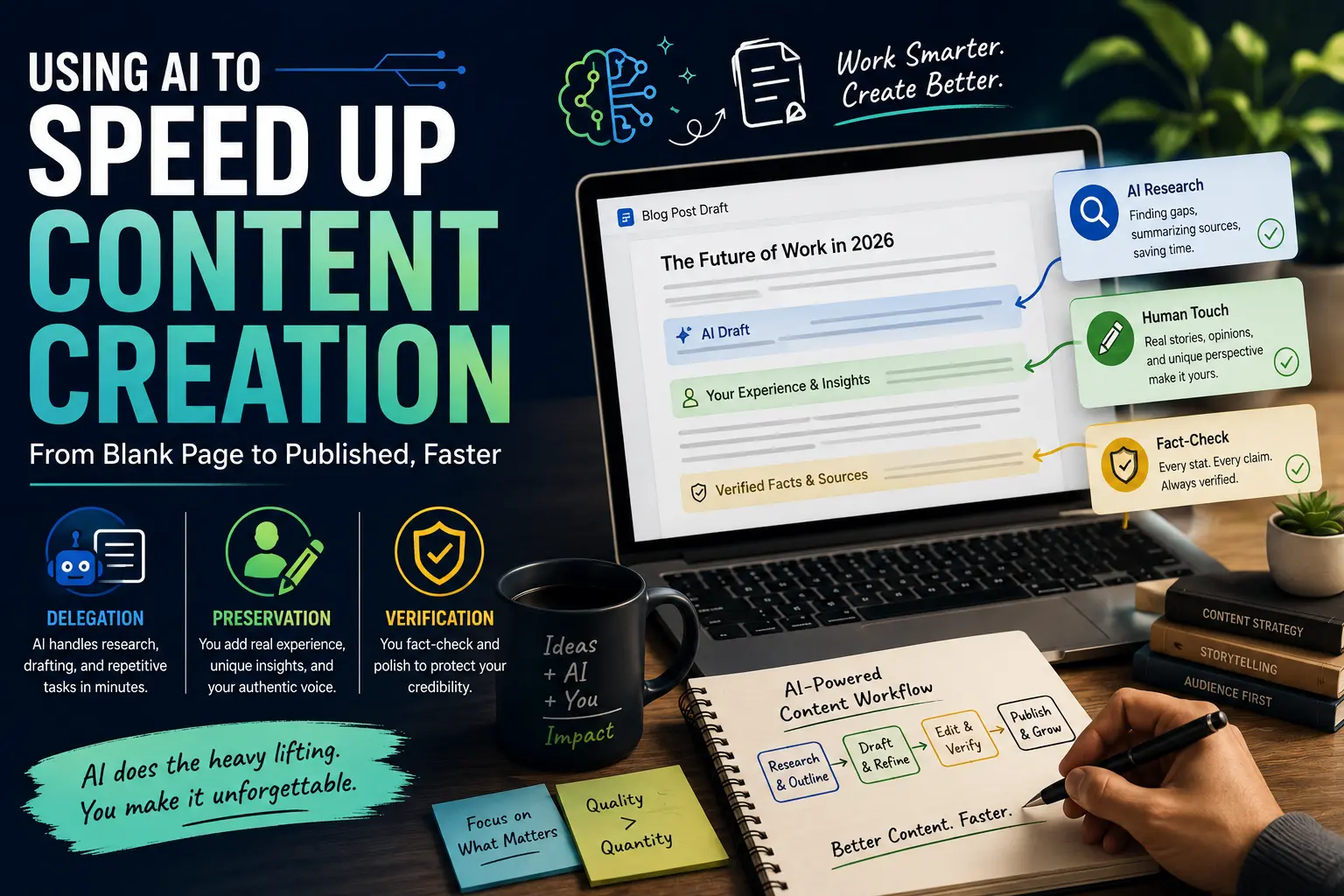
Every content workflow that uses AI well, without collapsing into generic noise, rests on three pillars:
Delegation – handing AI the mechanical work: research compression, first drafts, format conversion, editing passes.
Preservation – keeping the parts AI can’t fake: real experience, a specific opinion, an actual example that happened to you.
Verification – checking every factual claim before it goes out, since confident and correct are not the same thing in AI-generated text.
Skip delegation, and you’re back to the slow, blank-page grind AI was supposed to fix. Skip preservation, and your content becomes interchangeable with everyone else’s AI draft. Skip verification, and speed just means publishing mistakes faster than before.
AI in Everyday Content Life
Feeding rough notes into an AI tool to identify missing ideas is a great example of delegation at work. Rewriting an AI-generated draft with a real experience or mistake demonstrates how preservation adds authenticity that AI cannot replicate. Carefully verifying every AI-generated statistic against the original source before publishing shows how verification protects credibility and maintains long-term trust.
Here’s roughly how the workload actually splits, stage by stage:
| Stage | Who Handles It Best |
| Research & Outlining | AI compresses, human directs |
| First Draft | AI generates raw material, human rewrites for voice |
| Repurposing (threads, posts, scripts) | AI converts format, human approves tone |
| Editing for Clarity | AI flags issues, human makes the call |
| Fact-Checking | Human, always, no exceptions |
Wow – a tool that drafts in seconds but still can’t tell a story that actually happened to you? That’s the quiet limit keeping content genuinely human, even in an AI-assisted workflow.
Sit back, think – if you removed every AI-generated sentence from your last published piece, would there still be enough of you left standing to make it worth reading?
Leave a Reply