
The Day I Stopped Clicking (And Why You Will Too)
Lately, whenever I search on Google, I don’t really “browse” anymore. I type a question, and before I can even blink, an AI overview powered by Gemini hands me a ready-made answer—neatly summarized, step-by-step, almost like a teacher who has already read the whole internet for me. I get what I need without clicking a single blue link.
At first, it felt magical. Then it felt…unsettling. If I’m getting everything from that AI box, what happens to the websites behind it? What powers this invisible layer that sits between me and the actual pages? That question took me down a rabbit hole—and at the bottom of it, I found a new term: Generative Engine Optimization (GEO).
From Link Lists to Answer Engines
AI models like Gemini receive your query and interpret it in natural language rather than just matching keywords. They gather passages from multiple web pages using semantic search. Then they generate a fresh answer—summarizing, rephrasing, and combining those passages, often with citations back to sources. We stay on Google’s page while AI reads the web and curates the information for us.
Traditional search engines like Google, Bing, and Yahoo, when paired with SEO, deliver ranked lists of links. AI engines like Google Gemini, ChatGPT, and Perplexity instead curate direct answers from web content, changing the way users discover information and brands. GEO focuses on tailoring content—through authoritative language, statistics, quotes, and structure—so it ranks high inside these AI-generated responses, not only on classic search engine result pages.
GEO (Generative Engine Optimization) optimizes content not just for ranking but for being quoted and trusted inside these AI answers. A Princeton-led study in 2023–24 on 10,000 queries showed that pages with clear structure, statistics, citations, and expert-style language increased their visibility in LLM answers by around 30–40 percent.
Four Stages That Decide If AI Chooses You
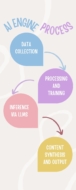
Generative AI engines transform raw web data into instant, conversational answers through stages that prioritize relevance, trust, and synthesis—making GEO essential if you want your content included.
-
Data collection
AI engines crawl billions of web pages, PDFs, and structured data via APIs and build massive indexes, similar to traditional search but enriched with semantic embeddings that focus on meanings over keywords. Retrieval-augmented generation (RAG) pulls the most relevant content during a query, emphasizing fresh information and strong E‑E‑A‑T (experience, expertise, authoritativeness, trustworthiness) signals. -
Processing and training
Systems clean, chunk, and store the raw data in vector databases such as FAISS or Pinecone. LLMs train or fine-tune on this content while filters demote low-quality material. At this stage, schema markup and structured data help AI retrieve and interpret your information more accurately, significantly improving inclusion in AI answers in multiple GEO case studies. -
Inference via LLMs
When a user submits a query, the engine retrieves and ranks passages based on relevance scores, semantic closeness, and authority. The LLM then cross-checks facts across sources and resolves conflicting signals before forming a coherent response. -
Content synthesis and output
The final response blends all the information into structured prose: direct answers first, followed by citations and sometimes follow-up suggestions. Newer 2025–26 models increasingly mix in images, charts, and videos, pushing zero-click outcomes toward the 60–65 percent range as more users get everything they need without leaving the AI surface.
The Authority Code
Core GEO strategies, validated by Princeton’s GEO-bench benchmark on 10,000 queries, highlight tactics that boost source visibility in generative engine responses by up to 30–40 percent.
-
Authoritative tone
Use a confident, expert voice with precise phrasing, and weave in accurate technical terms such as “retrieval-augmented generation,” “vector embeddings,” or “schema markup.” This kind of expert-style language outperforms casual wording and increases LLM preference by roughly 15–20 percent in experimental setups. -
Statistics and citations
Anchor your claims in real numbers and research. Inline statistics (for example, “zero-click searches now approach 60–65 percent in 2026”) with clear citations signal evidence-based content, which generative engines prioritize over vague statements. -
Structured data
Implement schema markup, bullet lists, and tables so crawlers and AI models can parse your content quickly. Studies and practitioner reports show that structured formats increase AI citation and extraction rates, sometimes by 25–40 percent compared with unstructured text. Tools like Google’s Rich Results Test or Schema validators help you confirm that implementation. -
Fluency and simplicity
Write in natural, scannable prose with short sentences, H2/H3 headers, and active voice. Clear structure and readable language improve AI synthesis quality and make your pages easier to quote inside answer blocks. -
Unique insights
Bring in your own opinions, experiments, and proprietary data instead of echoing what every other article says. The GEO research shows that tactics like adding quotations, distinct statistics, and original commentary meaningfully lift visibility scores across many query types.
GEO (Generative Engine Optimization) Tools
Several tools now help you monitor and improve how AI engines see and use your content.
-
Geoptie / GEO rank trackers
Track citations and brand mentions across ChatGPT, Gemini, Perplexity, Claude, Copilot, and other AI engines, along with metrics such as AI visibility index and share of voice. These tools show where your words appear inside AI answers, not just in SERPs. -
Goodie AI, Gauge, Superlines, Profound
Use these dedicated GEO analytics platforms to log prompts, analyze which content earns citations, and receive suggestions for improving structure, tone, and evidence for AI search. -
Writesonic, Relixir, RankPrompt
These prompt-focused tools provide GEO-oriented templates. They help you draft answer-style sections with headings, bullets, and inline stats that align with how LLMs prefer to retrieve and quote information. -
Contently, Clearscope, SearchAtlas, Inlinks
Classic SEO and content optimization suites now extend into GEO. They assist with semantic optimization, entity mapping, topical depth, and answer-block formatting so your pages align with question-style queries and entity relationships. -
Alli AI
This platform streamlines schema markup and technical GEO across multiple pages, making it easier to scale structured data and on-page improvements without heavy manual work. -
Semrush AI Toolkit, Ahrefs Brand Radar
These tools add AI overview metrics and citation insights on top of traditional SEO features, so you can track both rankings and how often AI overviews and assistants reference your brand.
GEO isn’t just another tactic; it’s the new conversation your content needs to have with the world’s most patient readers: large language models.