Modern brands will not be able to rely on a single channel for marketing, as customers now shop via email, SMS text, push notification, social media, website and in-app experience before making a purchase. Omnichannel marketing tools allow brands to integrate these touchpoints to generate personalized messages and automate customer journeys so that the customer experience is consistent across all channels.
This guide examines five strong omnichannel marketing tool platforms for United States-based ecommerce companies in 2026, focusing on ecommerce, customer journeys, personalization, and automation.
Why Omnichannel Marketing Matters
Omnichannel marketing is the process of creating one cohesive marketing experience for your customer across multiple channels, instead of simply allowing each channel to operate independently. When email, SMS, web, advertisements, and app communications are built on the same customer data set, brands can react to their customers in real-time and provide more personalized experiences according to their actual behavior.
As ecommerce and other retailers become more modern in their strategies, they will find the following reasons to be very relevant in 2026:
- Customers demand to receive the same experience across all types of touchpoints
- Real-time segmentation allows brands to deliver tailored offers based on customer behavior (improving conversions and retention rates).
- Marketing automation puts an end to manual processes for marketing functions.
- More personalized customer offers result in increased repeat business and increased lifetime revenues.
What to Look For in Omnichannel Tools
To make the best selection regarding a platform; there are several functionalities US brands should seek to find when determining whether or not they’ll make use of an omnichannel tool:
- Messaging Across Multiple Channels: Email; SMS (Text); Push Notifications; In App Notifications; Social Media (if applicable).
- Journeys That Can Be Automated: Abandoned Cart; Welcome Flows; Win Back Campaigns; Lifecycle Journey/Path.
- Segmentation And Personalization: Behavioral Segmentation; Predictive Segmentation; Product Based Segmentation.
- Integrating With Other Systems: Native Integration With Shopify; Native Integration With WooCommerce; Native Integration With CRM; Native Integration With Analytics Stacks.
- Reporting: Ability To See Which Channel Provides Revenue And Engagement.
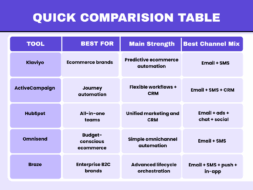
1. Klaviyo – Best for Ecommerce Brands
Klaviyo provides a top tier omnichannel tool built specifically for ecommerce-first brands in the US.
Klaviyo offers a unique combination of email and SMS marketing, predictive AI capabilities, as well as robust ecommerce integrations.
Reasons To Choose Klaviyo
- Email + SMS provided from ONE platform.
- Predictive AI to drive purchase likelihood, likelihood of churn, and expected timing of next order.
- Excellent integrations with both Shopify and WooCommerce.
- Pre-built ecommerce flows for abandoned cart, re-engagement campaigns, and win back campaigns.
Best for
- For those utilizing Shopify or WooCommerce.
- For those ecommerce brands seeking to utilize automation for revenue focused processes.
Watch out for
While extremely strong for those in ecommerce sectors, Klaviyo may not offer the full range of support needed for service-led brands looking for a more versatile platform.
2. ActiveCampaign – Best for Customer Journeys
ActiveCampaign is best known for customer journey mapping with its advanced automation capabilities. It works well for brand marketing by combining email, SMS, CRM, and automation all into one platform.
Why it stands out
It has powerful workflow automation to handle multiple complex journeys, an internal CRM that can help manage both the lead lifecycle and the customer lifecycle, and can be integrated into over 900 different applications including Shopify and WooCommerce.
It provides great value for money compared to other large enterprise tools.
Best for
This platform would suit brands who are looking for much more sophisticated automation of customer journeys, as well as SMB’s (or small to medium size businesses) and mid market companies who require a high degree of flexibility without having to pay large enterprise pricing.
Watch out for
One potential drawback of using ActiveCampaign could be that it may take longer to set up than other, simpler, all-in-one tools.
3. HubSpot – Best All-in-One Marketing Platform
HubSpot is a great all-in-one marketing solution for companies that want to use one platform to manage their marketing, CRM, sales and service functions. Italso supports the management of omnichannel engagement using email, ads, chat and social communications channels.
Why it stands out
What this solution provides is a single database for your marketing work and your CRM work, with easy to navigate interfaces to help your teams work effectively, robust reporting dashboards with dynamic content capabilities, and connectivity between your sales and service teams and marketing teams so that your overall brand remains aligned.
Best for
This platform would work great for modern brands looking for one system to manage both their marketing and customer management processes, and for teams that have a high level of comfort with using a single system to achieve both: marketing and customer management.
Watch out for
One potential disadvantage regarding HubSpot is that it can be expensive dependent on usage levels.
4. Omnisend – Best Budget-Friendly Ecommerce Option
Omnisend is designed for e-commerce businesses wanting an all-in-one solution for email, SMS messaging, and automated marketing workflows
Why it stands out
- Easily integrates with a variety of e-commerce platforms, allowing product centric workflows
- Single platform solution for email and sms marketing
- Highly automated capabilities for abandoned cart recovery and customer retention
- Lower price point in comparison to enterprise level competition on an average monthly basis making Omnisend more cost cutting friendly than its competitors throughout the entire buying process at scale.
Best for
Companies looking to expand their e-commerce presence through omnichannel marketing strategies via a less complex e-commerce platform versus a full scale omnichannel suite.
Businesses looking for an all in one solution for their automation needs.
Watch out for
Not quite as broad as some larger e-commerce platforms.
5. Braze – Best for Enterprise-Grade Lifecycle Marketing
Braze’s solution is an enterprise scale, multi-channel approach to lifecycle marketing, variable test results between multiple users, and customer engagement via mobile first.
Why it stands out
- Exceptional for creating cross-channel experiences for customers.
- Strong push notifications, in-app notifications, SMS messages, and email campaigns – allowing seamless user experiences across all digital devices.
- Exceptional for conducting experiments and providing customers individualized service based on their behavior.
- Perfect for B2C Brands with high volume customer transactions/products sold.
Best for
Industries that are currently in a transition from traditional retail to e-commerce with established and/or rapidly developing customer relationship management systems with multiple stages, or touchpoints involved in their transactions with the company.
Watch out for
Organizations that have limited staff that have both technical and strategic experience may experience challenges using this platform to develop functional customer relationship marketing.
How to Choose the Right Tool
Selecting tools should start by looking at which channels your target demographic relies on. For example, if you’re selling online products, Klaviyo and Omnisend should provide the fastest return on investment (ROI). If your team needs more in-depth journeys and CRM integration, you may want consider using ActiveCampaign or HubSpot.
A large commerce brand with high traffic and complex journeys will benefit from the scale and flexibility of a tool like Braze – this automated marketing system allows brands the utmost flexibility when trying to engage with their consumers. It’s best to do your due diligence by narrowing down the options to 2 tools, testing 1 of the tool’s 3 key workflows (abandoned cart, nurturing leads, etc.), and then measuring revenue, engagement (CTR and opens), and your team’s effort required to achieve these numbers.
FAQs
1 What are omnichannel marketing tools?
Omnichannel marketing tools help brands manage communication across email, SMS, push notifications, websites, and CRM from one platform. They keep customer messaging consistent across every touchpoint.
2. Why are omnichannel marketing tools important for modern brands in the USA?
US customers often interact with brands across multiple channels before making a purchase. Omnichannel tools help brands personalize those interactions, improve engagement, and increase conversions.
3. Which omnichannel marketing tool is best for ecommerce brands?
Klaviyo is one of the best options for ecommerce brands because it offers strong email and SMS automation, predictive analytics, and deep Shopify integrations.
4. Which omnichannel platform is best for advanced customer journeys?
ActiveCampaign is a strong choice for brands that need flexible automation, lifecycle journeys, CRM support, and multi-step customer engagement flows.
5. Is HubSpot a good omnichannel marketing platform?
Yes. HubSpot is a good choice for brands that want marketing, sales, and CRM in one connected platform. It works well for teams that want simplicity and unified customer data.
6. Which omnichannel tool is best for budget-conscious businesses?
Omnisend is a strong choice for smaller ecommerce brands that want email and SMS automation without paying for a large enterprise platform.
7. Which omnichannel marketing platform is best for enterprise brands?
Braze is a better fit for enterprise brands that need advanced lifecycle marketing, personalization, push notifications, and in-app messaging.
8. What features should I look for in an omnichannel marketing tool?
Look for cross-channel messaging, automation, segmentation, personalization, analytics, and integrations with your ecommerce or CRM tools.
9. Can omnichannel marketing improve customer retention?
Yes. Omnichannel marketing helps brands deliver timely and relevant messages, which can improve customer satisfaction, repeat purchases, and retention.
10. How do I choose the best omnichannel marketing tool for my business?
Choose based on your main channels, team size, budget, and integration needs. It is also a good idea to test 1–2 tools with one campaign before making a final decision.