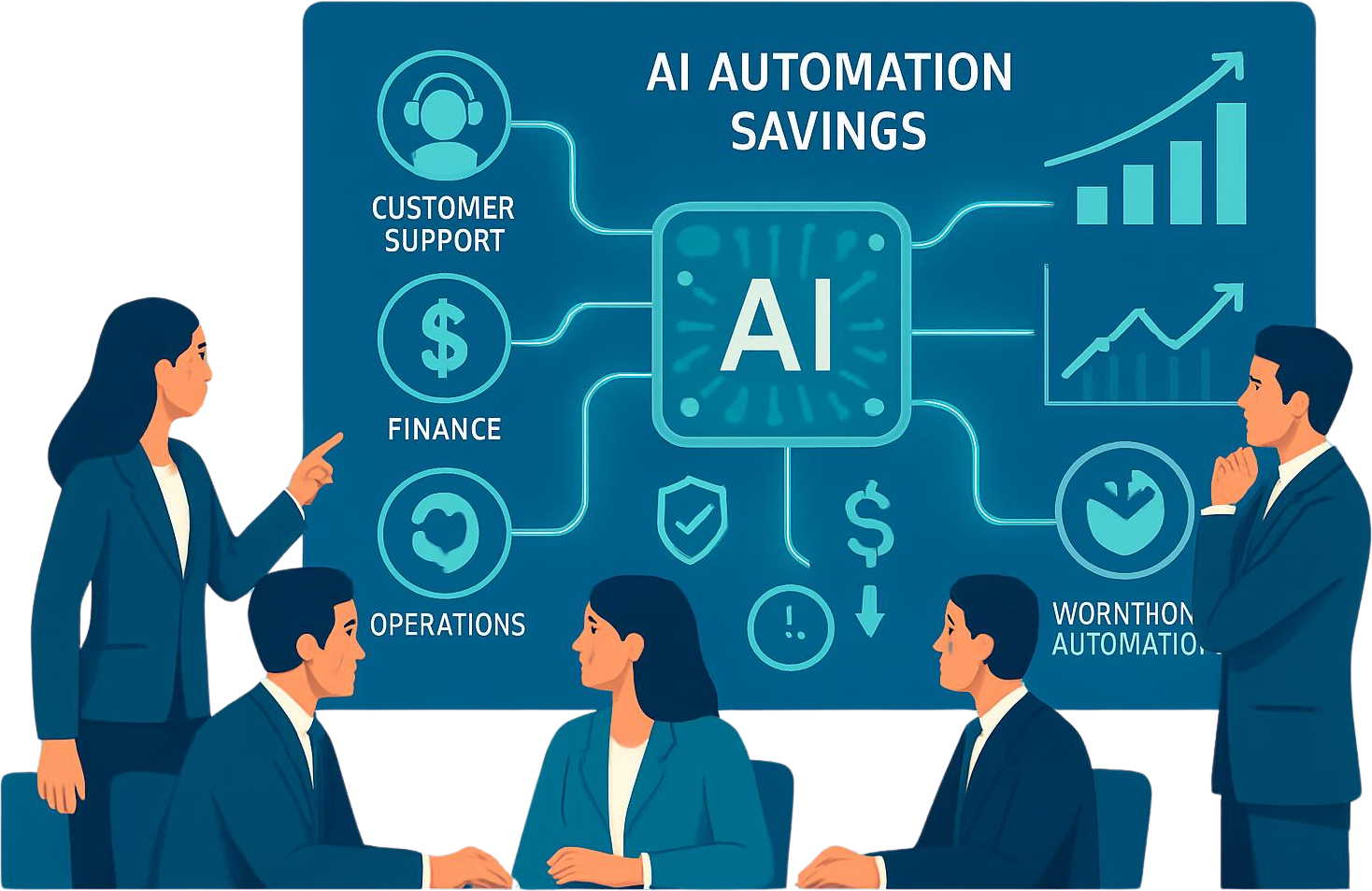
Any business in the US can utilize AI to lower their operational overhead. In 2026., businesses in the US are not only going after the cool tech; they’re using it to create labor savings through reduced labour intensive activities, faster cycle times, decreased rework, and increased team productivity with no increase in headcount.
The real issue is not “AI will eliminate jobs” instead, it is “AI will remove friction that allows teams to create a higher value from the same number of team members.”
Continually Rising Overhead
Companies have created excessive levels of operational overhead due to over reliance on manual handoffs, repeated approvals, long reporting cycles, and too much cross team coordination. The amount of time, budget, and attention wasted by minor levels of inefficiency across finance, customer service, operations, and HR can total a significant amount of year’s worth of dollars.
Many companies have multiple small inefficiencies that are the underlying cause of their overall operational overhead. Small inefficient processes consume time and money with no impact on a company’s budget.
4 Ways AI Can Achieve Savings
The 4 main ways AI can help reduce operational overhead are by
1. Automating repetitive tasks such as document processing, data entry, document routing, and scheduling.
2. Creating faster decision making through rapidly surfacing data patterns and recommended actions versus requiring a manual review of the data first.
3. Reducing errors that create additional rework and delay.
4. Providing leaders with the ability to better manage labor, energy and inventory.
The greatest impact of AI tools can be seen in several areas, including customer service, finance, internal processes, and overall efficiencies.
Customer service
For customer service, AI is commonly one of the first places to see a return on investment (ROI) in the form of AI tools that assist with ticket routing, response drafting, conversation summarizing, and deflecting repetitive questions prior to human involvement. This results in decreased time to respond to customers, as well as reducing the amount of stress on agents and reducing costs per ticket.
Customer operations
This is particularly important for an organization that is experiencing rapid growth, as the volume of support tickets is increasing more rapidly than the hiring of new agents. Whereas the traditional approach of increasing the number of agents to handle an increase in volume results in a linear increase in headcount, AI enables the existing team to take advantage of the additional volume while providing a more consistent experience for all of its customers.
Finance and back office
In terms of finance and back-office operations, AI is used to automate invoice processing, reconcile records, identify anomalies, and improve reporting accuracy. As such, automation is best suited for performing administrative functions that take up significant amounts of time and do not produce any revenue.
AI will also assist in the review of contracts, the extraction of information from documents, and will assist in the creation of budgets. This translates into reduced manual corrections, faster month-end closures, and improved visibility for leadership.
Operations and Supply Chain
The operational staff employs AI systems for forecasting demand, optimizing inventory levels, scheduling labor, and predicting equipment malfunctions before they negatively affect work outputs. The outcome of these actions is a reduced amount of downtime, a decrease in the number of emergency repairs performed, and a reduction of waste created by a company.
Predictive maintenance belongs to the category of cost-saving applications associated with AI functionality in manufacturing businesses and those that require infrastructure to deliver products or services. In logistics and retail businesses, AI systems can assist in accurately matching staffing levels and stock with actual demand for products rather than relying on guessing or estimation processes.
Internal Workflows
A large portion of a company’s indirect expenses occurs due to friction created by internal processes such as approvals, handoffs, document routing, status updating and repetitive administrative activities. Through the use of AI to map internal workflows, businesses can identify bottlenecks and automate routine steps within each process, ultimately eliminating the time spent by employees searching for updated information.
Companies that focus on streamlining their processes will realize many and quick “wins” with this method. For example, even minor improvements in task routing and approval times will lessen delays within businesses’ sales, operations, and service departments.
What Successful AI Implementation Looks Like
Organizations that derive the most benefit from AI start with a simple question: “Where are we spending the most amount of money and/or time?” making all AI implementations measurable by their value, service load, cycle time, and number of errors.
The majority of successful implementations commence with one metric, one process, and one team completing that particular metric. Upon a successful demonstration of value by each business unit, the organization will scale up all successful implementations to ensure a company-wide rollout.
Evaluating Your Return on Investment (ROI)
If you want to measure if Artificial Intelligence (AI) has reduced overhead, track these key metrics:
- Amount of time saved for each task or project
- Decrease in manual errors or reworking of tasks
- Cycle time before and after the automation of tasks / processes
- Cost to complete each task
- Hours available as a result of completing a task towards a higher value activity
If there is improvement in these metrics, but it still “feels painful” for personnel to complete their jobs, this indicates that the implementation is not complete.
Things to Avoid
Businesses tend to overestimate the capabilities of AI when it operates in isolation. When a process has poor data, lacks clarity, or the team has not received training; the end results will be weak. AI produces the best results when it is integrated with a well-defined workflow, with assigned ownership and a business case that is defined.
Businesses also make another common mistake in attempting to automate everything at once. The best method is to identify the processes with the highest friction first before scaling to other tasks / processes.
Conclusion
AI reduces overhead costs through the elimination of waste and inefficiencies; not because they make the company appear to be revolutionary in their approach. The companies that will win in the United States will be those who leverage AI to reduce administrative burden, to increase speed of decision-making, and ultimately; provide their teams with additional time to perform “real” work.
FAQs
1.What constitutes operational overhead?
Operational overhead refers to all expenses such as time and labour that are incurred on internal business functions that do not directly generate revenue.
2. In what way does AI help reduce operational overhead?
AI will help to increase the speed of decisions, reduce the amount of manual coordination necessary to perform tasks, and automate repetitive tasks thereby improving the accuracy of results.
3. Which functions in business normally receive the most savings from AI?
Typically the areas that will experience savings from AI are customer support, finance, operations, supply chain and internal processes.
4.Will businesses need to lay off staff in order to save money by using AI?
No, typically the goal is to automate repetitive processes allowing employees time to be more productive by working on higher value-add activities.
5. How should a company begin to implement AI for the purpose of reducing operational overhead?
Select a single, high-friction process, establish a measurable metric by which to assess success, implement the automation solution and expand only after the pilot has demonstrated to produce a positive value for the business.