AI can spit out 2,000 words in the time it takes you to make coffee. Whether those words are worth reading is a different question entirely — and that gap is really what this whole debate comes down to.
Everywhere you look, people are arguing two extremes. AI is going to replace writers. Or, AI-generated writing will never be as good as the real thing. Both takes are lazy, honestly, because they treat “writing” like one single skill instead of the pile of different tasks it actually is.
Here’s the more useful question: what is AI genuinely better at, and where does a human still win? Because the answer isn’t “one beats the other.” It’s that they’re good at completely different things.
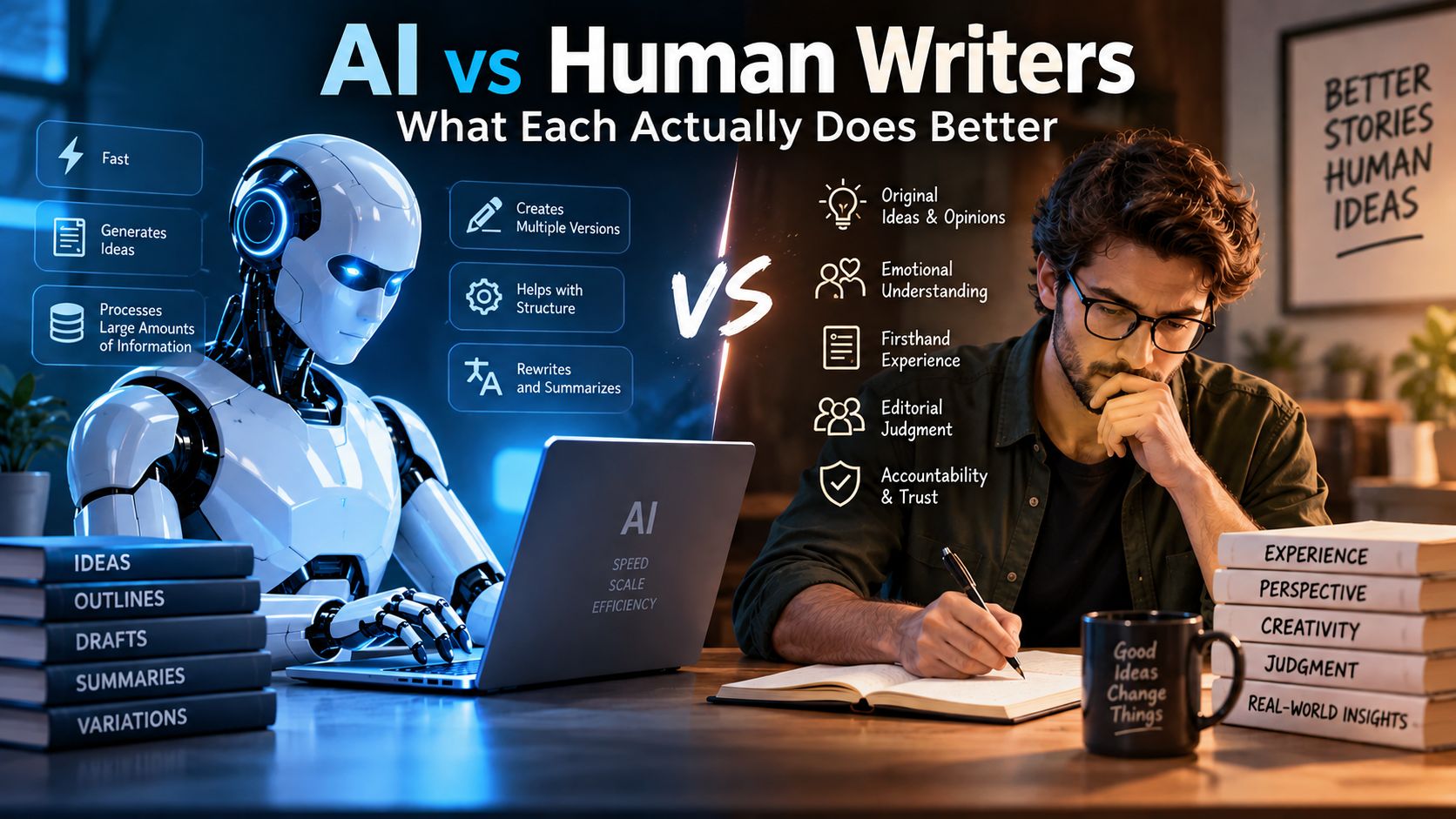
AI is fantastic at speed-related tasks — drafting, restructuring, summarizing, spitting out variations, brainstorming, chewing through repetitive work. Humans are still the ones you need for anything that depends on actually having lived through something: judgment, originality, emotional read, accountability, taste, and just knowing what’s worth saying in the first place.
Even Google seems to agree the “who wrote it” question matters less than “is it actually helpful.” Their guidance keeps circling back to originality, firsthand experience, and content that isn’t just a rehash of what’s already out there. So instead of picking a side, let’s actually break down where each one pulls ahead.
The quick version
If you want the short answer before diving in: AI wins on drafting, summarizing, rewriting, generating variations, and organizing information at scale. Humans win on firsthand experience, personal perspective, emotional nuance, original reporting, interviews, editorial taste, and — the big one — actually being accountable when something’s wrong.
None of that means humans are automatically the better writers. It just means the two are built for different jobs.
AI is fast. Really fast.
Staring at a blank page is a special kind of misery, and it’s one AI genuinely solves. Give it a topic and a decent brief, and it’ll hand you an outline, headings, examples, a few headline options, meta descriptions — all in the time it takes to refill your water bottle.
Say you need an article on password managers. Instead of opening a blank doc and groaning, you can just tell it: give me an outline for a 2,500-word beginner’s guide covering how password managers work, the security upside, the risks, and how browser-based tools stack up against standalone apps. Boom — usable structure, almost instantly.
But a first draft is not a finished article, and this is where the human part kicks back in. Someone still has to ask: is this even the right topic? Is the angle interesting, or just safe? What does the reader already know that we don’t need to explain again? What’s missing? What claims actually need checking before they go out the door? AI shrinks the cost of getting started. It doesn’t do your editorial thinking for you.
Where AI really shines: rewriting
Honestly, the strongest use case for AI isn’t writing from scratch — it’s transformation. Feed it something that already exists and ask it to simplify it, tighten it, make it punchier, turn it into bullet points, or repackage it as a social post or an email. It’ll crank out variations fast.
This is genuinely useful for content teams juggling multiple channels. One solid article can become a LinkedIn post, a tweet, an Instagram caption, a newsletter blurb, a video script, and an FAQ — same underlying substance, different wrapper each time.
It also handles volume better than we do
Humans get tired reading. AI doesn’t. Hand it a hundred-page report, a stack of product specs, a long transcript, or a pile of customer reviews, and it can flag common themes, contradictions, and key takeaways way faster than a person could.
That’s a genuine advantage during the research phase. But there’s a catch worth taking seriously: processing text isn’t the same as understanding it. AI can miss context, or draw a conclusion that sounds right but isn’t. For anything that matters, someone still needs to go back to the source material and actually check the claims before they get published.
Variations, structural nitpicking, and turning notes into something usable
Ask a human for five headline options and you might get five decent ones after some effort. Ask AI, and you’ll get fifty in seconds — some great, some garbage. That’s fine, because the human’s job shifts from generating every option to picking the right one.
It’s also a decent editorial assistant. Point it at a draft and ask it to flag repetition, weak transitions, missing sections, inconsistent terms, or paragraphs that just drag on too long. Use it to challenge your draft instead of trying to replace it.
And if you’ve got someone who knows their subject cold but hates writing, AI is genuinely useful for turning scattered notes into a rough skeleton. Give it a handful of bullet points about a product launch — battery’s better, camera improved in low light, app crashes sometimes, price is steep — and it’ll organize that into something like Design, Performance, Battery, Camera, Problems, Price. Then the actual expert comes back in and adds the insight that makes it worth reading.
Now for where humans still win, decisively
This is the part that actually matters.
Firsthand experience is the big one. AI can describe a phone’s specs. It cannot spend two weeks actually using the thing. AI can explain what a restaurant serves. It never sat at the table. There’s a real difference between “the phone has a 5,000mAh battery” and “I used this as my daily driver for a week and usually ended the day around 20–25% battery.” The second sentence is information nobody could fake without actually living it — and that’s exactly the kind of thing Google’s guidance keeps pointing at when it talks about unique value.
Original opinions aren’t the same as opinion-shaped sentences. AI can absolutely produce “the iPhone is the best phone for most people.” But it can’t tell you why it believes that, because it doesn’t believe anything. A human reviewer can explain that they prefer it because the software behaves predictably, the camera holds up consistently, and it plays nice with the rest of their setup. The value isn’t the conclusion — it’s the reasoning behind it.
Emotional context is something a human just reads better. Someone typing “my laptop is suddenly really slow, what do I do?” probably doesn’t want a wall of fifteen possible causes. They want something short, calming, and actionable. A writer who’s paying attention picks up on that. AI, left unsupervised, tends to just dump information.
Knowing what to cut is underrated. AI defaults to adding more. Good writers know when to take things away — this paragraph’s dead weight, that example is distracting, the reader doesn’t need the technical weeds here. Good writing isn’t about volume. It’s about choosing the right information and trashing the rest.
Original reporting still requires a human body in the world. AI can summarize a press release all day long. It can’t interview someone, show up to an event, test a product with its own hands, or chase down a source who’s avoiding your calls. A site that just summarizes what everyone else already wrote is playing in a commodity market. A site that actually tests things and talks to real people has something much harder to copy.
Asking better questions matters more than answering them well. AI is great at responding to a question — but the question itself usually has to come from a person who’s noticed something everyone else missed. Everyone’s asking if a tool is faster; the real question might be whether it makes fewer mistakes. Everyone’s comparing battery capacity; what actually matters is real-world battery life. That kind of reframing can change an entire piece, and it doesn’t come from a prompt.
Editorial judgment is its own skill. Say you’ve got twenty facts about a new product. AI can organize all twenty neatly. Figuring out which three actually matter to the reader — that’s a human call. It’s honestly why a tight 700-word piece from someone who knows the space can beat a sprawling 3,000-word AI dump.
Trust doesn’t come from clean grammar. It comes from expertise, transparency about method, real testing, accurate sourcing, and a willingness to say “we got this wrong” when necessary. If you’re reviewing a laptop, readers want to know you actually used it. AI, on its own, can’t answer that question — because the answer is no.
Where AI pulls ahead again: consistency and repurposing
To be fair, AI isn’t only good for drafting and summarizing — it’s also genuinely strong at consistency. Need a hundred product descriptions in the same format, same tone, same structure? AI holds that line far more easily than a tired human team on a deadline. Just remember: repetitive doesn’t mean unimportant. Product copy and FAQs still deserve a human check before they go live.
It’s also excellent at stretching one piece of content into many formats — turning a single how-to guide into a checklist, a video script, a carousel, a newsletter blurb, a thread. The original expertise should still come from a person. The repackaging can increasingly be automated.
And there’s real value in using it as a language assistant rather than a ghostwriter. Asking it to tighten a paragraph without changing the meaning is very different from asking it to write the whole thing. One improves your communication. The other hands over the thinking.
The real mistake isn’t using AI — it’s using it for the wrong job
The problem isn’t that people use AI. It’s that they ask it to do the parts only a human can actually do. Handing AI “write a review of this phone” and hitting publish gets you specs and vague generalities. A better workflow flips it: the human actually uses the product, tests the battery, forms real opinions, and compares it to competitors — and AI helps organize those notes, suggests structure, flags gaps, and drafts headline options. Then a human comes back in to verify facts, strip out anything generic, and make the final call.
A decent way to frame it: AI expands the number of possibilities. Humans decide which ones are actually worth keeping. It can generate twenty headlines and ten intros — someone still has to pick the one that’s actually good. And as AI makes churning out words nearly free, the things that don’t scale as easily — experience, taste, evidence, access, judgment — become more valuable, not less.
Why this matters especially for tech writing
Tech content ages fast. An article accurate six months ago about pricing, specs, or a software feature can be flat-out wrong today. That’s exactly why a site relying entirely on generic AI summaries is vulnerable — and why the winning move is letting AI handle speed while humans own verification and judgment. Google’s own guidance leans the same way: reward accuracy and original value, not just volume.
So — will AI replace writers?
Probably not entirely, but it’ll absorb a lot of the repetitive stuff first — basic summaries, product metadata, first drafts, routine documentation. What it won’t easily touch is investigative work, personal essays, real reviews, interviews, and expert analysis. Writers may end up spending less time typing sentences and more time researching, testing, interviewing, and fact-checking — which isn’t a downgrade, just a shift in where the value actually sits.
The modern writer starts looking a lot more like a researcher-editor-fact-checker hybrid than someone who just produces sentences all day. AI does more of the mechanical lifting. Humans do more of the thinking.
The bottom line
AI isn’t the new writer. It’s the new assistant — a genuinely useful one that speeds up drafting, research, editing, and repurposing. But the things that actually make content worth reading — experience, evidence, originality, and someone willing to stand behind what they wrote — still need a person in the loop. And the more common AI-generated content becomes, the more those human touches stand out.
AI for scale. Humans for substance. AI for speed. Humans for judgment. That’s the combination worth building around.
Leave a Reply