Cloud computing is a model that delivers computers, storage and services over the internet without owning a machine. Imagine renting a car instead of buying one—you get instant access to a vehicle (storage, servers, and apps) over the internet whenever needed and pay only for your drive time- no garage, zero maintenance, and no upfront costs required.
Origins of Cloud Computing
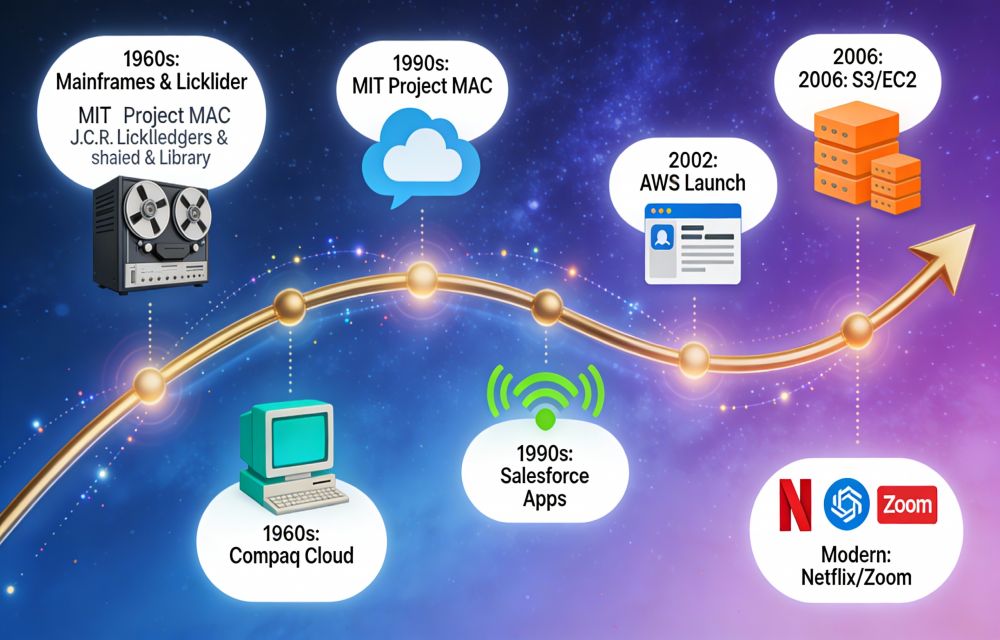
Lets time travel, back to the 1960s, huge mainframe computers humming in air conditioned rooms and their reels spinning like mechanical hearts. Then visionary J.C.R. Licklider dreamt of an “Intergalactic Computer Network” which can be accessed by people anywhere from the world, without owning a one. This thought ignited and they came up with a working model “Project MAC” at MIT, letting students share one computer like a communal library. Fast forward to 1990s. The internet emerged, Compaq coined the word “cloud computing” in a business plan envisioned as a utility and Salesforce thought a step ahead – started delivering softwares through browsers ditching installations.
Amazon, the then online bookstore giant sees the future in 2002 with AWS, renting out the spare servers that it had. By 2006, AWS unleashed S3 for storage and EC2 for virtual servers turning sci-fi into reality. Google and IBM joined the quest with massive farms and NASA ultimately came up with open-source clouds in 2008. Could we ever imagine, what started as sharing a computer to avoid waiting in lines, turns out to be a massive powerhouse that runs our Netflix binges and Zoom calls?
Why “Cloud”?
Tech diagrams in 1990s sketched the internet as a simple cloud icon symbolizing opaque yet reliable, connecting everything without showing the wires. This came up from the telecom days where networks were “clouds” of unseen infrastructure, evolving into today’s term “Cloud computing”, coined by Compaq in 1996. Like the clouds that shifts with the weather needs, cloud computing scales effortlessly.
Core Service Models (From a bird’s eye view)
Cloud computing operates through three models:
- Infrastructure as Service (IaaS)- for virtual servers
- Platform as a Service (PaaS)-for app development
- Software as a Service (SaaS)-for ready-to-use applications.
Tech giants like Amazon, Microsoft, and Google top the industry by providing scalable solutions to our needs through Amazon Web Services(AWS), Microsoft Azure, and Google Cloud Platform(GCP). These enable pay-as-you-go pricing.
Cloud in everyday life:
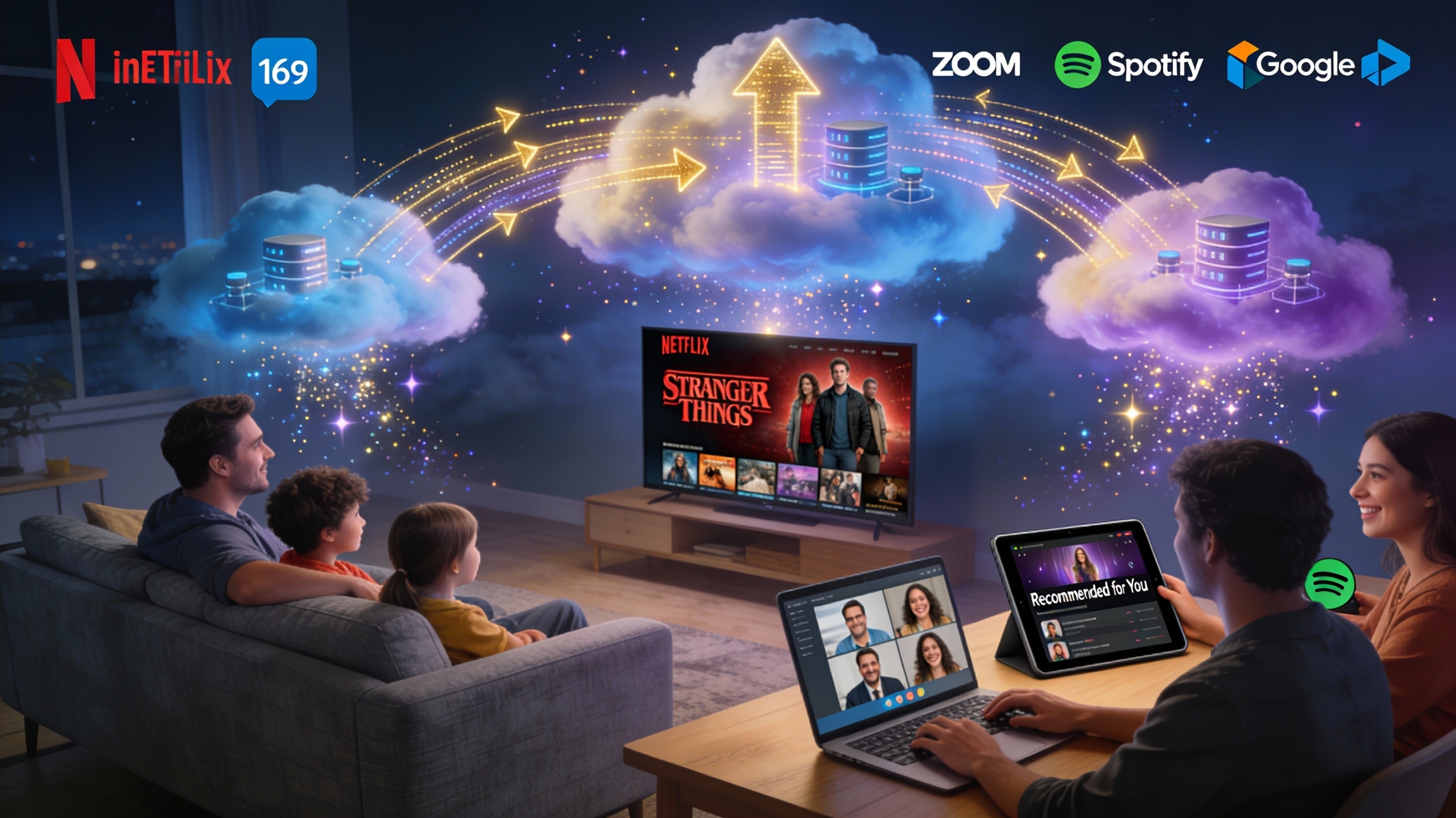
One of the online streaming platforms which most of us use on a daily basis to binge-watch our favorite content is Netflix. It relies on AWS to stream content to millions globally; scaling servers during peak time avoids buffering, keeping us hooked to the screen.
Most used online music platform—Spotify uses cloud infrastructure for real time music recommendations. It provides a seamless experience to the users handling massive data loads dynamically.
Collaboration tools like Zoom, Google drive or Dropbox which helped us through tough times like Covid pandemic, opening doors to working from anywhere rely on cloud infrastructure scaling our needs from video conferences to sharing files to connecting everyone on through apps like Teams and Office.
| Category | Examples |
| Entertainment | Netflix, Spotify, YouTube, gaming platforms |
| Communication | Zoom, Google meet, Teams, Gmail, Outlook, etc |
| Storage and back up | Google Drive, iCloud, OneDrive, etc |
| Productivity and Finance | Google Workspace, Paytm, Gpay |
| Smart Devices and Shopping | Alexa, Siri, Amazon, Flipkart |
Wow—no hardware, infinite power? That’s cloud magic
Sit back and think about how this invisible cloud is powering our lives.