Ever wondered why some websites always show up on Google while others stay invisible? The secret is SEO. Today, growing online isn’t just about being present—it’s about being found. Without the right tools and strategies, reaching your audience can feel like guesswork. Modern SEO tools make it easier by improving visibility, attracting organic traffic, and helping your website perform better without paying for every click.
Modern SEO tools simplify how websites are analyzed, optimized, and monitored. From keyword research and content optimization to performance tracking and search analytics, these tools help businesses understand how search engines crawl, index, and rank web pages. For beginners and growing teams alike, SEO tools make it easier to compete, scale, and build long-term online authority.
With the right SEO tools and best practices, businesses can improve search visibility, attract high-intent organic traffic, and rank consistently on Google—without depending heavily on paid ads.
4 Must-Know SEO Tool Types for Smarter Optimization
SEO tools can be categorized under four different categories:
- SEO Audit tools: These are primarily designed to analyze one or more metrics related to search engine optimization efforts.
- Keyword research tools: The objective of these tools is to report on the search metrics of keywords or help in identifying the keywords to target. These don’t measure ranking for specific web pages.
- Rank trackers: Almost all SEO rank trackers provide keyword research but their main function is to monitor how well web pages or domains rank for individual keywords.
- All-in-one tools: These tools cover many features including advanced features like automation and AI.
4 Game-Changing Reasons to Invest in SEO Tools Now
- Drives Organic traffic: The key role of a SEO platform is to drive organic traffic to your website. They optimize the content and website structure and help you to crawl up the search engine pages.
- Cost-effective: SEO platforms can be cost-effective in the long run. With increased organic visibility, website attracts more traffic without paying for clicks or impressions.
- Builds brand authority: If your website ranks high in search engine result pages, it proves the authority and credibility of the site.
- Boosts Conversions: SEO tools helps you to target right audience for specific demographics thereby converting searches to revenue.
Top 5 tools:
- Semrush One: It stands out as the market leader for comprehensive SEO, offering deep keyword data and a full suite of organic marketing tools despite a sometimes overwhelming interface with 50+ sub-sections. Keyword Magic Tool for exploratory research (26B+ keywords), Keyword Gap analysis, position tracking, and Organic Traffic are its key strengths. The SEO Content Template provides real-time optimization scores for readability, SEO, and tone, while Copilot AI warns drop in ranking and suggests fixes. It is a great platform for marketing agencies, startups, local businesses or large enterprises fro comprehensive SEO and digital marketing analysis.
However, higher costs can be bothering and sometimes overwhelming for users new to SEO tools. Data available for non-English regions is very less.
- Ahrefs: It excels in backlinks-integrated keyword research through Keyword Explorer with 20B+keywords, clickstream-based Traffic Potential estimates and content gap analysis. It is perfect for driving organic growth in US markets.
It provides unique metrics like Traffic Potential and Business Potential Score that help to prioritize high-ROI opportunities.
Competitor analysis, rank tracking, historical backlinks trends from referring domains, multi-platform supports are its key features. Its beginner-friendly interface delivers top-tier data quality, especially for agencies dissecting rival strategies.
This tool is ideal for advanced US SEOs and digital marketers targeting precise traffic and link-building opportunities.
- Google Keyword planner: Google Keyword Planner offers exploratory key word ideas and deeper data on search volume, trends, competition and bid ranges. It also helps with forecasts to plan budgets for ads and suggests keywords based on the website. It provides data that guides organic strategy by highlighting where ranking well could reduce amount spent on ads.
Google Search Console shows how Google views your site, flags indexing and reports search performance. It monitors visibility on Google and troubleshoots technical and indexing problems.
On the other hand, Google Analytics complements by providing deeper understanding on users behavior once they land on your site through engagement metrics like bounce rate, time on page, and conversions
All of these tools are completely free, with no upgrade requirement, making them especially attractive for smaller US firms that need reliable, US-specific search data before investing in premium SEO platforms.
But here are few disadvantages. This tool gears more towards advertisers than organic SEO and often suggests generic keywords with less focus on niche needs.
- Moz: It is a reliable all-in-one SEO platform which stands out with features like Priority Score and SERP analysis making it excellent for US businesses targeting long-tail keywords and on-page optimization in competitive niches.
Keyword Explorer for opportunity discovery, rank tracking across 170+ engines, Site Crawl for technical audits, page optimization, link-building support, and custom automated reports are its key features. It offers 30 days free trail for Moz Pro,. Also provides powerful Domain Authority for stronger SEO strategies and in depth analysis to know keyword gaps and backlink insights.
This is perfect for US firms building comprehensive strategies, from keyword planning to link building and reporting.
- Surfer SEO: It turns keyword clusters into optimized content delivering on-page scores and traffic forecasts that pairs perfectly with research tools for US e-commerce and SaaS growth. Surfer analyzes top-ranking pages to generate data-driven briefs covering LSI keywords, word count, heading structure, and intent alignment. Its Surfer Editor provides real-time grading, while Surfer AI generates branded content and targets AI search/chatbot visibility. It easily integrates with Google Docs or WordPress.
This tool provides simple top-performer analysis, AI writing in your voice, free detector/humanizer tools. It is ideal for US content teams prioritizing Google rankings through precise, competitor-matched optimization.
Semrush vs Ahrefs vs More: Battle of the SEO Giants
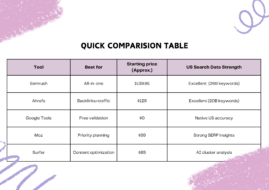
Here is a quick comparison table:
Pick Your SEO Weapon: Team Size, Budget, and Goals Decoded
Best SEO tool can be chosen by aligning features with your team size, budget, and specific goals like keyword discovery and traffic scaling.
Team Size: Small teams and startups, should start using tools like Moz or Google to avoid deep learning curve. Larger companies can use comprehensive suites like Semrush or Ahrefs that support multiple users, customized reports, and automation.
Budget: Beginners can use Surfer for content focus and Google for basics. Mid range companies can use Ahrefs’ backlinks. Always try free trails to validate ROI before purchasing the tool.
Goals: Go for Semrush or Ahrefs for keyword research and huge databases. Surfer or Moz can be used for traffic forecasting and content. For Technical audits, pair Google Search Console with paid add-ons.
Integration tips: Connect tools to Google Analytics/Search Console for “not provided” keyword unlocks (Semrush, Ahrefs). Use Zapier to automate workflows: trigger rank alerts to Slack, sync keyword data to Google Sheets, or push content briefs to CMS like WordPress. This creates unified dashboards and saves hours on manual reporting.
Master Keywords, Explode Traffic: Your Next Steps to SEO Domination
Keyword research is a critical pillar of any successful SEO strategy, and the right tools can make a significant difference in your results. The ideal keyword research tool always depends on your goals, budget, and experience level.
Keywords matter for both SEO and PPC. Relevant search terms drive qualified traffic, improve visibility, and help you climb the rankings on search engine results pages (SERPs). Undoubtedly free tools like Google Trends, Google Keyword Planner, and basic keyword generators are a great starting point for many businesses; while more advanced platforms can be explored with the help of SEO specialists as you grow.
Ultimately, without well-researched, relevant keywords, your content will struggle to reach the right audience. By regularly updating your keyword strategy, staying aligned with search trends, and choosing tools that fit your US business needs, you set your website up for stronger rankings, better traffic, and more profitable marketing campaigns.