Trying to rank for a competitive topic by publishing one article at a time can feel like filling a bucket with a teaspoon. You publish something, optimize it, share it, wait, check Search Console, and hope Google notices. Sometimes it works. Often, another site with dozens of closely related articles keeps outranking you anyway.
The difference usually isn’t the quality of that one article. It’s what surrounds it. One site might have a single article about technical SEO. Another might have fifty, covering crawling, indexing, redirects, Core Web Vitals, sitemaps, structured data, internal linking, and JavaScript SEO. The second site has built something bigger than any individual article — an actual body of knowledge around one subject. That’s topical authority. It isn’t about publishing constantly to look busy. It’s about becoming genuinely useful within a specific area.
What Topical Authority Actually Means
Topical authority is the degree to which a site becomes associated with a subject because it consistently publishes useful, connected information about it. Think about which sites you naturally trust. If you need camera advice, you probably trust a publication that’s spent years reviewing lenses, sensors, and accessories over a random site that published one camera article last week — not because the specialist always has the single best answer, but because context matters. A site builds that context by covering related questions, connecting its content, and maintaining it over time. The goal was never to convince Google you’re an expert. It’s to actually become useful enough that expertise becomes visible through the site itself.
Pick a Niche You Can Actually Cover
The easiest way to make topical authority impossible is choosing a topic too broad to realistically own. “Digital marketing” covers SEO, social media, email, paid ads, analytics, ecommerce, branding, and more — a small site trying to cover all of it ends up shallow across dozens of subjects instead of deep in any one. A narrower direction works better: technical SEO for Shopify stores, email marketing for small ecommerce businesses, Google Ads for local service companies. The narrower subject gives you something valuable — a realistic shot at being comprehensive. You don’t have to stay narrow forever, but especially when a site is young, depth beats trying to compete everywhere at once.
Map the Topic Before Writing a Single Word
Don’t open a keyword tool and start writing whatever has the highest volume. Understand the subject first. Building authority around Shopify technical SEO might mean mapping out site structure, collection page SEO, duplicate URLs, canonical tags, image optimization, app-related performance issues, structured data, internal linking, mobile usability, and indexing problems. Notice what’s happening there — you’re not just collecting keywords, you’re building a picture of everything someone would need to understand about the subject. A keyword list tells you what people search for. A topic map tells you what people actually need to understand. Once that map exists, every new article has a real purpose — you’re filling a specific gap in coverage, not chasing whatever the keyword tool surfaced next.
Build Around Pillar Pages and Supporting Content
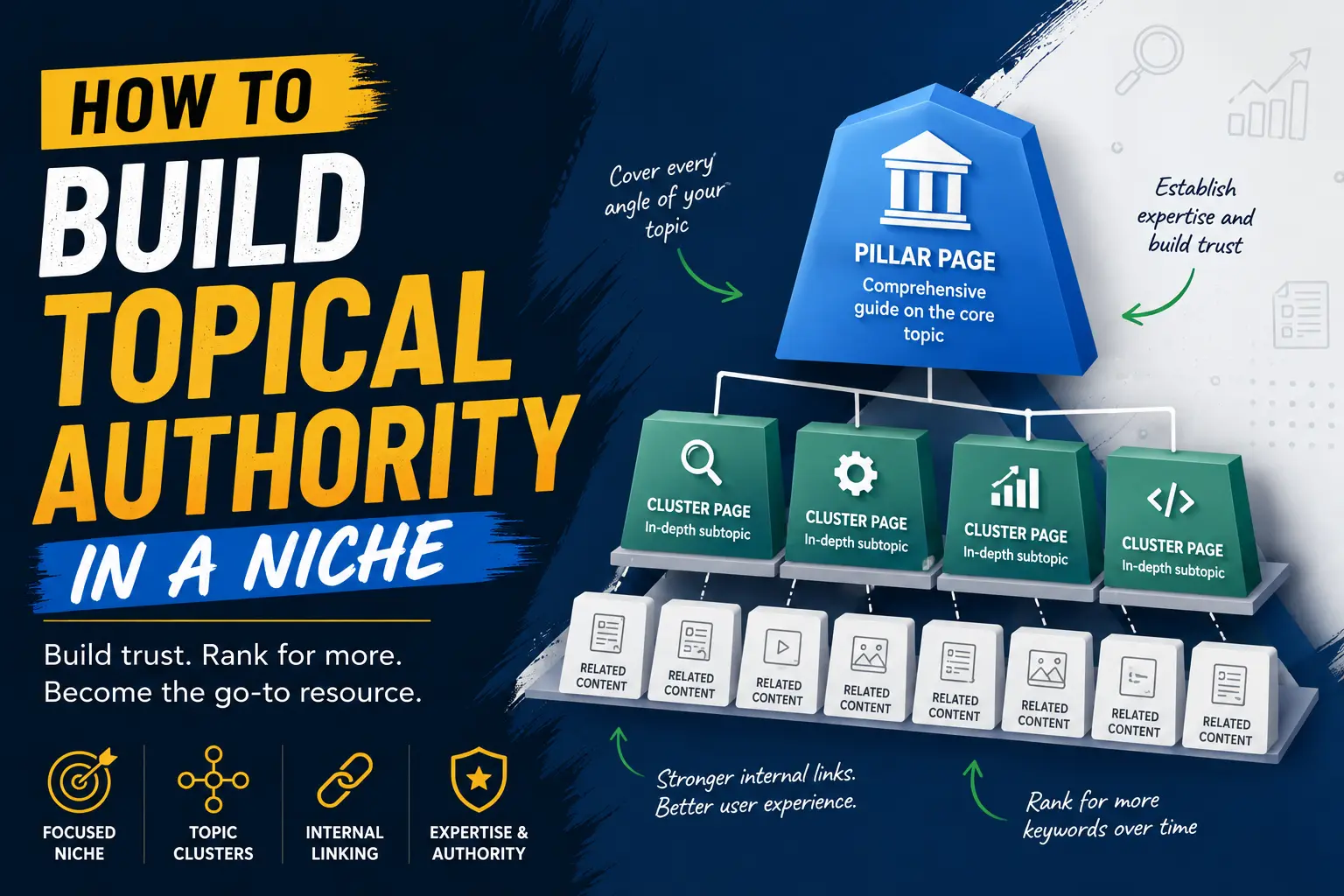
A pillar-and-cluster structure tends to work well here. A broad “Shopify SEO Guide” pillar page sits at the center, surrounded by detailed supporting articles — image SEO, duplicate content, canonical tags, collection page optimization, Core Web Vitals. The pillar gives readers the big picture; supporting articles go deep on specific questions, and internal links tie them together so a reader exploring canonical tags might discover duplicate content next, then return to the broader guide. The site starts feeling less like a pile of unrelated posts and more like a connected resource.
Consistency Isn’t the Same as Constant Publishing
Topical authority doesn’t require five articles a week. Publishing constantly can actually backfire if quality slips. A site posting about SEO on Monday, Instagram on Wednesday, crypto on Friday, then SaaS the next week might publish nothing technically wrong — but what is that site actually becoming known for? Compare that to a site spending six months covering one well-defined subject from multiple angles. The second site is building a far clearer identity. Consistency means staying useful within a chosen area, not just hitting a quota.
Go Back and Update What Already Exists
Building topical authority isn’t only about adding more — it’s also about looking backward. Information changes. Platforms release new features, search behavior shifts, and advice that made sense two years ago can quietly go stale. A site with fifty articles isn’t automatically more authoritative than one with thirty — if twenty of those fifty are outdated, the bigger library might actually be a worse experience. A simple review routine helps: are the facts still accurate, are the screenshots current, have the tools changed, is there a newer example worth adding, should this link to something published since. Sometimes strengthening one existing article is worth more than publishing another mediocre one.
Show You Actually Know the Subject
This is where a lot of content strategies quietly fall short — publishing technically correct information without demonstrating real expertise. Thousands of articles explain what Core Web Vitals are. Far fewer say something like “we tested this on a real ecommerce site and found the biggest performance problem wasn’t the images — it was a third-party script.” That version has something the first doesn’t: actual experience. Real testing, before-and-after results, and honest mistakes don’t require revealing confidential client details, just anonymizing enough to share what was genuinely learned. The point is showing the article came from doing the work, not just reading about it.
Build Relevant Links, Not Just More Links
Backlinks still matter, but link building shouldn’t turn into a pure numbers game. A hundred irrelevant links aren’t automatically worth more than a handful of genuinely relevant mentions. A link from a site that regularly covers Shopify development or ecommerce technology reinforces the subject in a way an unrelated link simply doesn’t, even if the domains carry similar overall strength. Contributing expert commentary, publishing original research, collaborating with relevant publishers, and showing up in the communities your audience already exists in tend to produce exactly this kind of contextually relevant link — the best links usually come from having something genuinely worth referencing.
Connect the Knowledge With Internal Links
Publishing related articles isn’t enough on its own — they need to be connected. Every new piece should prompt the question: which existing articles would help this reader understand the subject better? The same question works in reverse on older content: does this article have a natural opportunity to point toward something newer? Over time, this builds a real internal structure — a pillar guide linking out to product SEO, collection SEO, duplicate content, image optimization, and Core Web Vitals, letting a reader move through the subject naturally. Internal linking shouldn’t feel like SEO decoration bolted on afterward. The best internal links just answer whatever question the reader is likely to ask next.
Measure the Cluster, Not Just One Keyword
One keyword climbing from position 18 to 11 is nice, but it doesn’t tell you whether the broader strategy is working. The more useful signals are whether more pages are picking up impressions, whether new articles get indexed and found quickly, whether the site starts appearing for related queries it never directly targeted, and whether traffic is spreading across the whole cluster instead of depending on one lucky article. Topical authority is supposed to create compounding value — the next useful article shouldn’t have to start completely from zero.
Don’t Publish Just to Fill a Gap
A topic map might surface a hundred possible article ideas. That doesn’t mean a hundred articles need to exist. Each one deserves a real filter: does it answer a meaningful question, does it add something the existing content doesn’t already cover, is there enough real expertise behind it to say something worthwhile? If the honest answer is no, it’s fine to leave it alone. Topical authority isn’t built by filling a site with words — it’s built by creating a body of information that keeps getting more useful, not just longer.
A Simple Way to Start
Choose one narrow subject instead of an entire industry. Build the topic map — concepts, questions, tools, comparisons. Pick the pillar topic that gives the overall picture. Build supporting articles deep enough to stand on their own. Connect everything with internal links that genuinely help. Add real experience wherever possible — tests, screenshots, mistakes, observations. Go back and review older content regularly. And measure the cluster as a whole, not one keyword in isolation.
The Bigger Picture
Topical authority gets misunderstood as an SEO trick. It isn’t, really. At its best, it’s just a better way of building a website — asking what someone would genuinely need to know to understand a subject, then building that knowledge base piece by piece instead of chasing whatever a keyword tool suggests next.
The process takes time, and that’s exactly what makes it valuable. A competitor can copy an article tomorrow — the headline, the structure, even the keyword targets. What they can’t easily copy is years of connected articles, first-hand experience, updated information, earned relationships, and accumulated knowledge around one subject. That’s not winning one keyword. That’s building a site that’s earned a reason to be considered every time someone searches within that area — which is a far sturdier foundation for long-term SEO than any single ranking ever will be.
Leave a Reply