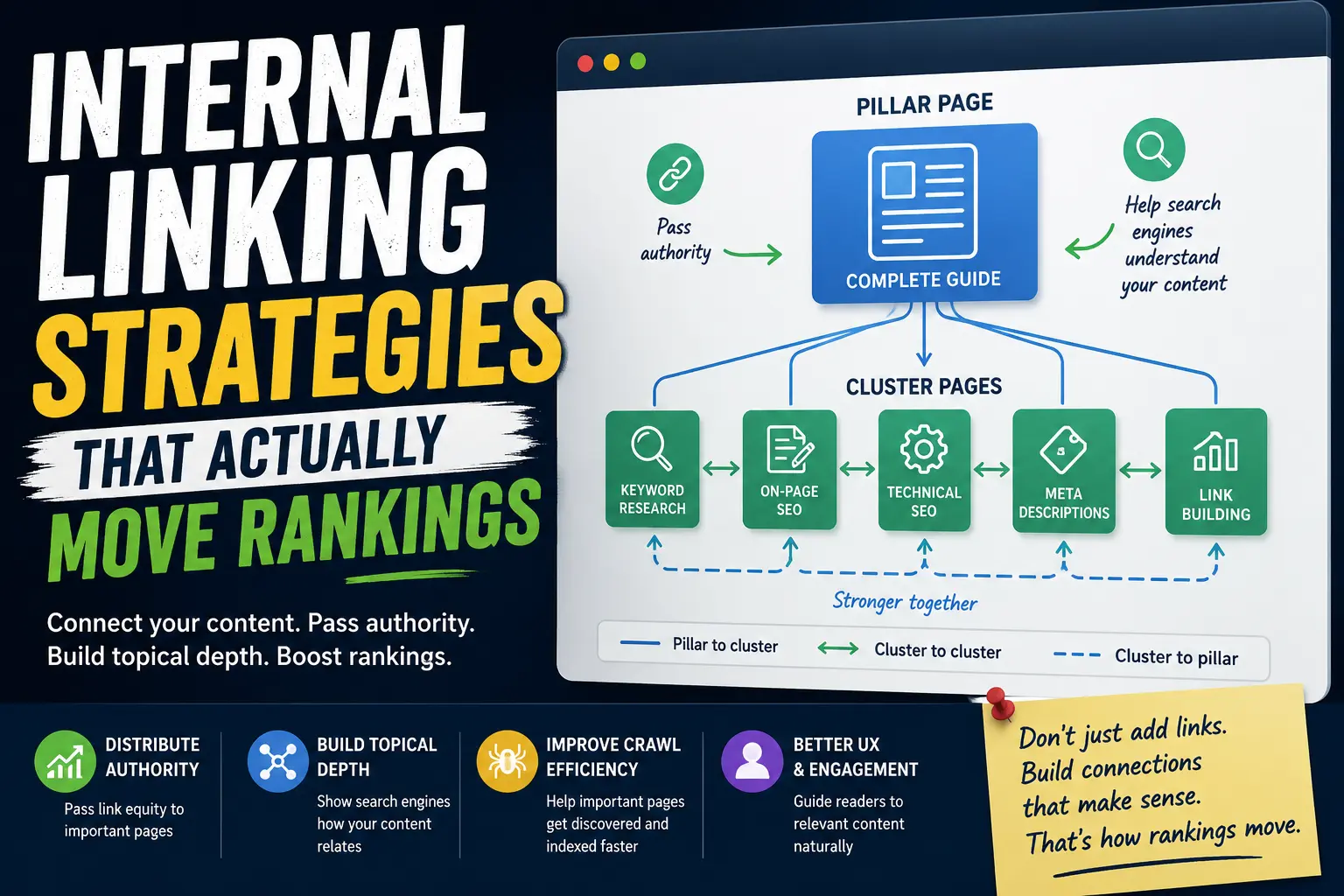
Most people treat internal linking like furniture arrangement — something you do at the end, almost as an afterthought, once the “real” work of writing the content is done. Add a few links here, sprinkle a few there, and call it a day. But if you’ve ever watched two nearly identical articles perform completely differently in search — same word count, same keyword targeting, same publish date — the difference often isn’t the writing. It’s the wiring underneath it.
Internal links are the nervous system of a website. They tell search engines which pages matter, they pass authority from your strongest content to your newest content, and they quietly decide which pages even get crawled in the first place. Get the wiring wrong, and your best content can sit buried three clicks deep, starved of the authority it needs to rank.
This isn’t a “add more links” post. It’s a breakdown of the internal linking strategies that actually move rankings — and why most sites get this wrong without realizing it.
Why Internal Linking Gets Overlooked
Search engines reward external backlinks so visibly that internal linking feels like the boring cousin nobody invites to the party. Backlinks are hard to earn, so when a site gets one, it’s a celebration. Internal links, by contrast, are entirely within your control — and things that are entirely within our control tend to get treated as less important, not more. That’s backwards. Internal links are the one ranking lever you don’t have to beg anyone for.
There’s also a structural reason internal linking gets ignored: most content teams write in isolation. A writer finishes an article, hits publish, and moves to the next assignment. Nobody goes back to ask, “Does this new page connect to anything else on the site? Does anything connect back to it?” Over time, sites end up with hundreds of published pages that behave like isolated islands — each one competing for its own scraps of authority instead of pulling from a shared reservoir.
What Internal Links Actually Do for Rankings
It helps to separate the three distinct jobs internal links perform, because most people only think about the first one.
They distribute authority (link equity).When a page with strong backlinks links to another page on your site, some of that authority flows through. A single link from your highest-authority page to a struggling page can do more for that page’s rankings than another six months of on-page tweaks.
They establish topical relationships. Search engines use internal links, and the anchor text within them, to understand how pages relate to each other. A cluster of pages all linking to and from each other around a shared theme signals topical depth — this is the mechanism behind topic clusters and pillar pages.
They control crawl priority. Crawlers allocate limited time and resources to each site. Pages that are linked to frequently, and from important pages, get crawled more often and indexed faster. Pages buried deep with no internal links pointing to them can sit unindexed for weeks, no matter how good the content is.
Miss any one of these and you’re leaving rankings on the table, even with excellent content.
The Pillar-and-Cluster Model, Done Properly
Most sites have heard of the pillar-and-cluster model by now: one comprehensive “pillar” page targeting a broad topic, surrounded by narrower “cluster” pages targeting specific subtopics, all interlinked. The idea is sound. The execution is usually half-finished.
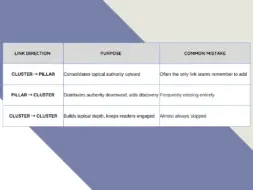
Here’s where it typically breaks down: teams build the cluster pages, link each one back to the pillar, and stop there. That’s only half the structure. The pillar needs to link out to every cluster page too, and — this is the step almost everyone skips — cluster pages should link sideways to each other where relevant, not just up to the pillar.
Think of it less like a wheel with spokes and more like a small web. A page about “on-page SEO basics” can link to the broader “SEO guide” pillar and connect readers to related cluster pages such as “keyword research” and “meta descriptions.”
Anchor Text: The Most Underused Signal You Control
If internal linking is the wiring, anchor text is the label on each wire.
Most internal links use anchor text like “click here,” “read more,” or copied page titles without much thought. That wastes an opportunity because anchor text helps search engines understand the destination page’s topic. Use descriptive, relevant anchor text that matches how readers naturally describe the destination page. Vary your anchor text instead of repeating the same exact phrase across every link to a page. Using identical anchor text across fifty pages can look artificial and limits opportunities to reinforce related keyword variations.
Fixing Orphan Pages Before They Cost You
An orphan page is any page with no internal links pointing to it — reachable only through a sitemap or direct URL.
Link Depth: How Far Is Too Far?
Click depth — how many clicks it takes to reach a page from the homepage — has a well-documented relationship with both crawl frequency and rankings. Pages sitting four, five, or six clicks deep get crawled less often and rank worse on average than pages within two or three clicks, even when the content itself is comparable.
This is where navigation and internal linking intersect. A clean hierarchy can bury important pages, so use contextual links, related-content sections, and pillar pages to surface them.
A Practical Way to Prioritize Internal Linking Work
Not every page deserves the same linking attention, and treating them equally wastes effort. A useful way to prioritize:
-Send links to pages that are “almost ranking.” Pages sitting in positions 8 through 20 for a valuable keyword often just need an authority push, not new content. These are the highest-leverage linking targets on the entire site.
-Link from your strongest pages, not just your newest ones. Identify pages with the most backlinks or organic traffic, then prioritize them for internal links to important content.
-Revisit old content when you publish new content.
The question worth sitting with
Most sites don’t have a content problem. They have a connection problem — good pages sitting quietly, disconnected from the authority and context that would let them compete. Before you write the next article, ask yourself: How many existing pages are actively supporting each other, and how many are sitting unnoticed?
Leave a Reply