
Long-term B2B client relations rely heavily on the relational aspects of consistency, visibility, and timely follow-up, making the right B2B CRM all the more critical in 2026.
The best CRM tools do more than store contact information. They track conversation trails, manage sales processes, personalize communication, and maintain account health over time.
Why is B2B CRM so important?
B2B client relationships often entail a long purchasing cycle, having multiple parties involved in purchasing decisions and having multiple areas of a company involved in supporting clients (sales, marketing, and support).
A CRM can help maintain organization around the process by consolidating customer history, automating follow-ups & providing account teams with the context needed to remain relevant to each client.
The greatest benefit of using a CRM for long-term client management, however, is that it creates continuity. Your team will remember what they promised, what the status was last quarter, and what each account is going to require next.
1. HubSpot
If you’re looking for the best choice among options for managing complex sales relationships as a B2B organization, then look no further than HubSpot. HubSpot is an incredibly versatile solution that works great for teams where marketing, sales, and customer service can all access the same account information.
HubSpot is primarily designed to be user-friendly, and the user interface and experience are extremely well done compared to others in its category.
All teams using HubSpot will be provided with a full suite of features to support their entire customer lifecycle through automation, pipeline management, activity monitoring, and reporting, allowing the account team to coordinate activities effectively throughout the term of the customer’s relationship with HubSpot.
Thus, if you are part of a B2B organization and are focused on structure and long-term visibility, then HubSpot is a fantastic all-around choice.
2. Salesforce
Salesforce offers robust capabilities for enterprises that need custom-tailored and enterprise-grade account management.
It is also an excellent solution for larger B2B organizations that must manage complicated sales processes, various products and large end-user populations so sales and service teams can work together seamlessly.
Salesforce’s strengths lie primarily in its ability to be configured in a variety of ways. As it is so customizable, Salesforce is ideal for Companies that utilize innovative workflows and have multi-year relationships with their customers.
If your B2B organization’s needs dictate that you leverage a scalable system for your organization, you should consider Salesforce as one of the most substantial tools available.
3. Pipedrive
B2B teams looking for strong exposure of pipelines without major complicated issues should consider using Pipedrive. The platform was built specifically with sales-driven organizations in mind so they can clearly see their deals, follow-up activities, and account activity using an easy-to-empty layout.
Pipedrive helps sales teams manage business relationships after contact is established and keeps both new and experienced reps focused on their next steps. This gives them the ability to conduct long sales cycles while also ensuring everyone remains visible to many customers.
Pipedrive would be a good fit for teams wanting speediness, clarity, and ease of use.
4. Zoho CRM
For those looking for cost-effective ways to experience a more extensive suite of functionality than that offered by other CRMs, Zoho will provide an appealing alternative.
Zoho provides the essential tools for sales automation, lead management, contact management, analytics, and workflows. It also supports long-term client relationships. The biggest benefit to B2B teams is the Zoho platform provides a lot of features while at the same time, keeping them out of enterprise-level complexity and allowing them to focus on the business aspects of running a business rather than worrying about implementing an enterprise-class platform.
Starting small companies that want to manage their accounts and minimize their overhead costs would do well to begin their search using the Zoho platform.
5. Creatio
Creatio suits businesses that want a process-driven CRM. It offers strong automation and flexible case-based workflows. Ideal for B2B teams that manage structured sales motions, Creatio allows companies to adapt workflows based on different client types or account stages.
For businesses looking for long-term relationships, Creatio provides a greater level of customizability regarding business processes than many other basic CRMs on the market.
This makes Creatio an ideal solution for those companies needing a CRM that can accurately reflect how their client management processes occur, rather than forcing them into a rigid template.
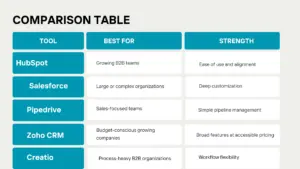
Which solution should you choose? Here are some recommendations:
HubSpot is a user-friendly CRM that integrates marketing, sales, and service. Salesforce offers a highly customizable solution with enterprise-level control. Pipedrive provides a sales-first solution with visibility into long deals. Zoho CRM delivers broad capabilities without the price tag of an enterprise solution. Creatio works well when client relationships depend on custom workflows and structured processes.
FAQs
1 What is the best CRM for long-term B2B relationships?
HubSpot and Salesforce are often the strongest choices, while Zoho CRM, Pipedrive, and Creatio fit different team sizes and workflows.
2. Why do B2B companies need a CRM?
B2B companies need a CRM to manage long sales cycles, multiple stakeholders, and ongoing account relationships in one place.
3. Which CRM is easiest for teams to use?
HubSpot and Pipedrive are often considered the easiest to adopt because they focus on usability and clarity.
4. Which CRM is best for enterprise B2B sales?
Salesforce is usually the best fit when a company needs deep customization and complex reporting.
5. Which CRM is best for growing B2B companies on a budget?
Zoho CRM is a strong option because it balances features, automation, and affordability.
6. What CRM feature matters most for long-term account management?
Multi-contact account tracking, automation, activity history, and reporting are especially important for long-term B2B relationships.
7. Can a CRM help improve client retention?
Yes. A CRM helps teams stay organized, follow up consistently, and personalize communication across the account lifecycle.
Leave a Reply