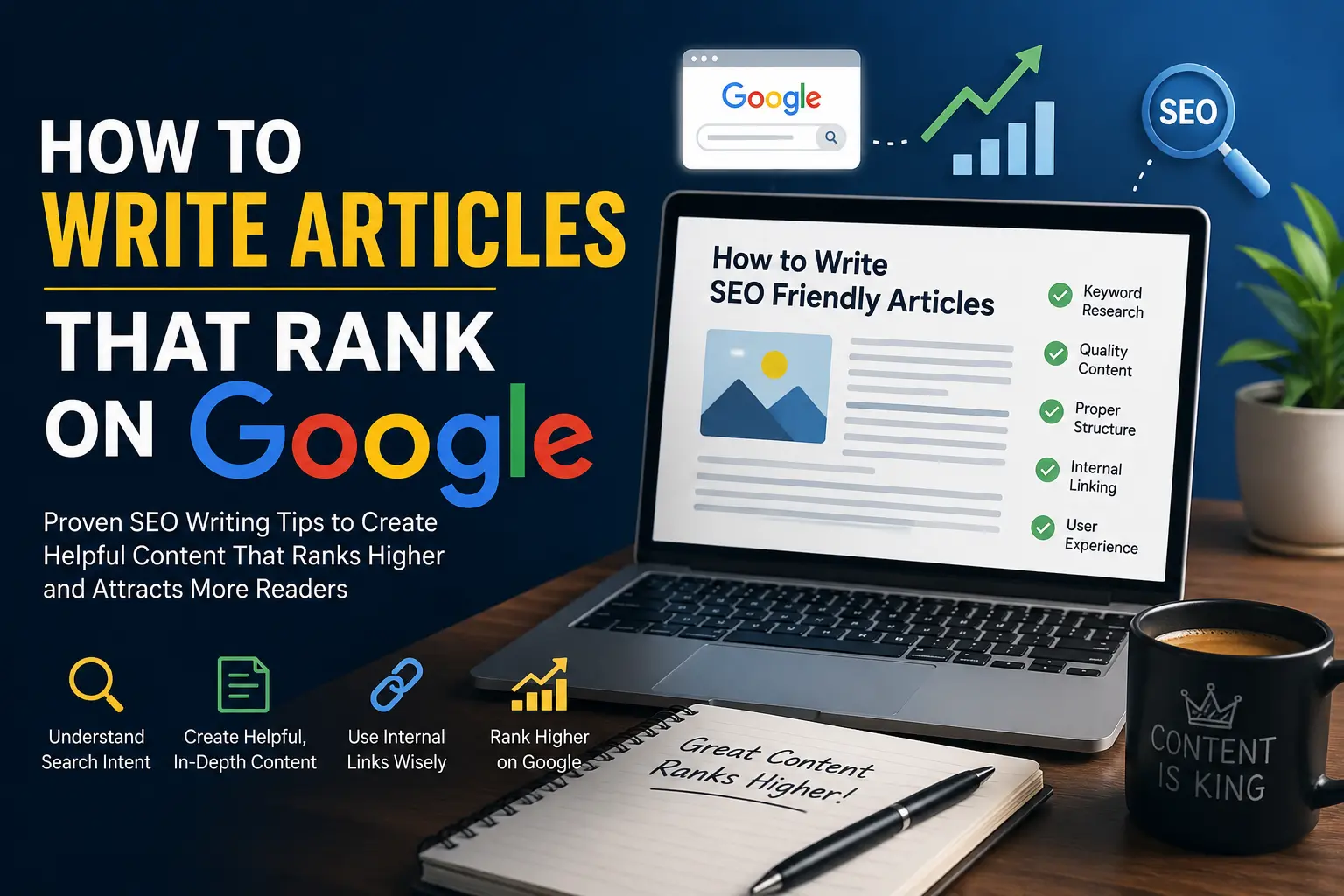
Every day, millions of articles are published online, yet only a small percentage ever appear on Google’s first page. The difference isn’t always better writing—it is understanding what Google wants and what users need. In this guide, you’ll learn practical, experience-based techniques to write articles that rank higher while genuinely helping readers.
Many people make use of a reversed form of SEO writing in their practice. The first step in this strategy is to select a specific keyword using an efficient keyword tool that indicates a huge number of searches. Then, writers have to produce a great amount of text that revolves around this keyword. Although this method can sometimes be successful, it creates a type of content that is often not useful for readers since it is written for the keyword but not for a real person.
Successful materials that get high places in Google are the ones that answer real questions posed by real users. When applying this writing strategy, one should start with the question and then produce a relevant quality answer eliminating the necessity to get focused on writing for the keywords.
Contents
- Start with Search Intent
- Find Questions Before Keywords
- Analyze Google’s First Page
- Structure Your Article Properly
- Write Comprehensive Answers
- Use Natural Language
- Build Internal Links
- Fix Technical SEO Issues
- Write Better Titles & Meta Descriptions
- Refresh Old Content
- Demonstrate Real Expertise
Find a Good Topic by Searching for a Relevant Question.
It is better to think about a question before using a keyword tool. For instance, you may use support tickets, comments, and other sources of information that will give you good ideas for writing various texts without relying on keyword metrics.
When it comes to actually working on a specific question, keyword research turns into a step in the refining process and a way of checking how people phrase such question, which variations exist, and how much said question is actually in demand. This order is more important than it seems at first sight. Content created for the sake of addressing an actual challenge is regarded as informative. On the other hand, content written around a keyword tends to appear as a filler.
Examine the First Page Results Before Starting to Write
Whatever content shows on page one of the search results is not accidental as it represents the best guess made by Google in terms of satisfying the search intention as stated in the millions of searches conducted. Going through the top 5-8 search results may reveal insights that are impossible to get from keyword planners: whether searchers prefer a how-to guide or a straightforward answer, whether they want a list or a detailed explanation, what subtopics appear in all the top results, and what issues the existing articles fail to cover.
The objective is not to replicate the composition of the current top sites, rather the goal is to discover what the purpose of the sites is and create a webpage that accomplishes this task even better than the top-ranking webpages.
Structure for Scanners First and Readers Second
It is generally known that very few people completely read a web article in one go. Rather they look through headings, they only read some of the highlighted text and in seconds decide whether it is worth their time to stay and read the text in full. Articles that get into the top positions had been designed with this particular behavior of the users in mind from the very beginning:
- Clear H2 and H3 headings that can serve as the content outline
- Short paragraphs of only 3-4 sentences at maximum
- Bullets and lists wherever possible
It’s not simply a mark of readability. Google’s models prefer websites that quickly and effectively answer the question asked by a user. A smart layout allows users to find the information they need quickly, so the levels of engagement of internet users (time spent on the page, low bounce rate) are typically higher than in the case of poorly structured long articles with answers buried deep in the text.
Don’t Be Content with Giving Partial Answers
One of the common mistakes is aiming for a word count — filling the text with unnecessary information, just to make it longer. This is a misconception, as long texts usually rank high not because they are long but because answering a question in detail requires more words than doing that in a shorter way.
To effectively answer the question, one has to consider the following questions and problems the reader might face. If the reader needs to consult additional web sources after reading the article, it means that the writer hasn’t done a good job implementing the idea.
Use the Language of Your Target Audience
Search engines have greatly improved at comprehending synonyms, similar ideas and natural phrases, so cramming in exact keywords again and again is not only unneeded but also can be more detrimental than anything else. It is more important to write in the language your audience uses when discussing the issue, which can be very far from formal terminology used by the writer.
Analyzing Search Console searches for existing content (or forum posts, reviews and comments in case the site is new), one learns actual phrases constructed by real people, which are usually much more casual, specific and diverse than those the writer would come up with himself. Utilizing the same terminology will help the content to match search intent and the audience.
Internal links are more powerful than most writers think.
Likewise, providing links to other articles of interest on the site from the new article is an effective means of keeping readers longer on the site and giving search engines a better idea of the overall structure of the site.
Perhaps the error here is thinking of internal linking as something that happens afterwards, but internal linking should take place as part of the overall content strategy — selecting before writing what pages will be linked to as well as other articles that the new article will link to in the future.
Technical Issues Still Determine Whether Good Writing even Has a Shot
An outstanding article on a slow-loading page, with poor mobile design, or blocked from being indexed by a technical glitch may never rank, regardless of how well it is written. Some of the technical basics that you may want to check before you have a ranking problem instead of a content problem include:
- Page speed (especially on mobile, where a significant part of the search audience has been using lately)
- Correct heading levels (H1, appropriate H2, and H3) for understanding the content structure by search engines
- A simple, clear URL and page title reflecting the content of the article
- Functional internal and external links, as broken links decrease both the users’ and crawl behavior trust towards a web page
- Structured data wherever applicable (FAQ schema, article schema, review schema) which helps to get more clickable search result
Although all of these things are not a replacement for good writing, great writing, which is behind the technical barrier, will never compete.
Craft an Eye-Catching Title and Meta Description That Entice Readers to Click
Achieving a good ranking and getting clicked on are two separate worlds, and it is possible to achieve the first one without fulfillment of the second one. A technically correct title that simply restates the article’s topic may not attract many clicks, even if it ranks well. Instead, readers are more likely to engage with a title that clearly explains what the article offers and gives them a compelling reason to click. Including elements such as numbers, a timeframe, or a specific promise—for example, “without coding,” “in ten minutes,” or “the 2026 way”—can make the title more appealing and increase its click-through potential.
Revise the Old Content Rather Than Searching for New Ideas
One of the least recognized ranking strategies is using old articles that have performed poorly for a long time — instead of creating something new, try to update articles that fell on the search engine result pages. Updating content can include adding new statistics, resolving outdated facts, adding sections that were missing in the initial article, and even changing the title if the old one was not working.
The search engines tend to respond positively to signals of freshness, so well-updated content can rank better than a new article in the same niche.
Let Genuine Expertise Be Visible, Not Simply Accurate Information.
Search engines now give high importance to signals of real expertise and practical knowledge along with pure topical correctness. Generic articles rarely stand out to search engines or readers.
Content backed by case studies, tested insights, and real experience earns greater trust. Unique, experience-driven content is harder to copy and more likely to be remembered and referenced.
Common SEO Writing Mistakes
Writing for keywords instead of people
- Keyword stuffing
- Ignoring search intent
- Huge paragraphs
- No headings
- No internal links
- Outdated information
- Weak title
- Generic introduction
- No conclusion
Final Thoughts
Writing articles that rank on Google starts with writing genuinely helpful content. Google continually improves its algorithms to identify content that best serves users. Focus on helping readers first, and better search rankings will naturally follow.
Start with a real question. Provide thorough and clear answers to that question without ignoring how people read. Besides, you should also pay attention to technical aspects that help your content achieve better rankings in search engines.
Leave a Reply