

Anthropic Mathematician Says Claude Helped Prove the Riemann Hypothesis: What We Know
Anthropic's Levent Alpoge claims he and Claude proved the Riemann hypothesis in Lean. What was claimed, why Lean matters, what's unverified and the $1M Clay rules.
Mathematicians have been trying to prove the Riemann hypothesis since 1859. On Friday, November 20, Levent Alpöge, a mathematician who works at Anthropic, said he had done it, working with the company’s AI model, Claude. He also posted a machine-checkable version of the proof written in Lean. If it holds up, it would be one of the biggest results in the history of mathematics and the first Millennium Prize problem cracked with an AI’s help. That “if” is doing a lot of work, and it will take time to resolve.
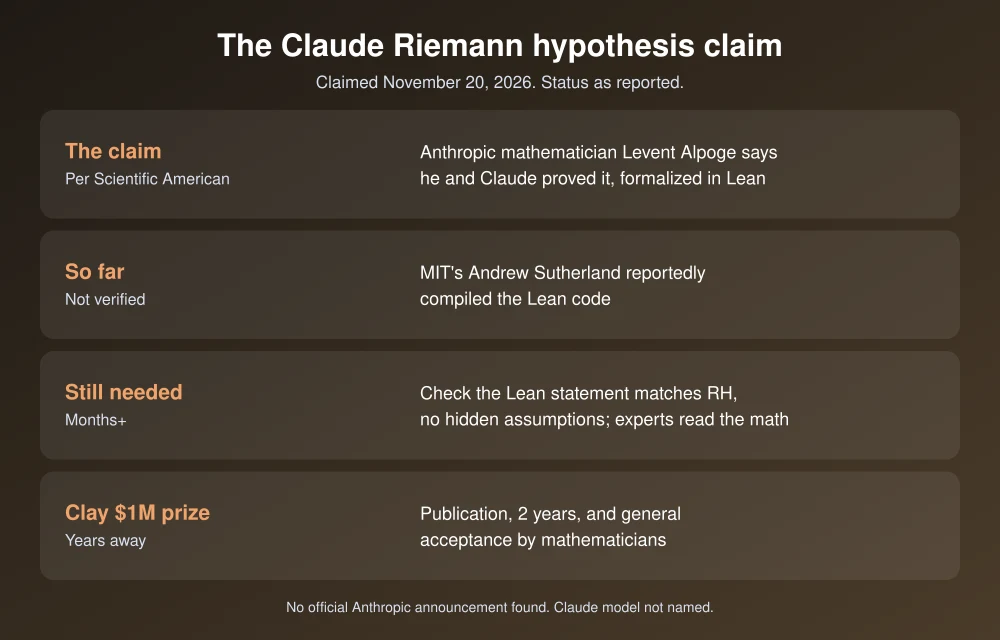
Quick answer: Levent Alpöge, a mathematician employed by Anthropic, claims he and Claude found a proof of the Riemann hypothesis and formalized it in the Lean proof language, according to Scientific American. It hasn’t been independently verified. MIT mathematician Andrew Sutherland reportedly compiled the Lean code, but experts still need to confirm the hypothesis is stated correctly in Lean and understand the math. Anthropic hasn’t published an official announcement. The $1 million Clay prize requires journal publication, two years and broad acceptance, so nothing is settled yet.
What exactly was claimed
According to Scientific American, Alpöge posted a statement saying he believes he has, working with Claude, discovered a proof of the Riemann hypothesis. He says the method extends to the Generalized Riemann Hypothesis, and that he and Claude formalized the arguments in Lean. Scientific American notes the claim came a day after Anthropic’s stock market debut.
What we don’t know yet: which Claude model was used, where the full Lean code lives publicly, and whether the formal statement in Lean exactly matches the Riemann hypothesis. We didn’t find an official post about it on Anthropic’s news page when we checked.
What is the Riemann hypothesis?
Bernhard Riemann proposed it in 1859. It says that all the “non-obvious” zeros of the Riemann zeta function have a real part of exactly 1/2. That sounds abstract, but it matters because those zeros control how prime numbers are spread out. A proof would confirm a huge body of results in number theory that mathematicians have built on the assumption that it’s true.
The Clay Mathematics Institute says it has been checked for the first 10 trillion zeros, but checking examples isn’t a proof. It’s one of Clay’s seven Millennium Prize problems, and only one of those, the Poincaré conjecture, has ever been solved.
Why Lean matters, and why it isn’t the final word
Lean is a programming language for writing proofs that a computer can check step by step. That’s a big deal for a claim like this: instead of waiting years for experts to read a long paper, the logic itself can be machine-verified. Scientific American reports that Andrew Sutherland of MIT independently compiled Alpöge’s Lean code and called it a historic moment.
But compiling isn’t the same as being accepted. Experts still need to check that the Riemann hypothesis is coded correctly, because a proof of a subtly different statement would prove nothing. They’ll also want to know the proof doesn’t rely on hidden assumptions. Sutherland himself said there is much work left to understand the mathematical details.
Who gets the $1 million prize?
Not anyone, yet. Under the Clay Millennium Prize rules, a solution must be published in a qualifying outlet, at least two years must pass after publication, and it must earn general acceptance in the global math community. Clay doesn’t accept direct submissions. Even in the best case, a decision is years away.
What it means if it’s real
- For math: a proof would settle the most famous open problem in the field and confirm many results that assume it.
- For AI: it would be the strongest evidence yet that AI models can contribute to frontier research, not just summarize it. Alpöge has previously shared Claude-assisted work on other famous problems, according to Scientific American.
- For security: don’t panic. Proving the Riemann hypothesis doesn’t break encryption. Modern cryptography depends on problems like factoring large numbers being hard, and this claim doesn’t give a method for that.
- For Anthropic: the timing, right after its IPO, guarantees attention. Investors watching Anthropic’s stock debut should treat it as unverified until mathematicians weigh in.
What to watch next
- Whether the full Lean proof is published openly and checked by independent formalization experts.
- Reactions from number theorists after reading the argument, not just the code.
- Whether Anthropic comments officially or names the Claude model involved.
- Whether a paper is submitted to a peer-reviewed journal, which starts Clay’s two-year clock.
For more on the AI race, see OpenAI’s GPT-6.2 launch and how to buy Anthropic stock.
FAQs
Did Claude prove the Riemann hypothesis?
Anthropic mathematician Levent Alpöge claims he found a proof working with Claude and formalized it in Lean. It hasn’t been independently verified or accepted by the mathematics community yet.
What is the Riemann hypothesis in simple terms?
It’s an 1859 conjecture that all non-obvious zeros of the Riemann zeta function have real part 1/2. Those zeros govern how prime numbers are distributed.
Will someone win the $1 million Millennium Prize?
Not soon. Clay’s rules require publication in a qualifying outlet, a two-year wait and general acceptance by mathematicians before a solution is considered.
Does proving the Riemann hypothesis break encryption?
No. Common encryption relies on problems like factoring huge numbers being hard, and a proof of the Riemann hypothesis doesn’t by itself give a way to do that.
Featured image: Anthropic.
Disclosure: TheTechHacker has no paid relationship with Anthropic or any company mentioned here.
More in News

How to Buy Anthropic Stock (ANT): IPO Access at Robinhood, Schwab, Fidelity, SoFi and E*Trade
Anthropic’s IPO is the first chance for most Americans to own shares in the company behind the Claude AI models, and two questions keep coming up: can you get shares at the IPO price, and how do you buy ANT once it starts trading? The answer depends on which brokerage you use and how quickly…
How to Fix Claude Not Working: Login Errors, Outages and Sign in With Apple
Claude had a rough couple of days. On November 13, Anthropic logged two separate incidents with elevated errors across claude.ai, the Claude API and Claude Code. The first stopped people from signing in, and the second, a few hours later, hit chats, connectors and agents. Late that night, purchases and plan upgrades failed for about…

Qwen4-Max Is Alibaba’s New Flagship AI, and It Makes GPT and Claude Look Expensive
Alibaba Qwen4-Max costs $1.50 per million input and $4.50 per million output tokens, far below Claude Opus 5.5 and GPT-6 Astra. Specs, prices and caveats.
The week in tech, minus the noise.
New reviews, fixes and the stories that matter — once a week, straight to your inbox.
We only use your email to send the newsletter. Unsubscribe any time. See our privacy policy.
Comments