

Gemini 4 Neon Explained: What It Is, Who Gets It and How Much It Costs
Gemini 4 Neon launched Nov 18 for Google AI Pro and Ultra and the Gemini API at $3/$15 per 1M tokens with 1M context. Where it fits vs Carbon and Hydrogen.
Google now has four Gemini 4 models, and the newest one is probably the one most paying users will end up using every day. Gemini 4 Neon, released on November 18, sits between the heavyweight Gemini 4 Carbon and the fast, cheap Gemini 4 Hydrogen. Google’s pitch is simple: near top-tier reasoning without Carbon’s cost or wait. If you pay for Google AI Pro or Ultra, or you build on the Gemini API, it’s worth knowing where Neon fits and what it costs.
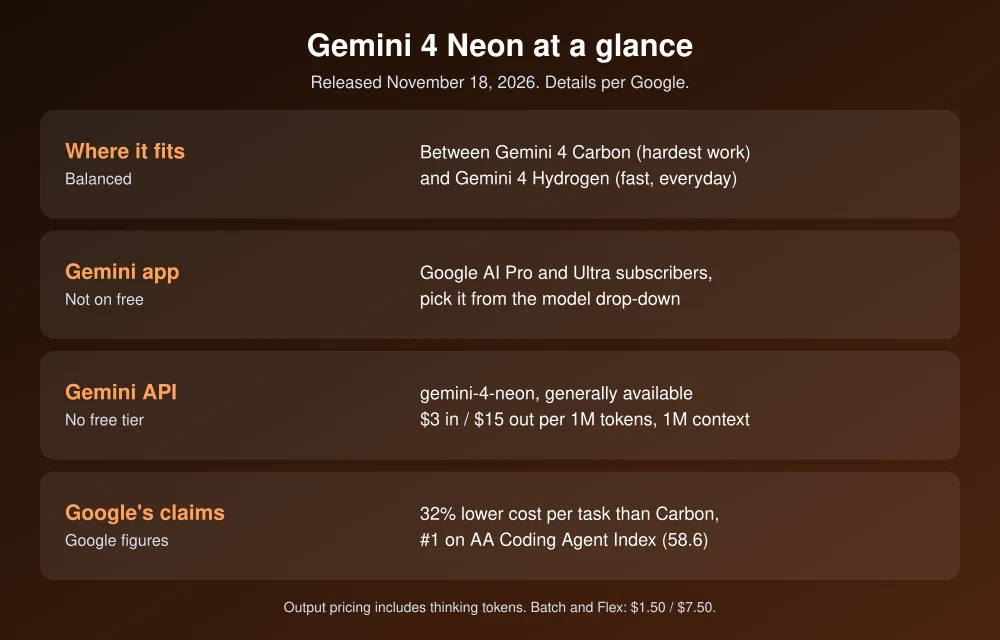
Quick answer: Gemini 4 Neon is Google’s mid-tier Gemini 4 model, released November 18, 2026. In the Gemini app it’s available to Google AI Pro and Ultra subscribers from the model drop-down, not on the free plan. In the Gemini API it’s generally available as gemini-4-neon at $3 per million input tokens and $15 per million output tokens, with a 1 million token context window and no free tier. It’s also in Google Antigravity for AI Pro and Ultra subscribers.
What Gemini 4 Neon is
In Google’s announcement, Neon is described as frontier-level intelligence with fast task completion across software engineering, knowledge work and science. Google places it like this:
- Gemini 4 Carbon: the heavyweight for your hardest, long-running projects.
- Gemini 4 Neon: the balance of depth and efficiency.
- Gemini 4 Hydrogen: fast everyday execution. Google says the free Tasks feature in the Gemini app runs on it.
Google also says that at its default high thinking level, Neon costs 32% less per task than Carbon.
Who can use Gemini 4 Neon
- Gemini app: Google AI Pro and Ultra subscribers can pick Gemini 4 Neon from the model drop-down. Google’s announcement doesn’t include free or AI Plus users.
- Google Antigravity: paid AI Pro and Ultra subscribers in the desktop app, CLI and IDE extensions. Businesses get it through Gemini for business.
- Gemini API and Google AI Studio: on the paid tier. There’s no free tier for Neon.
9to5Google reports that the app’s picker now labels Neon “Deeper analysis,” with Hydrogen as “Everyday help” and Carbon as “Code & complex work,” and that Neon replaces Gemini 4 Argon there. Google’s announcement doesn’t spell that out, so your picker may look slightly different.
Gemini 4 Neon API pricing
According to Google’s Gemini API pricing page:
| Tier | Input (per 1M tokens) | Output (per 1M tokens) |
|---|---|---|
| Standard | $3.00 | $15.00 |
| Batch and Flex | $1.50 | $7.50 |
| Priority | $5.40 | $27.00 |
Output pricing includes thinking tokens, so a request at a high thinking level can cost noticeably more than the visible answer suggests. Neon supports four thinking levels, from low to extra high, and a 1 million token context window. For comparison, Google lists Hydrogen at half Neon’s price, and Carbon and Argon at $2 input and $10 output through November 30, 2026, rising to $4 and $20 from December 1.
How good is it?
Google’s announcement leans on third-party leaderboards. By Google’s account, Neon scores 61 on the Artificial Analysis Intelligence Index (third overall at its highest thinking level), tops the Artificial Analysis Coding Agent Index at 58.6, and reaches 65.2% on Terminal-Bench 4.1. Those are Google’s figures, and independent testing over the next few weeks will show how they hold up. In Antigravity, Google says Neon has its lowest fabrication rate yet in internal testing, and it can plan while Hydrogen executes routine edits in the same session.
Should you switch to Neon?
- Gemini app users on Pro or Ultra: use Neon for research, long documents and analysis. Keep Hydrogen for quick everyday questions, and save Carbon for the hardest multi-step work.
- Developers: Neon makes sense when Hydrogen isn’t accurate enough but Carbon is overkill. Test with Batch pricing first if your workload isn’t real-time, and watch thinking-token costs.
- Free users: nothing changes for you with this release. The free Tasks feature runs on Hydrogen.
If you’re weighing subscriptions, compare with OpenAI’s new GPT-6.2 Astra and Sol models and our ChatGPT plans comparison. Gemini on Mac can now also take actions for you: see how to use Gemini computer use on Mac.
FAQs
Is Gemini 4 Neon free?
No. In the Gemini app it’s for Google AI Pro and Ultra subscribers, and in the Gemini API it’s only on the paid tier.
How much does the Gemini 4 Neon API cost?
Standard pricing is $3 per million input tokens and $15 per million output tokens, including thinking tokens. Batch and Flex are half that.
What’s the difference between Gemini 4 Neon, Carbon and Hydrogen?
Google positions Carbon for the hardest long-running work, Hydrogen for fast everyday tasks, and Neon in between, balancing depth and efficiency.
What is the Gemini 4 Neon context window?
Google lists a 1 million token context window shared by input, thinking and output.
Featured image: Google.
Disclosure: TheTechHacker has no paid relationship with Google or any company mentioned here.
More in News
Surfer SEO Pricing 2026: Every Plan Explained and Is It Worth It?
Surfer, long known as Surfer SEO, has rebuilt itself around AI search. It still has the Content Editor that made it popular with bloggers, but its main pitch in 2026 is tracking whether ChatGPT, Gemini, Perplexity and Google’s AI Overviews mention your brand. That change shows up in the pricing, which now starts at $49…
ElevenLabs Pricing 2026: Free Plan, Paid Plans and Voice Cloning Explained
ElevenLabs is the AI voice tool most people try first when they need realistic narration, a voiceover or a cloned voice. It has a free plan, but its credit system makes it hard to tell what each paid tier actually gets you. This guide explains ElevenLabs pricing in 2026, how many minutes of audio each…
Google’s November Pixel Drop Rolls Out With Gemini on Pixel 10, Custom Widgets and $29.99 Pixel Tag
Google's November 2026 Pixel Drop brings Gemini Intelligence to Pixel 10, custom widgets and a new Call Screen. Pixel Tag goes on sale Nov 11 for $29.99.
The week in tech, minus the noise.
New reviews, fixes and the stories that matter — once a week, straight to your inbox.
We only use your email to send the newsletter. Unsubscribe any time. See our privacy policy.
Comments