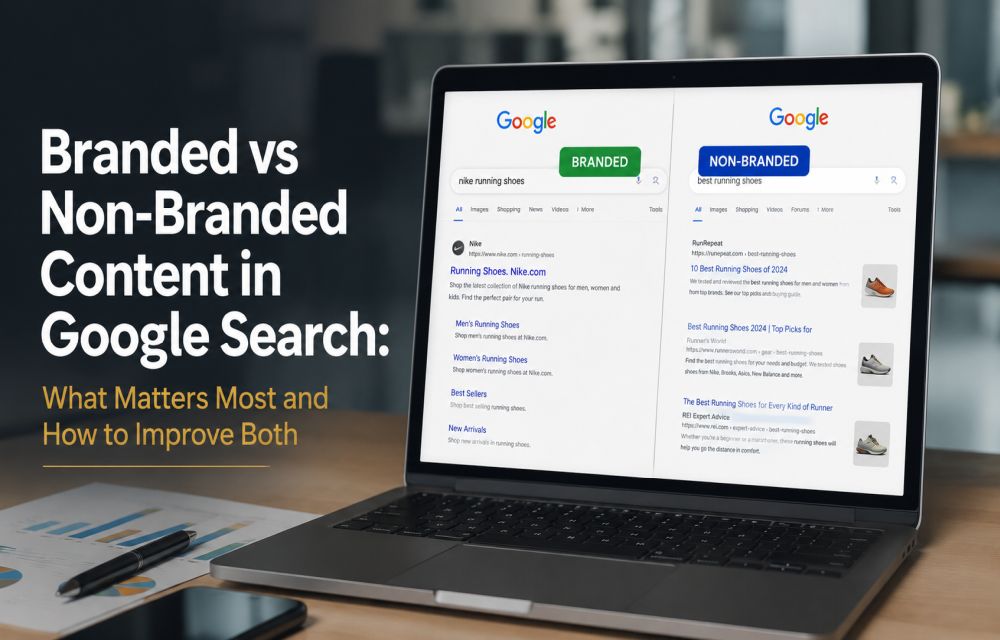
Recently I had a discussion with one of my clients during the SEO audit. She asked me the difference between the branded and non-branded content differences. Branded and non-branded content play different roles in search, and the smartest strategy is not choosing one over the other but knowing how each supports growth. Branded content helps people who already know your company find you faster, while non-branded content helps you reach new users who are still searching for answers, solutions, or comparisons.
In simple terms, branded content is tied to your name, product, or company identity. Non-branded content is built around broader search intent, such as “best SEO tools,” “how to fix iPhone Files app,” or “top video editing software for Windows.” Both matter, but they depend on different signals in Google Search.
What branded content depends on
Branded content depends mostly on brand awareness, authority, and trust. When someone searches your brand name, Google looks for signals that confirm your site is the right result. That means your homepage, about page, social presence, citations, reviews, and consistent brand mentions all matter.
If your brand is strong, branded searches become easier to rank and easier to control. This is especially important for a platform like TheTechHacker, because once people know your name, they should immediately find your best pages, services, and editorial pillars.
Branded content also depends on how well your brand is distributed across channels. If people see your name on social media, newsletters, guest posts, YouTube, or partner sites, Google gets more confidence that your brand is real and relevant. So branded SEO is not just about keywords; it is about building recognition.
What non-branded content depends on
Non-branded content depends more on search intent, topic depth, content quality, and competition. These pages are trying to rank for broader queries where many websites are competing for the same visibility. Google wants to know whether your content is truly the best answer for that search.
That means non-branded pages need strong on-page optimization, topic coverage, internal linking, structured headings, and clear usefulness. If you are writing “Top 5 SEO tools for agencies,” Google wants a page that feels researched, current, helpful, and organized.
Non-branded content also depends heavily on topical authority. If your site consistently publishes useful content around a subject like SEO, software, AI, or troubleshooting, Google starts trusting you more in that topic cluster. That improves your chances of ranking for new search terms over time.
Which one depends on what
Here is the simplest way to look at it:
-
Branded content depends on brand strength, trust, and recognition.
-
Non-branded content depends on keyword relevance, content quality, and topical authority.
Branded search is often easier to rank because users already know what they want. Non-branded search is harder because you are competing for attention from scratch. But non-branded content is usually what brings in new traffic first, and branded content is what helps convert and retain that audience later.
So the relationship is connected. Non-branded content creates discovery. Branded content creates loyalty and direct demand. A strong site needs both.
How to improve branded content
If you want better branded visibility in Google Search, start by strengthening your identity across the web. Make sure your brand name, logo, descriptions, and positioning are consistent everywhere. Your homepage should clearly explain what you do, who you help, and why your brand matters.
You should also build pages that support branded search intent. For example:
-
About page.
-
Contact page.
-
Services page.
-
Media kit.
-
Privacy policy.
-
Author pages.
-
Brand story page.
These pages help Google understand that your brand is credible and established. They also give searchers a better experience when they want to learn more about you.
Another important step is to create branded content around your own ecosystem. For TheTechHacker, that means making people remember your main pillars like Insights, Labs, and Digital. If those terms become associated with your brand, your branded search footprint becomes stronger.
How to improve non-branded content
To improve non-branded visibility, focus on solving real search problems better than others. Start with keyword research, but do not stop at keywords. Look at the intent behind the query. Ask what the user wants to know, compare, fix, buy, or learn.
Then create content that matches that intent fully. A strong non-branded page should include:
-
a clear title,
-
a direct intro,
-
useful subheadings,
-
examples,
-
comparisons where needed,
-
FAQs,
-
and a conclusion that answers the main query.
Your content should also be updated regularly. Non-branded topics, especially in tech and SEO, change quickly. If your article is outdated, Google may pass it over for a newer, more relevant page.
Internal linking matters too. Link related articles together so Google can understand your topic clusters. For example, an article about SEO tools can link to articles about keyword research, site audits, backlink checking, and content optimization. That builds authority around the subject.
What should come first
If you are building a newer brand, non-branded content usually comes first because it helps you get discovered. Once people start recognizing your name, branded content becomes more powerful.
If you already have a known brand, branded content becomes a major conversion asset. People search your name, compare your services, and look for proof that you are trustworthy. In that case, branded pages should be polished and easy to navigate.
The best approach is to grow both at the same time:
-
use non-branded content to attract new readers,
-
use branded content to strengthen identity and trust,
-
and use internal linking to move people between both.
TheTechHacker approach
For TheTechHacker, this balance is especially important. Your non-branded content can bring traffic from topics like software, AI, troubleshooting, digital marketing, and product comparisons. Your branded content can then make people remember TheTechHacker as a credible media and digital growth brand.
That is where your three-pillar structure works well:
-
Insights for discoverable content.
-
Labs for innovation and tools.
-
Digital for services and growth.
When these three work together, your site becomes more than a blog. It becomes a searchable brand system. That is the real advantage.
FAQ
What is branded content in Google Search?
Branded content is content tied to your company name, product name, or brand identity. It helps people find your business directly.
What is non-branded content?
Non-branded content targets broader search terms that are not tied to a specific brand. It helps you reach new audiences who are searching for information or solutions.
Which is easier to rank?
Branded content is usually easier to rank because the search intent is already specific. Non-branded content is more competitive because many sites target the same terms.
Why is non-branded content important?
It helps you attract new visitors, build topical authority, and grow awareness before people know your brand.
Why does branded content matter?
It strengthens trust, improves direct search visibility, and helps users find your official pages quickly.
Can one article support both?
Yes, if the topic naturally includes your brand name and also targets a broader search query. This can work well for service pages, product pages, and thought leadership content.
Leave a Reply