

Best Dedicated Server Hosting for Small Businesses (2026): InMotion, Liquid Web, OVHcloud and IONOS
I compared InMotion, Liquid Web, OVHcloud and IONOS for US small businesses and explain why Hetzner and Hostinger didn’t make the dedicated list. You’ll also see when you actually need a dedicated server and what managed support costs.


Photo by İsmail Enes Ayhan on Unsplash
With a dedicated server, you rent one physical machine and nobody else touches it. No other tenant shares the CPU, RAM or disks, so when some other site gets hammered by a traffic spike, you don’t feel it, because there’s no other site on the box. For some businesses, that isolation is the whole point.
For a lot of others, it’s overkill. A typical company website (contact form, a few service pages) runs fine on decent shared hosting or a VPS, and I covered those in the guide to the best web hosting for small business websites. This one’s for workloads that have actually outgrown them.
The shortlist: OVHcloud, Liquid Web, InMotion Hosting, IONOS, Hetzner and Hostinger. Two of them don’t sell dedicated servers in the US the way you’d expect. And several vendors quote different prices for the same plan on different pages of their own sites, which doesn’t help when you’re trying to compare. I’ve flagged each case below.
Quick answer: For most US small businesses, I’d start with InMotion Hosting. It has data centers in California and Virginia, prices that are actually published, and an optional Premier Care bundle with senior sysadmin support. Pick Liquid Web if you want the host to handle day-to-day server management, OVHcloud if your team can run the server itself and you want anti-DDoS built in, and IONOS if price matters most and you don’t mind verifying the details yourself. Hetzner’s US locations are cloud-only, and I couldn’t find a dedicated server product from Hostinger.
Dedicated server vs VPS: which one do you actually need?
A VPS (virtual private server) is a slice of a physical server. A hypervisor splits one machine into several virtual ones, and each runs its own operating system. Good VPS plans reserve CPU and RAM for you. Hostinger, for example, calls its VPS “a dedicated, isolated environment on a physical server” with root access (full admin control over the system).
A dedicated server, often called bare metal, skips the splitting. You get the whole box. Every core, all the memory, every disk.
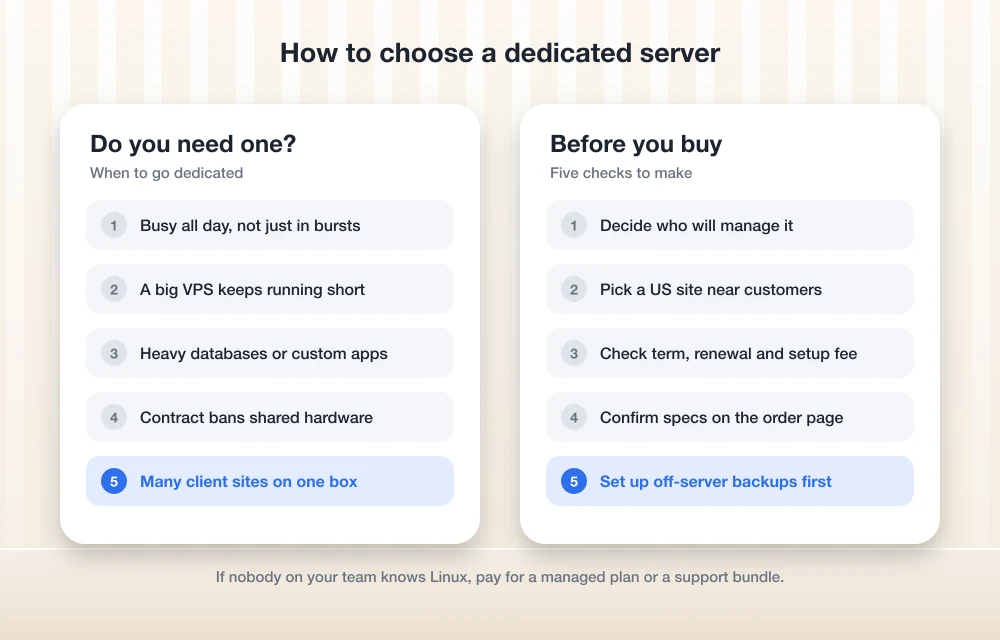
So when does dedicated hardware make sense?
- Your site or app is busy all day, not just in short bursts, and even a large VPS can’t keep up.
- You run heavy databases, a store with a big catalog, or custom business software that eats memory.
- A client contract or your own security policy says your data can’t share hardware with other customers.
- You host lots of client sites and want them all on one machine you control.
None of these sound like you? Stay on a VPS. It’s cheaper and usually easier to resize, while scaling up a dedicated server often means migrating everything to a new machine. Not fun.
Managed vs unmanaged: who keeps the server running?
For most small businesses, this matters more than which processor you get.
On an unmanaged (self-managed) server, the host keeps the hardware and network running, and that’s about it. Everything above that layer is yours: OS updates, security patches, firewall rules, control panel setup, backups.
On a managed server, the host’s team picks up much of the routine work. Liquid Web says it plainly on its managed dedicated page: “we handle the day-to-day management.” InMotion offers a similar safety net through its Premier Care bundles.
My rule is simple. If nobody on your team is comfortable at a Linux command line, pay for management. A cheap server that never gets patched isn’t a saving. It’s a liability.
The best dedicated server hosts for small businesses
1. InMotion Hosting
Best for: most US small businesses that want straightforward pricing and the option of expert help.
InMotion runs its dedicated servers out of data centers in California and Virginia, plus one location in Europe. It says they run “on infrastructure we own,” and plans scale up to 256 GB of RAM at a flat monthly price.
The entry plan, Aspire, is $35 a month on a 12-month term and renews at $49.99. InMotion lists it with 16 GB of DDR3 memory, a 1 TB SSD and one dedicated IP. DDR3 is an older memory generation, though. I’d treat Aspire as a starter box for a modest workload, not something you’ll grow into for years.
Above it sit Essential ($99.99/mo), Advanced ($149.99), Elite ($169.99) and Extreme ($349.99). One snag: InMotion’s main dedicated page and one of its own blog posts list different memory and storage for Essential. Check the spec on the order page before you pay.
For a small business, Premier Care is the option that matters most. On a 12-month term, Essential with Premier Care costs $218.98 a month, and the bundle includes cPanel Dedicated Premier (listed as a “$58.99/mo value”), Launch Assist onboarding (a “$199 one-time value”) and Tier 3 support from senior sysadmins. No in-house IT person? Then that support is really what you’re paying for.
Strengths
- US data centers on both coasts
- Prices are published, renewal rates included
- Premier Care adds senior sysadmin support plus onboarding help
- Lots of room to grow, up to 256 GB of RAM
Weaknesses
- The Aspire entry plan runs on older DDR3 memory
- Essential specs don’t match across InMotion’s own pages
- The best support costs extra
- You need a 12-month commitment for the $35 price
2. Liquid Web
Best for: businesses that want the host to do the server admin work.
Liquid Web now goes by “Liquid Web by Nexcess,” and its managed dedicated servers are built for owners who’d rather not touch the server at all. The pricing page lists InterWorx with unlimited sites, Plesk and cPanel as options, plus DDoS protection, root access, a dedicated IP and 10 TB of bandwidth.
The pricing is a mess. The managed dedicated page and the main pricing page show different numbers for what look like the same three tiers: $232, $503.50 and $622.25 a month on one, $219, $475 and $587 on the other. Another version of the pricing page showed a fully managed plan with an Intel Xeon E-2356G (6 cores at 3.2 GHz), 64 GB of RAM and a 793 GB SSD at $134 a month for the first two months, then $268. So treat all of these as numbers to verify, not quotes.
Bigger tiers go up to 16 cores with 1.7 TB of SSD storage, and 32 cores with 128 GB of RAM and 3.2 TB of SSD. There’s also a self-managed Cloud Dedicated option listed from $99 a month (Xeon E-2134, 4 cores, 12 GB RAM, 383 GB SSD), though another version of the page said $116.75.
It’s not the cheapest way to get a dedicated server. You’re paying for the host’s admin time. But if you don’t have an admin of your own, that’s often a trade worth making.
Strengths
- Fully managed, so the host handles daily server tasks
- DDoS protection and a dedicated IP listed as included
- You can pick InterWorx, Plesk or cPanel
- 10 TB of bandwidth on the plans reviewed
Weaknesses
- Prices don’t match across Liquid Web’s own pages
- Promo pricing doubles after the first two months
- Costs more than running a server yourself
3. OVHcloud
Best for: technical teams that will manage the server themselves and want DDoS protection built in.
OVHcloud says it has US data centers on the East and West coasts, and every dedicated server comes with anti-DDoS protection. A DDoS (distributed denial of service) attack floods a server with junk traffic until it goes offline, so getting mitigation by default is a real plus.
The range aimed at smaller companies is Advance, which OVHcloud pitches as “Versatile servers for small and medium businesses.” Its US bare-metal page says Advance servers go up to 1 TB of memory with a 99.95% SLA (service level agreement, the uptime the provider formally commits to). Public bandwidth runs from 1 to 5 Gbps, private from 1 to 6 Gbps.
Same pricing problem here. That page lists Advance “Starting at $98/month,” but the US Advance price list showed the Advance-3 model (AMD EPYC 4464P, 12 cores and 24 threads) from $255 a month, plus an installation fee equal to one month. The deals page? Dedicated servers from $66 a month, with free setup on some models. Check the live price list and the setup fee before you order.
I couldn’t confirm which managed support tiers OVHcloud offers on these servers, so assume you’re on your own. Fine if your team knows Linux. If it doesn’t, InMotion or Liquid Web is the safer bet.
Strengths
- US data centers on the East and West coasts
- Anti-DDoS protection on every dedicated server
- 99.95% SLA on the Advance range
- Large headroom, up to 1 TB of memory
Weaknesses
- Prices conflict across OVHcloud’s own pages
- Some models come with an installation fee
- Managed support options weren’t confirmed, so plan on running it yourself
4. IONOS
Best for: tight budgets, provided you verify the details yourself.
IONOS lists a lot of dedicated server deals under $100 a month. Its cheap dedicated servers page shows L-16 HDD at $47 a month, L-16 SSD at $51, L-32 SSD at $55, XL-32 SSD at $64, XL-32 NVMe at $73, XL-64 SSD at $78 and XL-64 NVMe at $90. The deals include firewall management, unlimited traffic and a Wildcard SSL certificate, which is one certificate that covers all your subdomains.
Read the storage labels carefully. HDD is a spinning hard drive, SSD is much faster flash storage, and NVMe is the fastest SSD interface of the three. If your site sits on a database, skip HDD.
The catch is everything IONOS’s official pages leave out: the CPU and full specs for each deal, the contract term, setup fees, whether the servers are in US data centers, and how much management is included. Those details decide whether a cheap server is actually a good deal. Get answers before you sign up.
Strengths
- Low monthly prices on lots of configurations
- Unlimited traffic
- Wildcard SSL and firewall management included
Weaknesses
- CPU and full specs weren’t clearly listed on the deals page
- Contract term, setup fees and data center locations not confirmed
- Not clear how much management you get
What about Hetzner and Hostinger?
Both made the shortlist. Neither works as a US dedicated server pick.
Hetzner’s locations documentation says its US sites in Ashburn, Virginia and Hillsboro, Oregon are for cloud products only, so you can’t order its dedicated root servers there. The closest thing is Cloud Dedicated AMD, which gives you dedicated vCPUs (virtual processor cores reserved for you) on a virtualized cloud server. Strong VPS-class product. Not bare metal, though. Hetzner’s actual dedicated servers appear to live in its European data centers.
Hostinger’s in a similar spot. I couldn’t find a dedicated server product on its official pages, and its top tier appears to be VPS with dedicated CPU and RAM. Hostinger hasn’t officially said it doesn’t sell dedicated servers, so check its menu yourself. For planning, I’d treat it as the “largest VPS” option and not a dedicated host.
Hetzner Cloud Dedicated AMD
Dedicated vCPUs in Ashburn or Hillsboro. A good fit if you want reserved resources in the US but don’t strictly need a physical server.
Hostinger VPS
Dedicated CPU and RAM plus root access on an isolated virtual server. Worth evaluating before moving to a full dedicated machine.
InMotion vs Liquid Web vs OVHcloud vs IONOS
Every figure below comes from the providers’ own published pages. No benchmarks.
| Feature | InMotion | Liquid Web | OVHcloud | IONOS |
|---|---|---|---|---|
| Management | Self-managed, or Premier Care with Tier 3 support | Fully managed | Treat as self-managed | Not confirmed |
| US data centers | California and Virginia | Not confirmed | East and West coasts | Not confirmed |
| Entry price seen on official pages | $35/mo (12-month term, renews at $49.99) | $219 to $232/mo managed (pages differ) | $98 to $255/mo (pages differ) | $47/mo |
| DDoS protection | Not confirmed | Yes | Yes | Not confirmed |
| Most RAM listed | 256 GB | 128 GB (largest tier I saw) | Up to 1 TB | Not confirmed |
| Best for | Most small businesses | Hands-off owners | Teams with Linux skills | Tight budgets |
Entry prices and renewal rates
Only InMotion and IONOS showed consistent prices across their official pages, so they’re the only ones getting plan cards. For Liquid Web and OVHcloud, go by the ranges above and check the live price.
InMotion Aspire
12-month term, renews at $49.99/mo
- 16 GB DDR3 memory
- 1 TB SSD
- 1 dedicated IP
InMotion Essential
Base list price
- Check memory and storage on the order page
- US data centers in California and Virginia
InMotion Essential + Premier Care
12-month term
- cPanel Dedicated Premier
- Launch Assist onboarding
- Tier 3 support from senior sysadmins
IONOS L-16 SSD
Contract term and setup fees not confirmed
- Unlimited traffic
- Wildcard SSL certificate
- Firewall management
IONOS XL-32 NVMe
Contract term and setup fees not confirmed
- NVMe storage
- Unlimited traffic
- Wildcard SSL certificate
IONOS XL-64 NVMe
Contract term and setup fees not confirmed
- NVMe storage
- Unlimited traffic
- Firewall management
Prices come from InMotion’s and IONOS’s official pricing pages at the time of writing. Hosting prices change often, so check the live page before buying.
How to choose a dedicated server in five steps
Confirm you’ve outgrown a VPS
Check whether your current plan runs out of CPU or memory during normal business hours, not just during an occasional spike.
Decide who will manage it
If nobody on your team can patch and harden a Linux server, budget for a managed plan or a support bundle like Premier Care.
Pick a US location near your customers
Choose an East or West coast data center based on where most of your visitors are, and confirm the location before paying.
Read the fine print
On the order page, check the contract term, the renewal price and any setup or installation fee.
Set up off-server backups before launch
Send regular copies of your files and databases off the server, for example to one of the best cloud storage services for business.
Matching the host to your team and workload
If you’re a small US business setting up a dedicated server today, start with InMotion. It’s got US data centers on both coasts, pricing that actually holds together, and Premier Care gives a non-technical owner senior admins to call when something breaks.
Want to hand off server work entirely? Get a live quote from Liquid Web, since full management is its core product. A team with solid Linux skills gets a lot of hardware for the money from OVHcloud, with anti-DDoS thrown in. IONOS is worth a look on price, but only once you’ve confirmed the specs, the term and the location.
Still undecided? Move to a bigger VPS first. Hetzner’s US cloud and Hostinger’s VPS plans suit businesses that need reserved resources without renting a whole machine, and you can always migrate to dedicated hardware later.
Frequently Asked Questions
What’s the difference between a VPS and a dedicated server?
A VPS is a virtual slice of a physical server, sometimes with CPU and RAM reserved just for you. A dedicated server (bare metal) is the entire physical machine. No other customer shares its hardware.
Does Hetzner offer dedicated servers in the US?
No. Hetzner’s own documentation says its US locations in Ashburn, Virginia and Hillsboro, Oregon are cloud-only. The closest US option is Cloud Dedicated AMD, which gives you dedicated vCPUs on a virtualized server, not bare metal.
Does Hostinger sell dedicated servers?
Not that I could find. Its official pages top out at what appears to be VPS hosting with dedicated CPU and RAM. Hostinger hasn’t confirmed either way, though, so check its current product menu.
Do small businesses need managed dedicated hosting?
If nobody on your team is comfortable updating, patching and securing a Linux server, yes. Managed plans like Liquid Web’s, or InMotion’s Premier Care bundle, put experienced admins in charge of the day-to-day work so you don’t have to be.
How much does a dedicated server cost for a small business?
On the official pages I checked, entry prices started at $35 a month (InMotion Aspire on a 12-month term, renewing at $49.99) and $47 a month (IONOS L-16 HDD), while managed plans ran over $200 a month. Prices change often, so confirm on the vendor’s live pricing page.
Featured image: İsmail Enes Ayhan on Unsplash.
Disclosure: TheTechHacker has no paid relationship with the companies in this article.
You might also like

10 Best Reseller Hosting Services
There are many reasons why reseller hosting services are better, and one of them is allowing you access to multiple cPanels. In addition, they offer more flexibility and control than shared hosting services. You can create your own hosting packages and set your own prices with a reseller account. You also can manage your own…

Best Web Hosting for Small Business Websites (2026)
How to choose web hosting for a US small business site, from shared and managed WordPress plans to cloud servers and website builders, plus the renewal-price traps to avoid and how to migrate safely.
Top WordPress Hosting Providers
This is a Guest Post from the MilesWeb team and the relevancy of the details are sorted by them. Thetechhacker opinions may/may not differ from what you have seen in this post. No matter whether you are creating a blog or starting an e-commerce business when it comes to website creation hosting is the first…
The week in tech, minus the noise.
New reviews, fixes and the stories that matter — once a week, straight to your inbox.
We only use your email to send the newsletter. Unsubscribe any time. See our privacy policy.
Comments