

Palo Alto Warns Fragnesia Flaw Is Being Exploited in PAN-OS Attacks: Fixed Versions and What to Do
Attackers chain PHP2Shell and Fragnesia against internet-exposed PAN-OS management interfaces. Fixed builds for 10.2 to 12.2 and the steps to take now.


Palo Alto Networks says attackers are exploiting a Linux kernel flaw called Fragnesia against PAN-OS firewalls. Every attack the company has seen targeted firewalls whose management interface is reachable from the internet. Fixes are out for PAN-OS 10.2, 11.1, 11.2, 12.1 and 12.2.
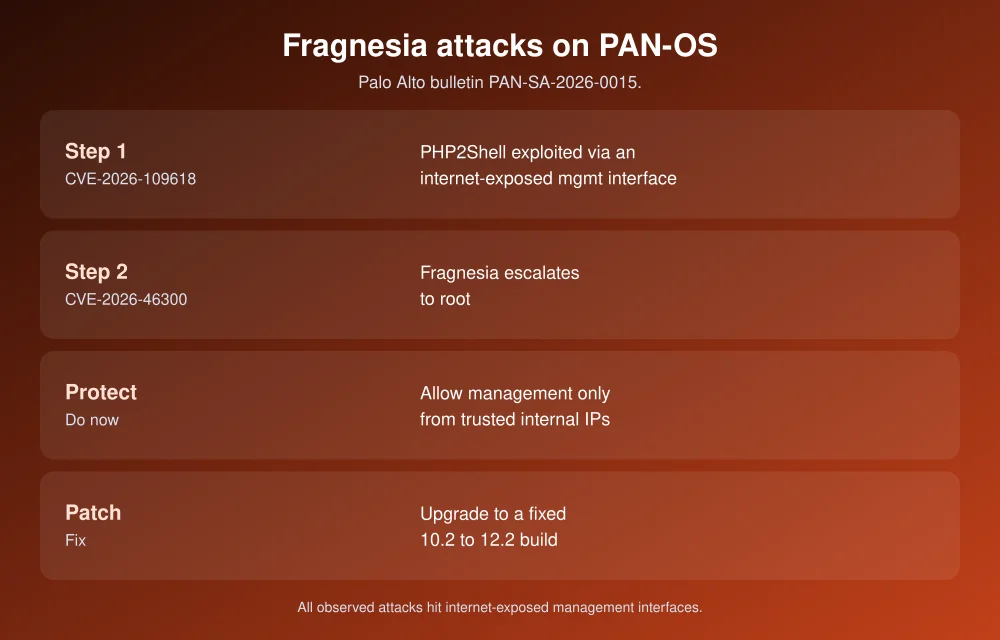
Quick answer: Fragnesia (CVE-2026-46300) is a Linux kernel privilege escalation bug. Palo Alto’s bulletin PAN-SA-2026-0015 confirms exploitation against PAN-OS management interfaces exposed to the internet. Attackers first exploit the PHP2Shell flaws (CVE-2026-109618 and CVE-2026-109619), then use Fragnesia to get root, BleepingComputer reports. If you’re already on a PAN-OS build fixed for CVE-2026-109618, Palo Alto says you’re protected. Still upgrade to a release listed below, and restrict the management interface to trusted internal IP addresses.
What Palo Alto Networks Confirmed
- The PAN-SA-2026-0015 bulletin was published on November 25, 2026.
- Exploitation of CVE-2026-46300 has been seen against management interfaces exposed to the internet.
- The only known way to exploit it is to first exploit PHP2Shell through an internet-facing management interface. Palo Alto knows of no other method.
- If the management interface is limited to trusted internal IP addresses, Palo Alto says the risk is significantly reduced.
Fixed PAN-OS Versions
These builds and all later versions contain the fix, according to Palo Alto:
| Release | Fixed builds |
|---|---|
| PAN-OS 10.2 | 10.2.7-h41, 10.2.10-h45, 10.2.13-h29, 10.2.16-h14, 10.2.18-h15 |
| PAN-OS 11.1 | 11.1.4-h40, 11.1.6-h42, 11.1.7-h14, 11.1.10-h38, 11.1.13-h18, 11.1.16-h6 |
| PAN-OS 11.2 | 11.2.4-h25, 11.2.7-h25, 11.2.10-h19, 11.2.13-h6, 11.2.16-h3 |
| PAN-OS 12.1 | 12.1.4-h15, 12.1.7-h15, 12.1.10-h6 |
| PAN-OS 12.2 | 12.2.4-h3 |
What Admins Should Do Now
- Find exposed interfaces. Check whether any firewall’s management interface, or a dataplane interface with a management profile attached, can be reached from the internet.
- Restrict access. Allow management access only from trusted internal IP addresses, as Palo Alto’s administrative access best practices recommend.
- Upgrade. If the interface is exposed, Palo Alto says to upgrade immediately. If it isn’t, upgrade at your next maintenance window.
- Confirm the PHP2Shell fix. Make sure you’re on a build fixed for CVE-2026-109618, which blocks the first step of the chain.
- Check for compromise. If a device was exposed, look for unexpected admin accounts, config changes and unknown files. Bring in your incident response team if anything looks wrong.
Background: Who Else Is Being Targeted
CISA warned on October 28 that Fragnesia and PHP2Shell were being chained to install PHP web shells and run commands as root, BleepingComputer reports. Dream Security researchers reported the same chain hitting servers in the United States, Japan, Taiwan and South Korea, including a US government affiliate. Track exploited flaws in CISA’s Known Exploited Vulnerabilities catalog.
Other urgent patches this week: VMware vCenter CVE-2026-123903 and the Chrome zero-day. Also see what the CrowdStrike and Zscaler deal means for customers.
FAQs
What is Fragnesia?
CVE-2026-46300, a Linux kernel flaw in the XFRM ESP-in-TCP subsystem that lets a low-privileged local attacker gain root, BleepingComputer reports.
Are all PAN-OS firewalls at risk?
Palo Alto says all observed attacks targeted management interfaces exposed to the internet. Restricted interfaces face much lower risk.
Which PAN-OS versions fix Fragnesia?
Builds listed in PAN-SA-2026-0015, such as 10.2.18-h15, 11.1.16-h6, 11.2.16-h3, 12.1.10-h6 and 12.2.4-h3, and later.
Am I safe if I patched PHP2Shell?
Palo Alto says a PAN-OS build fixed for CVE-2026-109618 protects you, but it still recommends upgrading.
Featured image: Palo Alto Networks.
Disclosure: TheTechHacker has no paid relationship with Palo Alto Networks.
More in News

November 2026 Patch Tuesday: Outlook Zero-Day Fixed, USB Audio Code 10 Bug Finally Solved
Patch Tuesday landed on November 10 this month, and for once the Outlook part of the release matters more than the Windows part. Microsoft fixed a spoofing bug in Outlook (CVE-2026-124194) that it says was already being exploited before the patch was ready, and that fix doesn’t come through Windows Update at all, it comes…

Update Chrome Now: Google Fixes Actively Exploited Zero-Day CVE-2026-125350
Google fixed an actively exploited Chrome zero-day, CVE-2026-125350. Which versions fix it, how to update Chrome on every device, and Edge and Brave fixes.

How to Fix Java4Shell (CVE-2026-114938): Check Your Java Version and Update
Oracle patched a serious Java flaw on November 17, 2026, and security researchers have nicknamed it Java4Shell. Tracked as CVE-2026-114938, it affects Java 17, 21, 25 and 27 and can be exploited over a network without a password. If you run Java on a server, a laptop or inside a container, the fix is simple:…
The week in tech, minus the noise.
New reviews, fixes and the stories that matter — once a week, straight to your inbox.
We only use your email to send the newsletter. Unsubscribe any time. See our privacy policy.
Comments