

ULA’s Vulcan Fails to Reach Orbit With 40 Amazon Leo Satellites
ULA says Vulcan suffered an anomaly 10 minutes after liftoff on Nov 15 and failed to deliver 40 Amazon Leo satellites to orbit. Timeline, statements and what is next.

United Launch Alliance’s Vulcan rocket failed to put 40 Amazon Leo broadband satellites into orbit on Sunday, November 15, 2026, after what ULA called “an anomaly 10 minutes into the flight.” The rocket lifted off from Space Launch Complex 41 at Cape Canaveral Space Force Station, Florida, at about 12:40 p.m. EST on the first Amazon Leo mission to fly on Vulcan. ULA said it does not yet know what went wrong and will investigate with its customer.
Quick answer: Vulcan’s Leo 1 (LV-01) mission failed to reach orbit, so the 40 Amazon Leo satellites on board were not delivered. ULA confirmed the anomaly about 10 minutes after liftoff but has not named a cause. Amazon called ULA “a trusted partner” and said it expects ULA to learn from the flight. No date has been given for Vulcan’s next launch.
What ULA said
ULA posted its statement about 50 minutes after liftoff. “Based on data received by our Launch Director, we confirm that the Vulcan vehicle launched from Space Launch Complex 41 suffered an anomaly 10 minutes into the flight and failed to deliver the Amazon mission to orbit,” the company said in its official statement.
The company added that “since the anomaly just occurred, we don’t have any specific data yet to understand what occurred today.” ULA said it holds itself to the standard of mission success and that “today, we did not meet that standard.” It said it will work with Amazon and “other appropriate organizations” to find the cause and corrective action, and that customers will have visibility into the investigation.
ULA has not said which stage of the rocket was involved. Any explanation circulating before the company’s investigation reports should be treated as unconfirmed.
How the launch unfolded
ULA’s own countdown updates give the sequence:
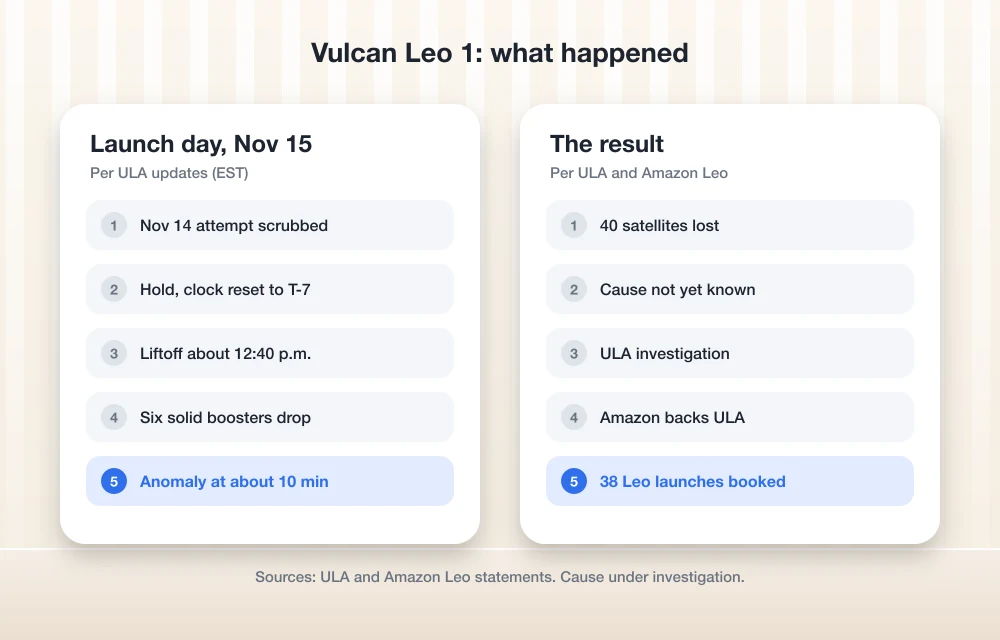
- November 14: The first attempt was called off because of “a network communication issue between the ground equipment and the launch vehicle,” and the fix would have run past the 29-minute window.
- November 15, morning: Fueling began, with ULA reporting a “green board.” Weather was forecast GO for a 12:11 p.m. EST liftoff.
- Countdown hold: At about 12:13 p.m., ULA stopped the countdown and recycled the clock to T-minus 7 minutes.
- Liftoff: Vulcan launched at about 12:40 p.m. EST, near the end of the window. ULA then confirmed burnout and jettison of the six GEM 63XL solid rocket boosters.
- Anomaly: About 10 minutes into the flight, the mission failed. ULA confirmed the failure at about 1:30 p.m.
The rocket was a Vulcan VC6L, which ULA says stands 215 feet tall and produces 3.9 million pounds of thrust at liftoff from two BE-4 main engines and six solid boosters. According to Amazon, LV-01 was also the first flight of Vulcan’s six-booster setup and of a shortened Centaur V upper stage built for low Earth orbit.
What Amazon said
Amazon Leo responded about 40 minutes after ULA’s statement. “There is risk with any launch, and that’s especially true for inaugural missions like LV-01,” the company said. “ULA has been a trusted partner for Amazon, and we believe they’ll learn from this mission and deliver on their long-term plans for Vulcan.”
Amazon has not said whether the lost satellites change its plans to start Leo service. Its mission page, last updated before the flight, said initial service was expected later in 2026.
Why this flight mattered for Amazon Leo
Amazon Leo, formerly Project Kuiper, is Amazon’s satellite internet network and its answer to SpaceX’s Starlink. Vulcan is central to building it. Amazon says ULA holds 38 Vulcan launches for the program, carrying about 1,500 first-generation satellites. “Vulcan will launch close to half our first-generation constellation,” Melissa Wuerl, Amazon Leo’s director of launch systems, said before the flight.
Before the failure, Amazon said the next Vulcan mission, LV-02, was expected within weeks of a successful LV-01. That timeline now depends on ULA’s investigation. As of its November 14 update, Amazon’s next launch on another rocket was an Ariane 6 mission, LE-04, targeted for no earlier than November 23 from French Guiana. Amazon has not said whether that date has changed.
What happens next
- Investigation: ULA says it will find the cause and fix it before Vulcan flies again. It has not given a return-to-flight date.
- Other customers: Vulcan also flies US national security missions. ULA has not commented on how the failure affects those launches.
- Amazon’s schedule: Amazon has not announced changes to its service timeline. We will update this story when ULA or Amazon shares more.
The failure comes days after a busy stretch for US spaceflight and air travel. SpaceX caught a Starship upper stage with its launch tower for the first time, and a separate FAA network problem caused a nationwide ground stop. For more of this week’s tech news, see our report on Tesla opening Cybercab orders.
FAQs
What happened to the Vulcan rocket carrying Amazon Leo satellites?
ULA says the Vulcan rocket suffered an anomaly about 10 minutes after its November 15, 2026, liftoff from Cape Canaveral and failed to deliver its 40 Amazon Leo satellites to orbit.
What caused the Vulcan launch failure?
The cause is not known yet. ULA said it did not have specific data right after the flight and will investigate with Amazon and other appropriate organizations.
How many Amazon Leo satellites were on the Vulcan rocket?
The LV-01 mission carried 40 Amazon Leo satellites, which Amazon described as its largest Leo payload to date.
Will the failure delay Amazon Leo internet service?
Amazon has not said. Before the launch, it expected initial service later in 2026 and planned its next Vulcan launch within weeks of a successful LV-01.
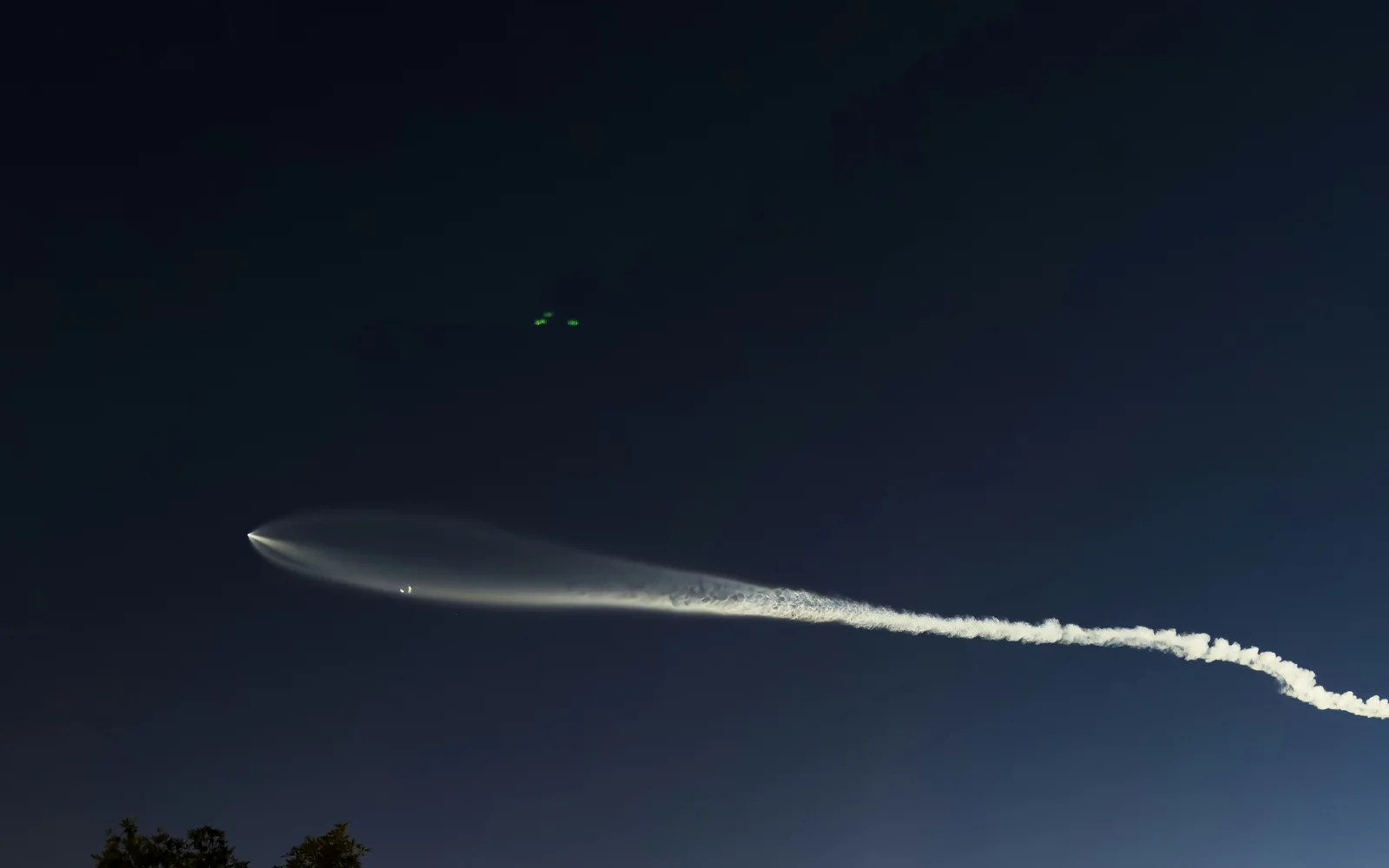
Featured image: Johnathan Kaufman on Unsplash. The photo shows a rocket launch trail and is not an image of this Vulcan flight.
Disclosure: TheTechHacker has no paid relationship with ULA, Amazon or any company mentioned here.
More in News

Papa Johns Is Using AI to Check Your Delivered Pizza, and Paying You in Pizza for Photos
Papa Johns asks customers to photograph delivered pizzas for AI quality checks and gives a free pizza in return. How it works, the rules and the AI details.
Is There a Blackout on November 17? No, It Is a Nationwide Emergency Alert Test
There is no November 17 blackout. FEMA and the FCC will test the Emergency Alert System on TV and radio at about 2:20 p.m. ET. Times, phones and what to do.

Anthropic IPO: 825 Million Shares at $70 to $78 Under Ticker ANT, S-1 Shows
Anthropic plans to sell 825M shares at $70 to $78 under ticker ANT on Nasdaq. Offering terms, revenue, losses, ownership structure and reported dates from the S-1.
The week in tech, minus the noise.
New reviews, fixes and the stories that matter — once a week, straight to your inbox.
We only use your email to send the newsletter. Unsubscribe any time. See our privacy policy.
Comments