

SpaceX Catches a Starship Upper Stage With Its Launch Tower for the First Time
On Starship Flight 15, SpaceX caught the upper stage with its launch tower after 22.5 hours and 26 Starlink deploys. The booster diverted to the Gulf.

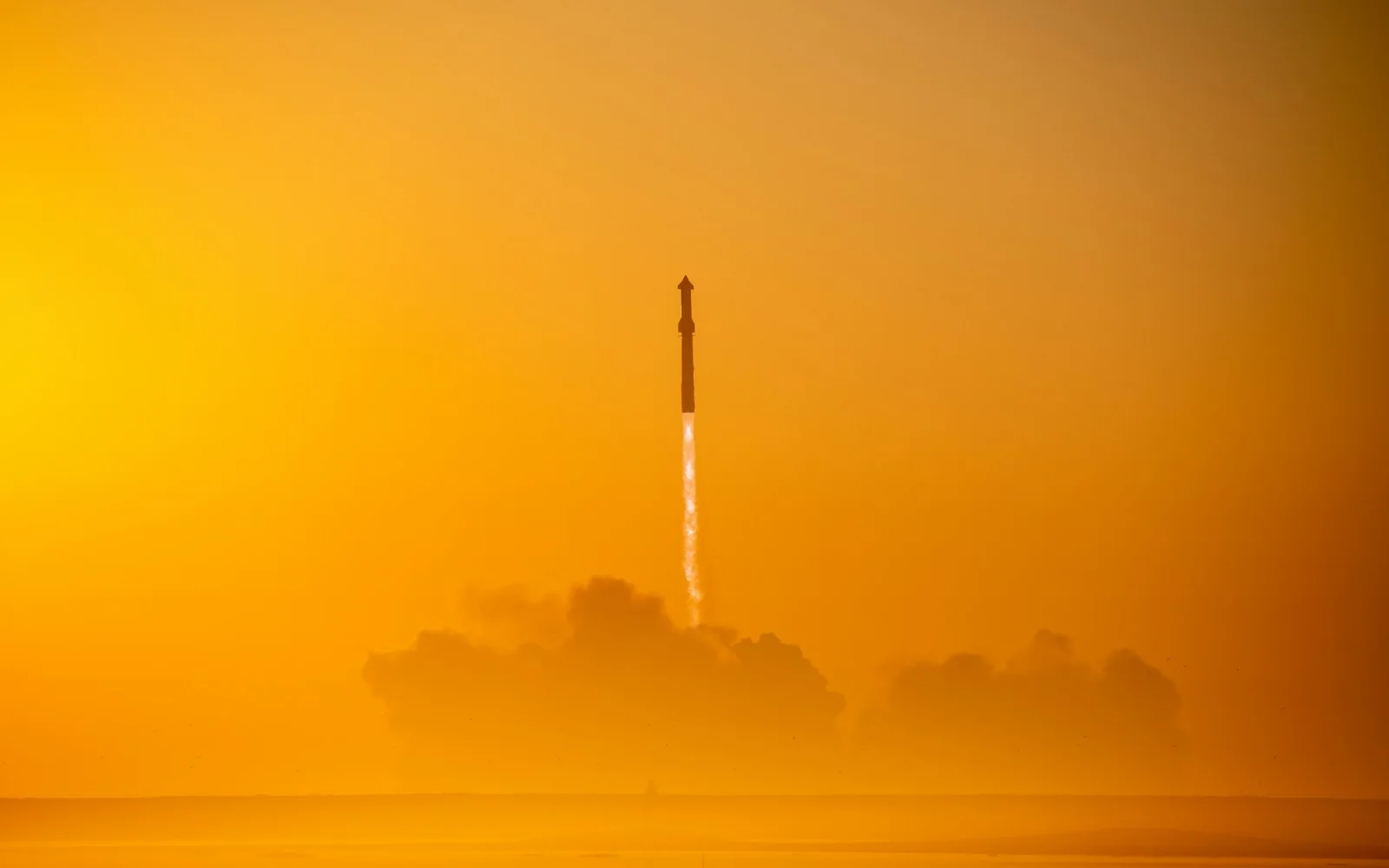
SpaceX caught a returning Starship upper stage with its launch tower for the first time on Saturday, November 14, at Starbase, Texas. The ship landed in the tower’s mechanical arms about 22.5 hours after it lifted off on Starship’s 15th test flight, after orbiting Earth and deploying 26 Starlink satellites. The Super Heavy booster did not return to the tower as planned. It diverted to an offshore landing in the Gulf after its boostback burn ended early because of low fuel.
Quick answer: On Starship Flight 15, which launched November 13, 2026, SpaceX’s upper stage reached orbit, deployed 26 Starlink V3 satellites, spent more than 20 hours in space, and then returned to Starbase, where the launch tower’s arms, nicknamed Mechazilla, caught it for the first time. The booster cut its boostback burn short due to low fuel mass, diverted to an offshore landing in the Gulf, and was then destroyed by its flight termination system. SpaceX says the root cause of the booster issue is under investigation.
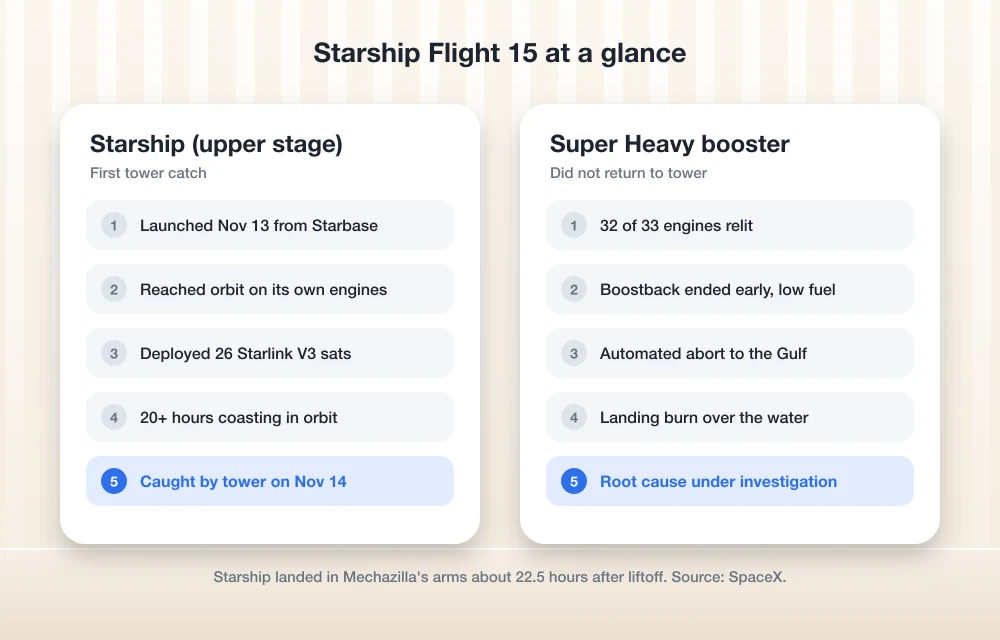
What happened on Flight 15
According to SpaceX’s Starship Flight 15 mission page, the vehicle lifted off from Pad 2 at Starbase on Friday, November 13, powered by the Super Heavy booster’s 33 Raptor engines. After hot-staging, the Starship upper stage continued to space on six engines, then relit a single Raptor engine for an orbital insertion burn.
Once in orbit, Starship deployed 26 Starlink V3 satellites. SpaceX said it made contact with every satellite and that they were beginning to raise their orbits to join the Starlink constellation.
The ship then coasted around Earth for more than 20 hours while flight controllers monitored its systems. It relit one sea-level Raptor engine for a deorbit burn, reentered the atmosphere and flew back toward the Texas coast. After a final maneuver over the Gulf, three engines ignited for a landing flip and slow descent, and the tower’s arms closed to catch it. SpaceX wrote that Starship “changed everything” when it returned.
| Time after liftoff | Event |
|---|---|
| 0:00:58 | Max Q, peak aerodynamic stress |
| 0:02:21 | Hot-staging and stage separation |
| 0:26:10 | Orbital insertion burn starts |
| 0:35:01 to 1:17:40 | Starlink satellite deployment |
| 21:35:57 | Deorbit burn starts |
| 22:10:46 | Starship reenters the atmosphere |
| 22:32:34 | Landing burn ends and the tower catches Starship |
The times are approximate and come from SpaceX’s published flight timeline.
What went wrong with the booster
The mission did not achieve a catch of both stages. SpaceX said the booster relit 32 of its planned 33 engines for the boostback burn, which “ended early due to low fuel mass.” The booster’s guidance system triggered an automated abort and diverted to an offshore landing location, where it performed a landing burn and hovered over the Gulf before its engines cut off. The flight termination system was then triggered. SpaceX said the root cause is under investigation.
Why the catch matters
SpaceX has caught Super Heavy boosters with the tower on earlier flights, but the upper stage is the harder part. It has to survive reentry from orbit before landing. Catching it at the launch site, instead of letting it splash down in the ocean, is a key step toward SpaceX’s goal of a fully reusable rocket that can be refueled and flown again quickly, which the company says would sharply cut the cost of reaching orbit.
On its Starship vehicle page, SpaceX describes the system as fully reusable and designed to carry crew and cargo to Earth orbit, the Moon and Mars. Starship is also central to NASA’s plans to return astronauts to the lunar surface.
For consumers, the most direct effect is on Starlink. Flight 15 carried 26 of the larger V3 satellites, and a reusable Starship would let SpaceX launch them in bigger batches. Our report on SpaceX and Qualcomm’s Starlink mobile network covers where that network is heading, and our comparison of 5G home internet vs cable vs fiber looks at how Starlink fits into home internet choices today.
What comes next
SpaceX has not announced a date for Starship Flight 16 on its mission page. It also has not said publicly when it will fly a caught upper stage again or attempt to catch both stages on the same flight. Separately, Tesla, another Elon Musk company, began taking personal orders this week for its driverless car, as we reported in our story on Tesla’s Cybercab orders.
FAQs
Did SpaceX catch Starship?
Yes. On November 14, 2026, SpaceX caught the Starship upper stage with its launch tower’s arms at Starbase, Texas, for the first time, about 22.5 hours after Flight 15 launched.
What happened to the Super Heavy booster on Flight 15?
Its boostback burn ended early due to low fuel mass. The booster diverted to an offshore landing in the Gulf, performed a landing burn, and was then destroyed by its flight termination system. SpaceX is investigating the cause.
How many Starlink satellites did Starship Flight 15 deploy?
Starship deployed 26 Starlink V3 satellites, and SpaceX said it made contact with all of them.
When is the next Starship launch?
SpaceX has not announced a date for Flight 16. Check SpaceX’s launches page for updates.
Featured image: nader saremi on Unsplash.
Disclosure: TheTechHacker has no paid relationship with SpaceX or any company mentioned here.
More in News
FAA Says New Router Traffic Flooded Its Network, Causing Nationwide Ground Stop
The FAA says a data flood tied to new router work destabilized its network, forcing the Nov 13 ground stop and 12,462 cancellations. Your DOT refund rights.
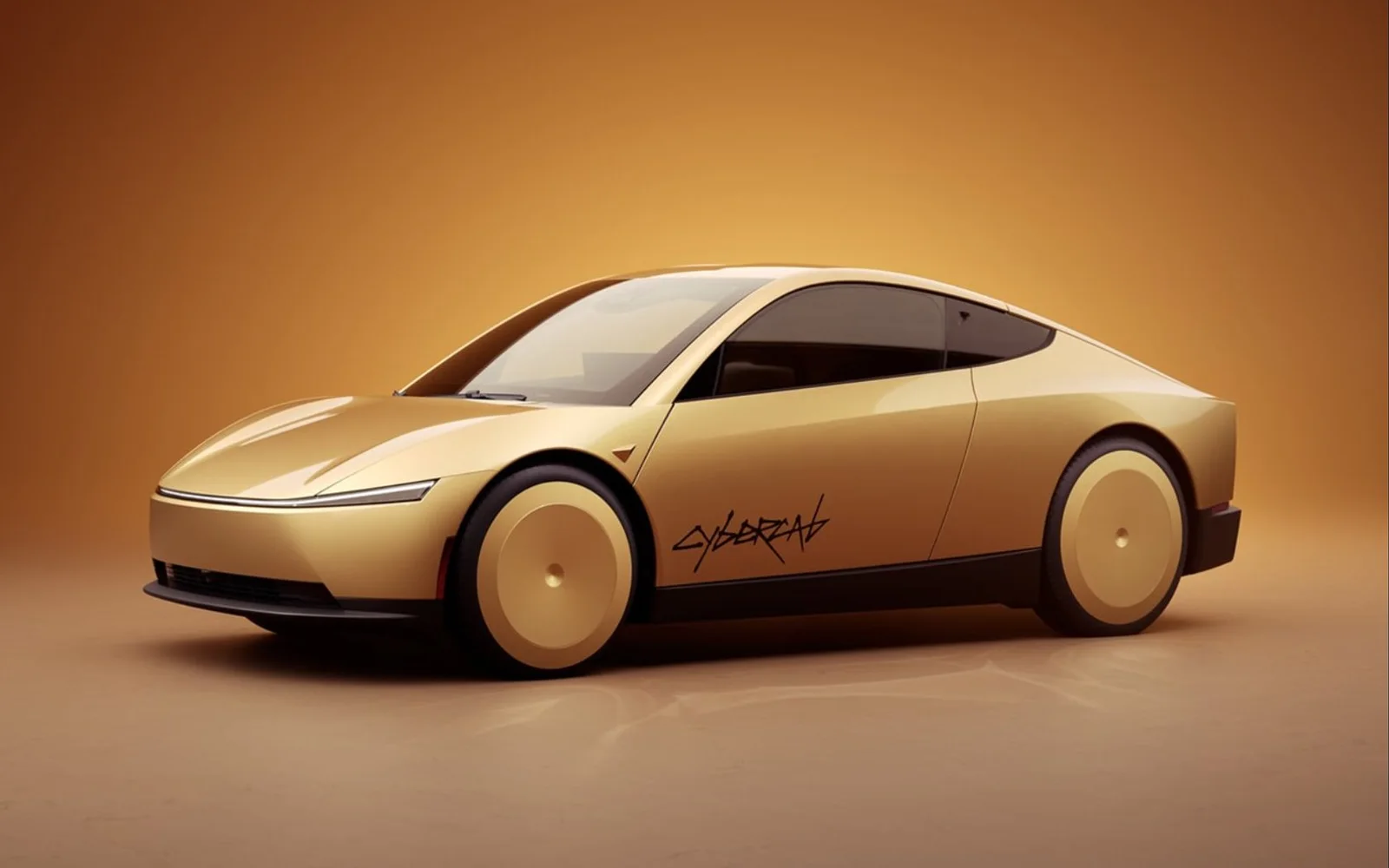
Tesla Opens Cybercab Orders to Select Buyers at $29,990 Plus $299 a Month
Tesla is inviting select buyers to order the Cybercab for $29,990 plus a required $299/month Autonomy Subscription, with delivery estimated for December 2026.

GTA 6 Launch Festival in Miami: Lineup, Tickets and Entry Rules
GTA 6: The Festival hits Mana Wynwood, Miami on Nov 21 with Travis Scott, Cardi B and Metro Boomin. Tickets, the DICE waitlist, age and ID rules.
The week in tech, minus the noise.
New reviews, fixes and the stories that matter — once a week, straight to your inbox.
We only use your email to send the newsletter. Unsubscribe any time. See our privacy policy.
Comments