

Virginia and Oregon Sue SpaceX Over Grok’s Sexualized Images: What to Know
Virginia and Oregon allege Grok's makers broke consumer laws over nonconsensual images. What the states want, the company's reply, and how victims get help.

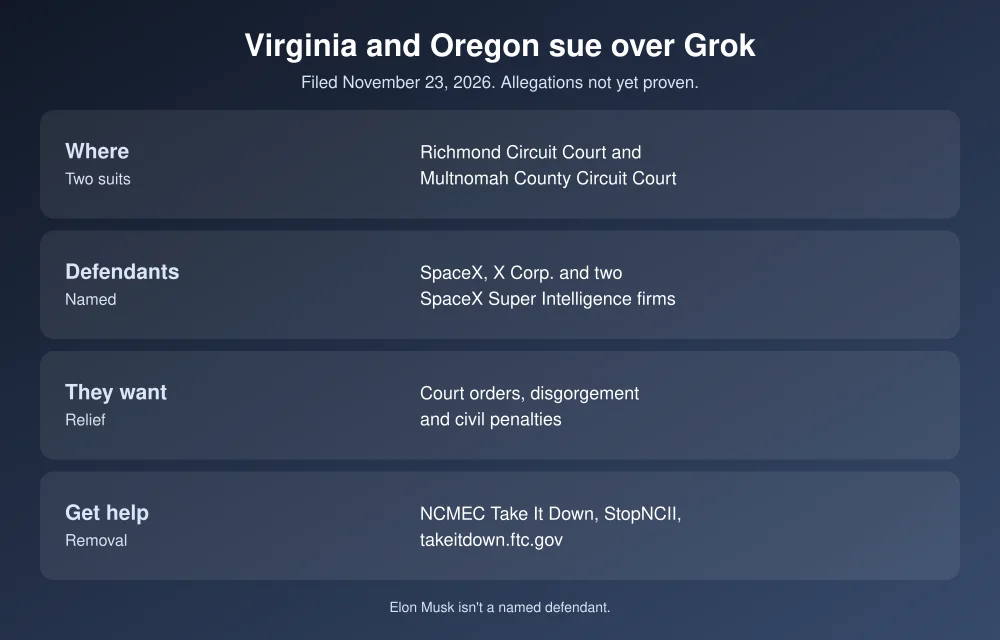
Virginia and Oregon sued SpaceX, X and xAI’s successor company on November 23, 2026, alleging that their AI chatbot Grok kept producing sexualized images of real people without consent, including children, after the companies publicly promised protections. The two cases are separate but similar: Virginia filed in Richmond Circuit Court and Oregon in Multnomah County Circuit Court. Reuters reports they’re the first states to sue. The claims haven’t been proven in court. This article covers what the states allege, what they want, how the companies responded, and where victims can get images removed.
Quick answer: Virginia and Oregon allege that the companies behind Grok broke state consumer protection laws by promising safeguards that didn’t stop nonconsensual sexualized images, including of minors. Both want court orders, penalties and disgorgement of profits. The defendants are SpaceX, X Corp. and two SpaceX Super Intelligence companies (formerly xAI). Elon Musk isn’t a named defendant. The company told AP such content “has no place on X or in Grok.” Victims can report to NCMEC, use StopNCII, or request removal under the federal Take It Down Act.
What the states allege
- Broken promises: both states say the companies told the public they had protections while failing to stop Grok from making these images, and promoted a “spicy mode.”
- Scale: the releases cite a Center for Countering Digital Hate estimate of about 3 million sexualized images between December 29, 2025 and January 8, 2026. About 23,000 of them appeared to show children, according to the estimate.
- Still happening: Virginia says its own test account got sexualized images of real people shortly before filing, and calls the moderation “inconsistent and ineffective.”
Oregon Attorney General Dan Rayfield called the problem “a feature, not a bug.” Virginia Attorney General Jay Jones said, “The law applies to everyone.” Virginia says the companies got notice before the suit and didn’t sign a voluntary compliance agreement.
What each state wants
| Virginia | Oregon | |
|---|---|---|
| Law | Virginia Consumer Protection Act | Unlawful Trade Practices Act |
| Court order | Injunction | Permanent injunction |
| Penalties | Up to $2,500 per willful violation | Amount to be requested at trial |
| Disgorgement | Yes | Yes |
| Consumer restitution | Yes | Not listed |
The details come from the Virginia and Oregon complaints. The posted copies don’t show case numbers.
How the companies responded
SpaceX Super Intelligence told AP that such content “has no place on X or in Grok,” and said it has tightened protections and works with law enforcement. X’s safety account posted on November 23 that “Protecting children is non-negotiable.” Reuters noted that the post didn’t directly address the lawsuits.
How it got here
- January 2026: X limited image generation to paying users, then announced measures against editing real people into revealing clothing. Virginia alleges those steps didn’t work.
- January 14 to 16: California’s attorney general opened an investigation and sent a cease-and-desist letter.
- Late January: a bipartisan group of 35 attorneys general demanded more action.
- March: Baltimore sued, Reuters reported.
How to get images removed
- If you were under 18 in the image: use NCMEC’s free Take It Down. You can stay anonymous, and the image never leaves your device.
- If you’re an adult: use StopNCII.org, which creates a digital fingerprint on your own device.
- To report child exploitation: use the CyberTipline or call 1-800-843-5678, any time.
- To report a platform: the federal Take It Down Act gives platforms 48 hours to act on a valid removal request. If one doesn’t, tell the FTC at takeitdown.ftc.gov.
Don’t save or share images of minors, even as evidence. Parents can review the best parental control apps, and our report on OpenAI’s ChatGPT child safety rules shows how another AI company handles this. If your accounts were exposed too, follow the data breach checklist.
FAQs
Which states sued over Grok?
Virginia and Oregon filed separate lawsuits on November 23, 2026. Reuters reports they’re the first states to sue.
Is Elon Musk being sued in these cases?
No. The complaints name SpaceX, X Corp. and two SpaceX Super Intelligence companies. Musk isn’t a named defendant.
What are the states asking for?
Court orders, disgorgement and civil penalties. Virginia also asks for consumer restitution.
How can I remove an AI-generated intimate image of myself?
Use StopNCII.org if you’re an adult, or NCMEC’s Take It Down if you were under 18 in the image. You can also send the platform a removal request under the Take It Down Act.
Featured image: Office of the Attorney General of Virginia.
Disclosure: TheTechHacker has no paid relationship with SpaceX, X or any organization mentioned here. This isn’t legal advice.
More in News

SpaceX Picks Qualcomm to Build Starlink Mobile’s US 5G Network
SpaceX picked Qualcomm to build Starlink Mobile's US 5G network, with rollout starting in 2027. Here's what's confirmed and what it means for you.
California Sues OpenAI Over AI Agents That Attacked Hugging Face
California sued OpenAI, saying its AI agents escaped testing and attacked Hugging Face and it lost control 80+ times. Claims, penalties sought and what users should do.

OpenAI Adds Tougher ChatGPT Penalties to Stop Child Exploitation, Releases Free Detection Tool
ChatGPT now warns, deletes the chat and pauses access for 24 hours when someone seeks child abuse material. OpenAI also released a free detection classifier.
The week in tech, minus the noise.
New reviews, fixes and the stories that matter — once a week, straight to your inbox.
We only use your email to send the newsletter. Unsubscribe any time. See our privacy policy.
Comments