

What to Do After a Data Breach: A 10-Step Checklist to Protect Your Identity
A data breach notice usually arrives the same way: a plain envelope or an email with a subject line about “a security incident,” a few paragraphs of careful language, and an offer of free credit monitoring. It is easy to set aside. But what you do in the first few days decides whether a breach…

Photo by Cht Gsml on Unsplash
A data breach notice usually arrives the same way: a plain envelope or an email with a subject line about “a security incident,” a few paragraphs of careful language, and an offer of free credit monitoring. It is easy to set aside. But what you do in the first few days decides whether a breach stays a letter in a drawer or turns into a fraudulent loan in your name.
Quick answer: After a data breach, first check whether anyone has already used your information. If not, freeze your credit at Equifax, Experian and TransUnion, accept any free credit monitoring offered, and then act on the specific data that was exposed: change passwords, replace cards, close exposed bank accounts, report a stolen driver’s license number to your DMV and lock your Social Security number for employment checks. The Federal Trade Commission’s IdentityTheft.gov lays out these steps for each type of information.
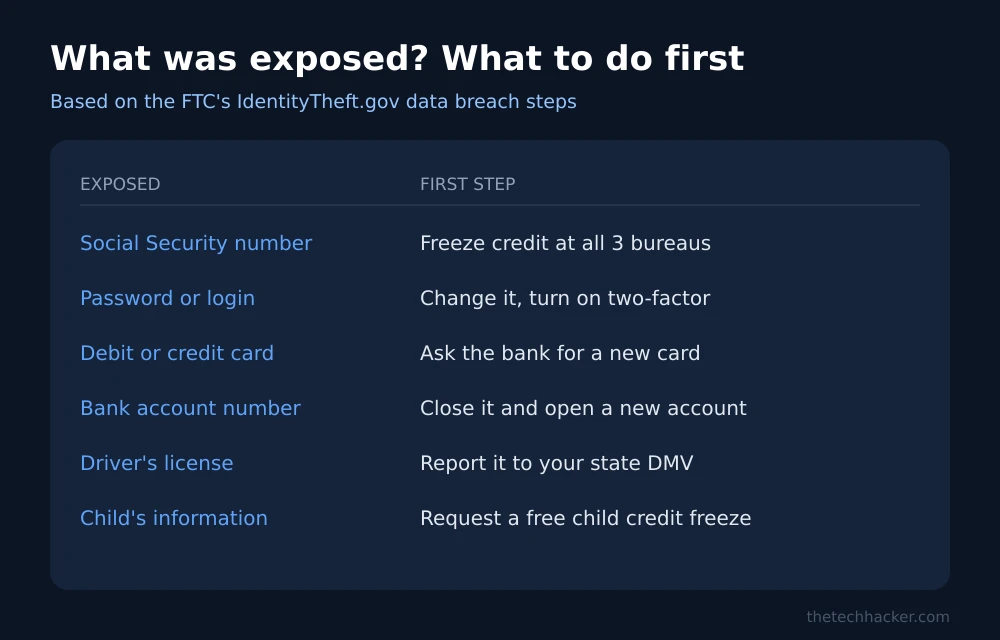
The 10-step checklist
The steps below follow the FTC’s official guidance on what to do after a data breach, arranged in the order that matters most.
1. Confirm the notice is real
Breach headlines attract copycat scams. Before acting on any link, phone number or request in a breach email or text, confirm it independently: type the company’s website address yourself or use the number on your statement or card. The FTC warns not to rely on contact details provided in an unexpected message.
2. Check whether your information has already been used
Get your free credit reports at AnnualCreditReport.com, the official source, where the FTC says you can check online every week for free. Look for accounts, inquiries or addresses you do not recognize. If someone has already used your information, report it at IdentityTheft.gov to get a personalized recovery plan.
3. Freeze your credit at all three bureaus
A freeze stops new credit accounts from being opened in your name, and it is free to place and to lift. You must contact each bureau separately. IdentityTheft.gov lists these contacts:
| Bureau | Phone |
|---|---|
| Equifax | 800-685-1111 |
| Experian | 888-397-3742 |
| TransUnion | 888-909-8872 |
Our step-by-step guide on how to freeze your credit covers timing, lifting a freeze for a single lender and how a freeze compares with a fraud alert.
4. Consider a fraud alert as a second layer
A fraud alert is free, lasts one year and requires only one call, since the bureau you contact must tell the other two. It makes lenders take extra steps to verify your identity before opening an account.
5. Accept free credit monitoring if it is offered
Monitoring does not prevent fraud, but it alerts you to new credit checks, accounts or late payments on your reports. If the breached company offers it, enroll before the deadline in your letter.
6. If your password or login was exposed
Change the password right away, use a long and unique one, and turn on two-factor authentication. If you reused that password anywhere else, change it there too. For financial sites, check for unfamiliar charges or changes such as a new mailing address.
7. If your debit or credit card number was exposed
Call your bank or card issuer using the number on the back of your card, cancel the card and request a new one. Update any automatic payments, and review statements for charges you did not make.
8. If your bank or investment account number was exposed
Tell your bank or brokerage what happened, close the account and open a new one. Watch for unauthorized withdrawals and update direct deposits and automatic payments.
9. If your Social Security number or driver’s license number was exposed
- Social Security number: review your work history in a my Social Security account to catch anyone using your number for a job, and consider locking your number for employment verification through E-Verify’s self-lock feature. File your taxes early so a scammer cannot file first, and respond quickly to any IRS letter.
- Driver’s license: report it to your state DMV. The state may flag the number or suggest a duplicate license. This is the step most relevant to people affected by the recent Uber driver data breach.
10. Protect your children and reduce future exposure
If a child’s information was involved, request a free credit freeze for them; children usually have no credit report unless someone is misusing their information. Then reduce how much of your data is circulating: our guide to data removal services explains how to remove your details from data broker sites.
What not to do
- Do not pay for “breach protection” pitched in an unexpected call or email.
- Do not give your Social Security number, PINs or passwords to anyone who contacts you about the breach.
- Do not assume you are safe because nothing has happened yet. Stolen data can be used months later, which is why a freeze is worth keeping in place.
This guide summarizes federal consumer guidance and is not personalized legal or financial advice.
FAQs
What is the first thing to do after a data breach?
Check your credit reports to see if your information has already been used, then freeze your credit at Equifax, Experian and TransUnion.
Should I accept free credit monitoring after a breach?
Yes. The FTC recommends accepting free credit monitoring if a company offers it. It alerts you to activity on your credit reports.
What should I do if my driver’s license number was stolen?
Report it to your state DMV, which may flag the number or suggest a duplicate license, and freeze your credit at all three bureaus.
Can I get a new Social Security number after a breach?
Usually not. The Social Security Administration generally issues a new number only with evidence that someone is misusing yours.
Featured image: Cht Gsml on Unsplash.
Disclosure: TheTechHacker has no paid relationship with Equifax, Experian, TransUnion or any company mentioned here.
More in Guides
What to Do After a Data Breach: Identity Theft Protection Explained (2026)
Got a data breach notice? Here’s the exact order I’d follow in the US: lock down your accounts, freeze your credit for free, get an IRS IP PIN, and decide whether a paid identity theft protection service is worth it.
How to Freeze Your Credit at Equifax, Experian and TransUnion: Step-by-Step Guide
A run of data breach disclosures in recent days, including stolen driver’s license data at Uber and a vendor-linked cyberattack at Expedia, has put the same question in front of millions of Americans: what do I do now that my personal details may be out there? Credit monitoring tells you after something has gone wrong.…
Cyber Insurance for Small Businesses: What It Covers and What Insurers Require
A guide to cyber insurance for US small businesses: first-party vs third-party coverage, common exclusions, what insurers ask about on applications, and the questions to put to your broker.
The week in tech, minus the noise.
New reviews, fixes and the stories that matter — once a week, straight to your inbox.
We only use your email to send the newsletter. Unsubscribe any time. See our privacy policy.
Comments