

SpaceX Picks Qualcomm to Build Starlink Mobile’s US 5G Network
SpaceX picked Qualcomm to build Starlink Mobile's US 5G network, with rollout starting in 2027. Here's what's confirmed and what it means for you.


This one caught my attention. On November 4, 2026, Qualcomm announced that SpaceX picked its hardware for Starlink Mobile’s nationwide, ground-based 5G network in the US. Not satellites this time. Actual cell sites on the ground.
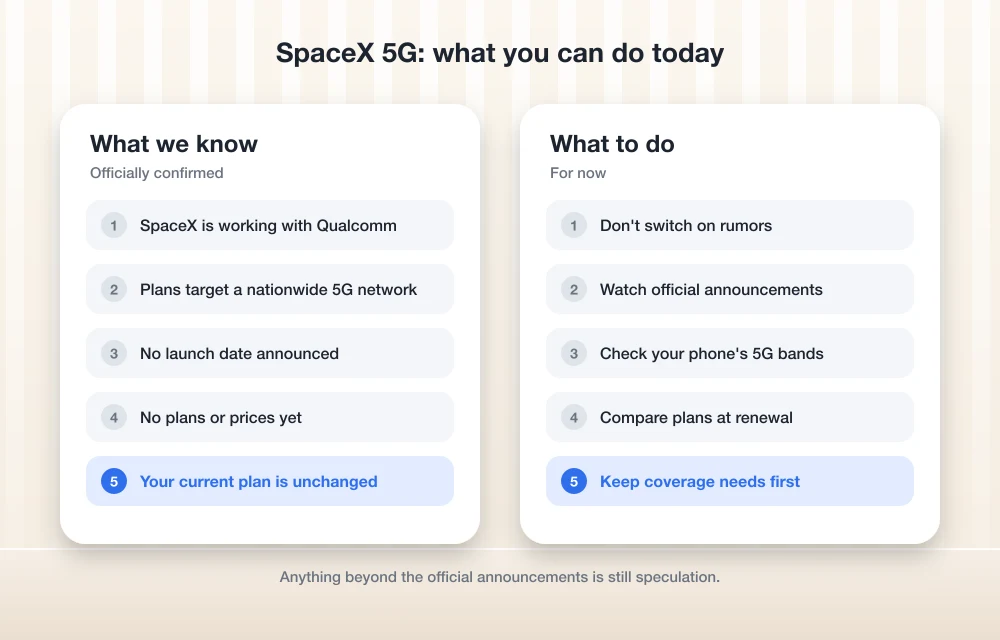
If SpaceX pulls it off, it could compete with AT&T, Verizon and T-Mobile for your monthly bill. That’s a big if, so I’ve kept what’s official separate from what’s only reported.
Quick answer: SpaceX selected Qualcomm’s Dragonwing cellular infrastructure platforms for Starlink Mobile’s US 5G ground network. According to Qualcomm, the rollout begins in 2027 and covers “tens of thousands of sites” under a multi-year deal. No plans, prices, launch cities or compatible phones have been announced, so there’s nothing to sign up for today.
What SpaceX and Qualcomm actually announced
According to the official Qualcomm press release on Business Wire, SpaceX will use the Dragonwing QRU100 for processing inside the radio units and the QDU100 for Layer 1 baseband processing. That’s the low-level signal work that turns radio waves into usable data. Qualcomm is also supplying its commercial-grade Layer 1 software.
The radios are Massive MIMO units with 64 transmit and 64 receive paths, written as 64T64R. Basically, lots of antennas per site, which Qualcomm says improves coverage, capacity and spectral efficiency. The network will use multiple frequency bands and be built in waves. Financial terms weren’t disclosed.
Starlink SVP Michael Nicolls said the company is building “the first fully-integrated nationwide satellite and terrestrial network.” Both companies also called the deal a step toward “AI-native 6G infrastructure,” which sounds exciting but says little about the phone in your pocket.
Not in the release, but reported: Qualcomm called this its largest 5G deal to date and said the radios run at 2 GHz.
The spectrum SpaceX already has
A carrier needs airwaves, and SpaceX has been buying. On May 12, 2026, the FCC approved assigning EchoStar’s licenses to SpaceX. That’s about 65 MHz of nationwide spectrum: 40 MHz of AWS-4, 10 MHz of H-Block and 15 MHz of unpaired AWS-3. The FCC also let SpaceX use it from satellites, the ground or both, and set faster build-out deadlines.
The EchoStar deal is reported to be worth about $19.6 billion, with the final transfer reportedly targeted for late 2027. SpaceX has also reportedly agreed to buy Grain Management’s nationwide 800 MHz licenses. Low-band spectrum like that is better at reaching indoors. That purchase still needs FCC approval.
Where T-Mobile’s T-Satellite fits
You may already know Starlink from T-Satellite, the T-Mobile service that connects phones to Starlink satellites in dead zones. It reportedly launched in July 2025 on T-Mobile’s spectrum, included with Experience Beyond and $10 a month for others, including AT&T and Verizon users. I couldn’t confirm today’s price, so check T-Mobile’s site first.
Neither company has said whether the new ground network changes that partnership.
What it means for your phone bill
Honestly? Nothing yet. There are no Starlink Mobile plans or prices. A new national network with its own spectrum could push prices down over time, but that’s my opinion, not an announcement. SpaceX has also reportedly been in talks to buy Boost Mobile, with no official confirmation.
One thing people will misread: “rollout begins in 2027” means deployment starts then. It doesn’t promise you can buy service in 2027.
We also don’t know which phones will work, how voice and eSIM will be handled, launch cities, or whether SpaceX will build its own towers or rent space on existing ones.
What you should do now
Stay put. Don’t switch carriers or cancel anything over this news. If your current carrier is giving you dropped calls or a stubborn SOS icon, fixing that now helps more than waiting. My guide on fixing an iPhone 18 Pro Max showing No Service or SOS on AT&T walks through it. And if you need a backup connection for your laptop on the go, a mobile hotspot is still the practical answer.
I’ll update this post when SpaceX or Starlink share real plans and prices.
Ready to leave your carrier anyway? Here’s how to switch carriers and keep your phone number.
Frequently Asked Questions
Is Starlink becoming a phone carrier like AT&T or Verizon?
SpaceX is building a nationwide ground-based 5G network for Starlink Mobile using Qualcomm hardware, which could make it a competitor. But no plans, prices or launch dates for customers have been announced yet.
When will the Starlink Mobile 5G network launch?
Qualcomm says SpaceX plans to start the US rollout in 2027, with tens of thousands of sites deployed over several years. That’s when building starts, not a confirmed date when you can sign up.
Will my current phone work on Starlink Mobile’s 5G network?
Nobody knows yet. SpaceX and Qualcomm haven’t said which phones will be compatible or how eSIM and voice calls will work.
Featured image: wirestock on Magnific.
More in News

Android 17 QPR2 Beta 7.1 Is Out: What’s Coming to Pixel Phones Next
Android 17 QPR2 Beta 7.1 is out for Pixel phones. See what Google has documented, which Pixels qualify, and when the stable update may land.

Galaxy S27 Launch Date: What We Know So Far
Samsung hasn't announced the Galaxy S27 yet. Leaks point to January 2027, with February possible. Here's past Unpacked timing and whether to wait.
iOS 27.2 Is Out: What’s New and Should You Update?
iOS 27.2 is rolling out with Siri AI memory, Suggestions in Messages and SynthID tags in Photos. Here's what Apple confirmed and whether to update now.
The week in tech, minus the noise.
New reviews, fixes and the stories that matter — once a week, straight to your inbox.
We only use your email to send the newsletter. Unsubscribe any time. See our privacy policy.
Comments