

T-Mobile T-Satellite: Is It Worth It in 2026, Even on AT&T or Verizon?
T-Mobile’s T-Satellite uses Starlink satellites to keep your phone texting in dead zones, and AT&T and Verizon users can sign up too. Here’s what it does, what it costs, and who should pay for it.
T-Satellite-Featured
Dead zones are the one thing no carrier ad likes to talk about. Drive far enough into the mountains, the desert or a long stretch of rural highway and your bars disappear. It doesn’t matter whose SIM is in your phone.
T-Mobile’s answer is T-Satellite, a service built with SpaceX’s Starlink that lets regular phones connect to satellites when there’s no tower around. The part that surprised me is that you don’t have to be a T-Mobile customer to get it. AT&T and Verizon users can sign up too.
I went through T-Mobile’s official pages to work out what it really does, what it costs right now, and who should actually pay for it. Where something isn’t confirmed on T-Mobile’s own site, I’ll say so.
Quick answer: T-Satellite lets compatible phones text and use select satellite-ready apps outdoors in places no carrier tower reaches. It’s included at no extra cost on T-Mobile’s Experience Beyond 2.0 and Better Value plans. Everyone else, including AT&T and Verizon customers with a compatible eSIM phone that isn’t locked to a carrier, pays $10/month, which T-Mobile calls a limited-time price. It’s worth it if you regularly go off-grid, and easy to skip if you rarely leave covered areas.
What is T-Mobile T-Satellite?
T-Satellite is T-Mobile’s satellite-to-phone service with Starlink. It’s meant for remote areas that no carrier’s towers reach, not as a replacement for normal cell service.
It launched commercially on July 23, 2025, running on more than 650 low-earth-orbit satellites. Low-earth orbit just means the satellites circle relatively close to Earth compared with traditional communication satellites. Before launch, T-Mobile says nearly 2 million people tried it during the beta, with up to 30,000 users a day.
The nice thing is how hands-off it is. According to T-Mobile, your phone connects to the satellite network automatically when no other service is available. There’s no button to press or mode to switch on.
What T-Satellite can and can’t do
This is where expectations matter. Satellite service is not the same as having full bars.
What T-Mobile officially confirms
T-Mobile’s own wording is: “Texting & select satellite-ready apps with compatible device in most outdoor areas in the U.S. where you can see the sky.” It also warns that service “may be delayed, limited, or unavailable.”
Beyond texting, T-Mobile lists messaging, Text to 911, data and location services, “among others.” Its main T-Satellite page also says you can talk over satellite using WhatsApp. For data, T-Mobile describes it as “satellite data with certain apps,” and says apps tuned for T-Satellite keep their essential features working first while you’re on satellite.
Which apps work? Check the current list
When T-Mobile rolled out app data in October 2025, its announcement named WhatsApp, AllTrails, AccuWeather, Google Maps, T-Life and X, plus built-in apps like Google Messages, Find Hub, Pixel Weather, Apple Music, Apple Weather and Fitness, and Samsung Weather. It also said WhatsApp supports voice notes, photos and group calls.
I couldn’t confirm that exact list on T-Mobile’s current pages, though. Apps can be added or dropped, so check T-Mobile’s site before you count on a specific app for a trip.
What it doesn’t do (or isn’t confirmed)
It won’t work indoors or under heavy cover. You need to be outside with a view of the sky.
Regular voice calls over satellite are not confirmed. I found no T-Mobile page saying normal phone calls work. The only calling T-Mobile mentions is through WhatsApp. I also didn’t find any speed figures on the pages I checked, so don’t expect to stream video out in the backcountry.
| Feature | Status (per T-Mobile) |
|---|---|
| Texting | Confirmed |
| Text to 911 | Confirmed |
| Data with select satellite-ready apps | Confirmed (check current app list) |
| Location services | Confirmed |
| Talking via WhatsApp | Confirmed on the main T-Satellite page |
| Regular voice calls | Not confirmed |
| Indoor use | No, needs a clear view of the sky |
Where T-Satellite works
In the US, T-Mobile says coverage includes the continental US, Puerto Rico, Hawaii and parts of southern Alaska. If you live in or travel to Alaska, check carefully, because “parts of” is doing a lot of work there.
It also works abroad through partners: Rogers Satellite in Canada, Telstra in Australia, One NZ in New Zealand and KDDI in Japan. One catch: Text to 911 doesn’t work in Japan.
Remember that “coverage” here assumes you’re outdoors with open sky. A canyon, thick forest or your car’s roof can get in the way. T-Mobile has an official coverage map on its T-Satellite page, and I’d look at it for the specific places you plan to go.
Which phones support T-Satellite?
T-Mobile says it supports “over 60 phones” and “over 75% of phones.” Its consumer explainer says most modern smartphones from the last four years should work.
Models I saw on T-Mobile’s support page include the iPhone 16, Galaxy S24, Galaxy Z Flip6, Z Fold6 and Pixel 9. Older Samsung phones show up too, like the Galaxy S21, S22 and S23 series (including the S23 FE), the A54 5G, Z Flip3/4/5, Z Fold3/4/5 and the XCover6 Pro.
That’s only part of the list, so don’t treat it as complete. The full, current list lives on T-Mobile’s satellite support page. You can also check your own phone with the T-Life app or the IMEI checker on T-Mobile.com. Your IMEI is your phone’s unique ID number, and you can usually find it in your phone’s settings under About.
If you’re not a T-Mobile customer, there are two extra requirements. Your phone can’t be locked to a single carrier, and it must have an eSIM available. An eSIM is a digital SIM built into the phone, so you can add a line without a physical card.
How much does T-Satellite cost?
Here’s the pricing as listed on T-Mobile’s main T-Satellite page when the research for this article was done. Prices like this change, so confirm on t-mobile.com before you sign up.
| Who you are | Price |
|---|---|
| T-Mobile customer on Experience Beyond 2.0 or Better Value | Included at no extra cost, nothing to do |
| Other T-Mobile customers | $10/month (limited-time price, “a savings of $5/mo”) |
| AT&T, Verizon and other non-T-Mobile customers | $10/month |
If you’re on an older T-Mobile plan, check your account rather than assuming. T-Mobile has listed other plans as including T-Satellite in the past, but its current main page only names Experience Beyond 2.0 and Better Value.
Text to 911 is free, even if you never pay
This is the part I think more people should know about. Anyone with an eligible phone can text 911 over satellite for free, including AT&T and Verizon customers. You do need to register, but you don’t need a T-Mobile account.
There’s an exception. T-Mobile says iPhone 14 and later models can’t use it, because those phones already have built-in satellite emergency features. T-Mobile also says the service automatically hands off to the phone’s own satellite emergency feature on certain iPhones and the latest Pixels.
So if all you want is an emergency lifeline and your phone qualifies, you may not need to pay anything at all.
How to sign up for T-Satellite
If you’re a T-Mobile customer
If you’re on Experience Beyond 2.0 or Better Value, it’s already included and there’s nothing to do. Otherwise:
- Sign in to your T-Mobile account in My T-Mobile or the T-Life app.
- Go to “Manage Data & Add-Ons.”
- Add T-Satellite to your line.
If you’re on AT&T, Verizon or another carrier
- Confirm your phone is on T-Mobile’s supported list, isn’t carrier-locked and has an eSIM available.
- Enroll online on T-Mobile’s T-Satellite page, call 1-800-937-8997 (1-800-T-MOBILE), or visit a T-Mobile store.
- Follow the steps to add the T-Mobile eSIM to your phone.
Because T-Mobile requires an eSIM, T-Satellite runs as a separate T-Mobile line on your phone, sitting next to your main AT&T or Verizon line. That’s a second account tied to your name, so it’s worth locking it down with a PIN. My guide on how to protect your SIM card from hackers covers the basics.
T-Mobile doesn’t publish specific settings menus for using the service, and it says no steps are needed once you’re set up. I’d rather tell you that than make up menu paths.
How to tell you’re on satellite
On an iPhone, T-Mobile says you’ll see signal bars, “SAT” and the network name “T-Mobile SpaceX” or “T-Sat+Starlink.” On Android, you’ll see a satellite icon and the same network names.
Who T-Satellite is worth it for
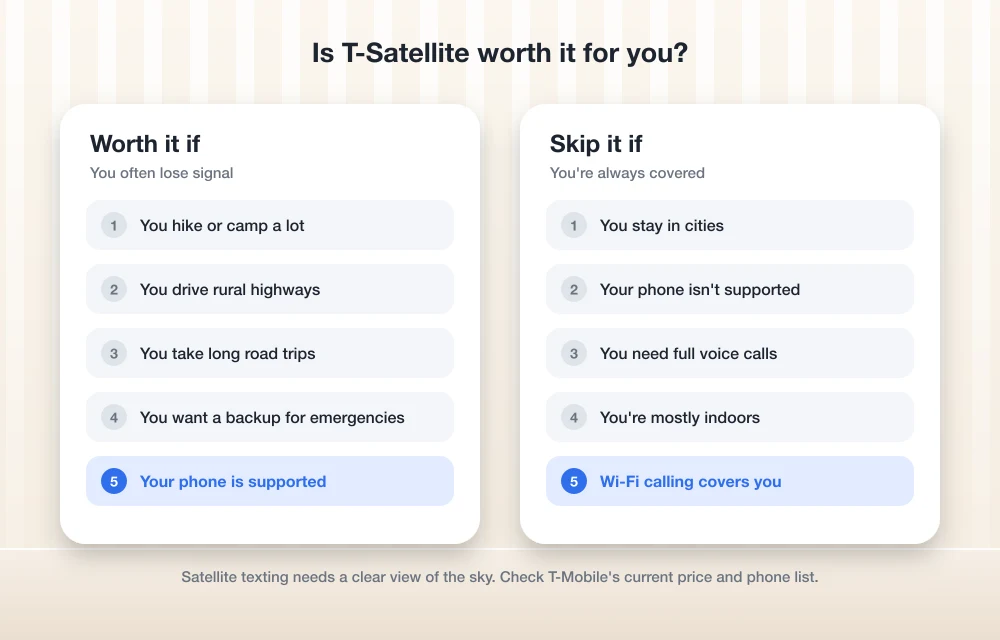
If you hike, camp or hunt in places where your phone shows “No Service” most of the day, this is the obvious use case. Being able to text a family member that you’re running late, or check a trail map in an app that supports it, is a big deal when you’re hours from a road.
Rural drivers are the other group I’d point to. If your daily commute or your drive to your parents’ place crosses a known dead stretch, $10 a month is cheap peace of mind. Road trippers crossing the West, where long gaps in coverage are common, fall in the same bucket. You could even add it just for the months you travel, though check T-Mobile’s current terms before planning around that.
And if you’re already on Experience Beyond 2.0 or Better Value, there’s nothing to decide. It’s included.
Who should skip it
If you live and work in a city or suburb and rarely go off-grid, I wouldn’t pay for it. You’d be paying every month for something you might never see.
Skip it, too, if your phone isn’t supported, is carrier-locked, or doesn’t have an eSIM to spare. And if your only concern is emergencies, check first whether your phone already has built-in satellite SOS (like iPhone 14 and later) or qualifies for T-Mobile’s free Text to 911.
Finally, if you were hoping to make normal phone calls from the middle of nowhere, that isn’t confirmed. WhatsApp calling is the only voice option T-Mobile mentions.
How T-Satellite relates to SpaceX’s Starlink Mobile 5G plans
T-Satellite runs on Starlink satellites today, but SpaceX is also building something of its own called Starlink Mobile. Starlink describes it as a nationwide network that combines satellites with cell towers.
According to reports of Qualcomm’s announcement on November 4, 2026, SpaceX picked Qualcomm’s Dragonwing QRU100 and QDU100 platforms for Starlink Mobile’s ground-based 5G base stations, with “tens of thousands” of sites planned from 2027. SpaceX has also reportedly bought EchoStar spectrum, and Elon Musk said in June 2026 that phones able to use it would likely ship in about two years. I wasn’t able to read SpaceX’s or Qualcomm’s own releases, so treat those details as reported rather than confirmed. I covered the news in more detail in my piece on the SpaceX and Qualcomm Starlink Mobile 5G network.
What we don’t know matters more for your decision right now. There’s no confirmed Starlink Mobile pricing, no consumer launch date, and nothing official on what it means for T-Satellite’s future. I wouldn’t hold off on T-Satellite waiting for a service that doesn’t exist yet. If Starlink Mobile does launch and you want to move, you can usually take your number with you. Here’s how to switch carriers and keep your phone number.
My take: is T-Satellite worth it?
For the right person, yes. If you regularly spend time outdoors where towers don’t reach, $10 a month for texting and some app data over satellite is a fair deal, and the fact that AT&T and Verizon customers can add it without switching carriers makes it even easier to recommend.
For everyone else, it’s a nice-to-have at best. Check whether your phone is supported, see if you already qualify for free Text to 911, and look at T-Mobile’s coverage map for the places you actually go. If those boxes line up, sign up before your next trip, not in the parking lot at the trailhead.
Frequently Asked Questions
Can AT&T and Verizon customers use T-Mobile T-Satellite?
Yes. Non-T-Mobile customers can sign up for $10/month as long as their phone is supported, isn’t locked to a carrier and has an eSIM available. You can enroll online on T-Mobile’s T-Satellite page, by calling 1-800-T-MOBILE, or at a T-Mobile store.
How much does T-Satellite cost?
It’s included at no extra cost on T-Mobile’s Experience Beyond 2.0 and Better Value plans. Other T-Mobile customers and non-customers pay $10/month, which T-Mobile describes as a limited-time price. Check t-mobile.com for current pricing.
Can I make regular phone calls with T-Satellite?
That isn’t confirmed. T-Mobile’s pages mention texting, select satellite-ready apps and talking over WhatsApp, but I found no official statement that regular voice calls work over satellite.
Do I need to turn T-Satellite on?
No. According to T-Mobile, your phone connects to the satellite network automatically when no other service is available. You’ll see “SAT” or a satellite icon and the network name “T-Mobile SpaceX” or “T-Sat+Starlink.” You also need to be outdoors with a clear view of the sky.
Is satellite Text to 911 free?
Yes. T-Mobile says anyone with an eligible phone can text 911 over satellite for free, including AT&T and Verizon customers, after registering. iPhone 14 and later can’t use it because they already have built-in satellite emergency features.
More in Guides
How to Switch Carriers and Keep Your Phone Number (AT&T, Verizon, T-Mobile)
Thinking about leaving AT&T, Verizon or T-Mobile? Here’s how to switch carriers in the US without losing your phone number, from getting your transfer PIN to handling a port that fails.
How to Fix ‘SIM Not Provisioned’ After Switching Carriers on iPhone and Android
Seeing “SIM Not Provisioned” or MM#2 after switching carriers? Here’s what the message means and the fixes I’d try, in order, on iPhone and Android.
How to Fix iPhone 18 Pro Max No Service or SOS on AT&T
Is your iPhone 18 Pro Max stuck on SOS or No Service on AT&T? Here’s how to tell if it’s the issue Apple has acknowledged, what to try first, and how to get a replacement.
The week in tech, minus the noise.
New reviews, fixes and the stories that matter — once a week, straight to your inbox.
We only use your email to send the newsletter. Unsubscribe any time. See our privacy policy.
Comments