

Cheapest Unlimited Phone Plans in the US (November 2026)
I compared the cheapest unlimited plans from AT&T, Verizon, T-Mobile, Mint Mobile, Visible and other prepaid brands using the carriers’ own plan pages. I also explain what ‘unlimited’ really means before you switch.
Unlimited-Phone-Plans-Featured
Every November I hear the same question from friends and family: “My phone bill is too high. What’s the cheapest unlimited plan I can switch to?” It’s a fair question, and the honest answer is messier than the ads make it look.
AT&T, Verizon and T-Mobile have all reshuffled their plans. Prepaid brands like Mint Mobile and Visible keep undercutting them. And “unlimited” means something different at almost every carrier. One plan may slow you down after 5GB. Another gives you 50GB before you drop behind other customers in line.
So I pulled prices from the carriers’ own plan pages wherever I could. Where I couldn’t confirm a price, I say so plainly. One warning first: these prices change often, and every number below excludes taxes and fees unless I say otherwise. Check the live plan page before you sign up.
Quick answer: For one line, the cheapest unlimited plan I could confirm on an official page is Mint Mobile’s 12-month Unlimited plan: $360 upfront, which works out to $30 a month for new customers during the first term. For a family of four, T-Mobile’s Essentials promo at $25 per line and Verizon’s Unlimited Welcome promo at $27.50 per line (both with AutoPay, plus taxes and fees) are the best deals I found. AT&T starts at $30 per line on Value 2.0, but only with several conditions and just 5GB of high-speed data before possible slowdowns.
The cheapest unlimited plans I could confirm
Here’s everything I could verify on official carrier pages. If a brand isn’t in this table with a price, I couldn’t check it against its own site, and I’d rather leave the number out than guess.
| Carrier | Plan | Confirmed price | The catch |
|---|---|---|---|
| Mint Mobile | Unlimited, 12-month | $360 upfront (about $30/mo), new customers, first term only | May be deprioritized after 50GB in a month |
| T-Mobile | Essentials promo, 4 lines | $25/line/mo with AutoPay | Included phones are paid off through up to 36 monthly bill credits |
| Verizon | Unlimited Welcome promo, 4 new lines | $27.50/line/mo with AutoPay | Promo applies to new lines |
| Verizon | Unlimited Welcome, 4+ lines | $30/line/mo with AutoPay | $10/line more without AutoPay |
| AT&T | Value 2.0 | From $30/mo per line | Needs AutoPay, paperless billing and a $5/mo bill credit on new bring-your-own-device lines; 5GB of high-speed data |
| T-Mobile | Essentials Saver 2.0, 1 line | $50/mo with AutoPay | Speeds may be lower than other customers during congestion |
All prices are before taxes and fees.
The big three: T-Mobile, Verizon and AT&T
The big three are “postpaid” carriers. That means you use the service first and pay a monthly bill after, usually with a credit check. Prepaid means you pay before the month starts. Postpaid plans tend to cost more for one line but get much cheaper per line as you add people.
T-Mobile
T-Mobile’s plans open to new customers right now are Experience Beyond 2.0, Experience More 2.0 and Essentials 2.0. The older Experience, Essentials and Go5G plans are only for existing customers. You can see the full lineup on T-Mobile’s official plans page.
Essentials 2.0 comes with unlimited talk and text and 50GB of premium data. Experience More 2.0 moves you up to unlimited premium data plus high-speed data in 215+ countries, which matters if you travel. T-Mobile says every new Experience plan includes unlimited premium data.
The cheapest single-line option I found on T-Mobile’s site is Essentials Saver 2.0 at $50 a month with AutoPay. T-Mobile says customers on it “may notice speeds lower than other customers” when the network is congested. For a lot of people that’s fine. If you live in a crowded city, keep it in mind.
For families, the standout is a promo of 4 lines for $25 per line per month on an Essentials promo plan, with AutoPay. It even comes with four Galaxy S26 phones “On Us.” The fine print matters here: those phones are paid off through up to 36 monthly bill credits. Before you sign, read what happens to those credits if you leave early.
I’ve seen single-line prices for Essentials 2.0, Experience More 2.0 and Experience Beyond 2.0 floating around, but I couldn’t confirm them on T-Mobile’s own pages, so I’m not listing them.
Verizon
Verizon has three unlimited tiers: Unlimited Welcome, Unlimited Plus and Unlimited Ultimate. Here are the per-line prices from Verizon’s official myPlan page, with AutoPay.
| Lines | Unlimited Welcome | Unlimited Plus | Unlimited Ultimate |
|---|---|---|---|
| 3 lines | $40/line | $55/line | $70/line |
| 4+ lines | $30/line | $45/line | $60/line |
Each line costs $10 a month more without AutoPay, and taxes and fees are extra. There’s also a promo: 4 new lines on Unlimited Welcome for $27.50 per line per month with AutoPay.
I couldn’t confirm Verizon’s single-line prices, the hotspot amount on each tier or the 55+ plan pricing on an official page. If you’re a solo user, check the live page. Verizon’s per-line math really favors families.
AT&T
AT&T’s unlimited lineup is Value 2.0, Extra 2.0, Premium 2.0 and Elite 2.0. AT&T advertises a starting price of $30 a month per line, but read how you get there. That price is only on Value 2.0, and only with AutoPay, paperless billing and a $5 monthly bill credit for up to 36 months on each new line where you bring your own device.
Value 2.0 is also the most limited “unlimited” plan in this article. You get 5GB of high-speed data and 3GB of hotspot. After 5GB, AT&T says it “may temporarily slow data speeds if the network is busy.” If you mostly use Wi-Fi, that might be enough. If you stream on the bus, it won’t be.
Extra 2.0 bumps you to 100GB of high-speed data (with possible slowdowns after that) and 50GB of hotspot. Premium 2.0 gives you unlimited high-speed data. I couldn’t confirm single-line prices, Premium’s hotspot amount or any Elite 2.0 details on AT&T’s site.
Prepaid brands and MVNOs
An MVNO (mobile virtual network operator) is a brand that doesn’t own towers. It rents capacity on a big carrier’s network and sells its own plans, usually cheaper. The trade-off is often lower priority when the network gets busy.
Mint Mobile
Mint runs on T-Mobile’s network. New customers pay $360 upfront for the 12-month Unlimited plan, which comes to $30 a month. That price is for the first term only, so expect to check renewal pricing later.
Mint says Unlimited customers who use more than 50GB in a month may be deprioritized. Mint has also run cheaper intro promos on Unlimited in the past, but intro pricing varies and I couldn’t confirm the current offer. If you see a lower number on Mint’s site today, that’s probably a promo.
Paying a year upfront stings a little. Still, if you have the cash, it’s the lowest single-line unlimited price I could confirm.
Visible
Visible is owned by Verizon and sells three tiers: Visible, Visible+ and Visible+ Pro. I couldn’t confirm their current prices or whether taxes and fees are included on Visible’s own site, so I’m not quoting numbers. It belongs on your shortlist if Verizon’s coverage is strong where you live, but check the live page.
Metro by T-Mobile, Cricket, US Mobile and Total Wireless
I couldn’t check any of these against their official plan pages, so no prices from me. Metro by T-Mobile runs on T-Mobile’s network. For the others, look up which network they use on their own sites before you compare, because the network matters more than the brand name on your bill.
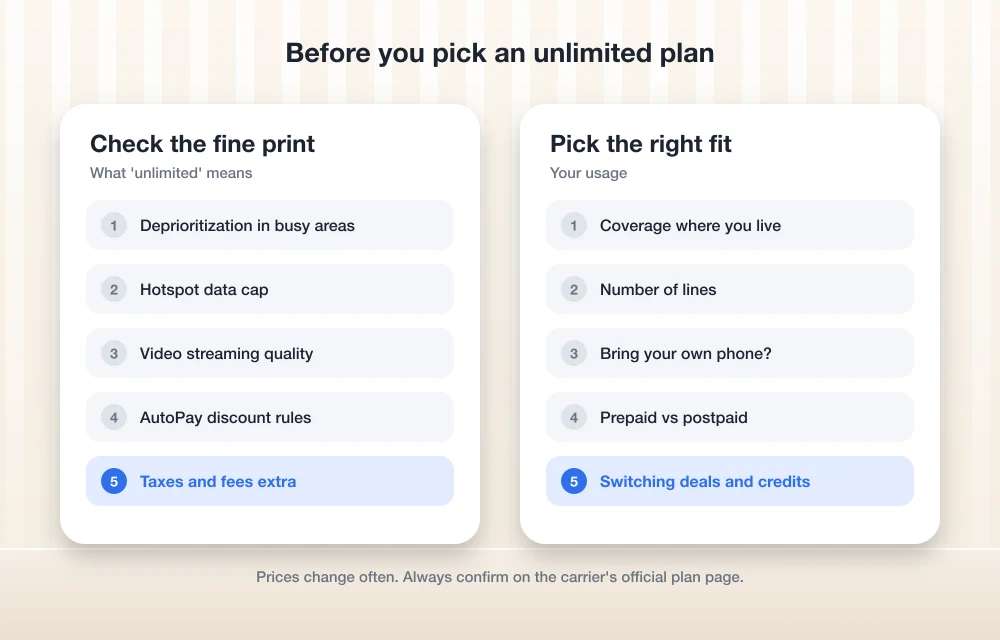
What “unlimited” really means
Almost no unlimited plan is truly unlimited in the way you’d expect. There are three things to look for.
Deprioritization and premium data
Deprioritization means that when a tower is busy, your data waits behind other customers. You don’t get cut off, but things can feel slow. “Premium data” is the amount you can use before that happens. In this article alone, the thresholds range from 5GB (AT&T Value 2.0) to 50GB (T-Mobile Essentials 2.0 and Mint Unlimited) to 100GB (AT&T Extra 2.0) to unlimited on higher tiers.
Hotspot caps
Hotspot is when you share your phone’s data with a laptop or tablet. Most plans cap it separately. AT&T’s Value 2.0 gives you 3GB and Extra 2.0 gives you 50GB. If you work from your laptop on the road, this number matters more than the headline price.
Video quality
Some cheaper plans limit streaming video quality on mobile data. I couldn’t confirm the exact video limits for any carrier here, and they vary by plan, so check the plan’s fine print if you watch a lot of video away from Wi-Fi.
AutoPay discounts, taxes and fees
Almost every price you see is an AutoPay price. Verizon is the clearest example: each line is $10 a month more without it. AT&T’s $30 starting price also needs paperless billing. If you don’t want to link a bank account or card, add that cost back in before comparing.
Taxes and fees are the other surprise. The big three’s prices exclude them, and how much they add depends on your state and city. I couldn’t confirm which prepaid prices include them. My advice is simple: go to the checkout page or ask for the full monthly total before you commit.
Multi-line pricing is where the real savings are
If you’re on your own, prepaid usually wins. Once you have three or four lines, postpaid starts to look good. Verizon’s Unlimited Welcome drops from $40 a line at three lines to $30 a line at four, which is $120 a month before taxes for a family of four. The promo brings that to $110. T-Mobile’s 4-line Essentials promo comes to $100.
Just remember that promo deals often tie you to bill credits or new lines. Read the terms, and do the math across a full year, not just month one.
Black Friday switching deals
When I checked, none of the carriers had posted Black Friday 2026 switching deals on their official pages. They usually appear in late November. My approach: decide which network works where you live first, then watch that carrier’s deals page. A great deal on a network with weak signal at your home isn’t a deal.
How to pick based on coverage where you live
This is the step people skip, and it’s the one that matters most. A cheap plan is useless if you get one bar in your kitchen.
- Check each carrier’s official coverage map for your home address and workplace.
- Ask neighbors or coworkers which carrier works well for them indoors.
- Remember that MVNOs use a big carrier’s towers, so Mint performs on T-Mobile’s coverage and Visible on Verizon’s.
- If you’re unsure, try a one-month prepaid plan on that network before you move the whole family.
If you spend time where there’s no signal at all, like hiking trails or rural roads, satellite texting might matter more to you than saving a few dollars. I covered whether T-Mobile’s T-Satellite is worth it, even on AT&T or Verizon.
Switching without losing your number
You can keep your number when you switch. It’s called porting, and the new carrier handles most of it. You’ll need your account number and a transfer PIN from your current carrier. I walk through it for each carrier in my guide on how to switch carriers and keep your phone number.
Don’t cancel your old plan first. Cancelling can release your number. Let the port finish, then the old service closes on its own.
If your phone shows an error after the switch, especially with eSIM activation, don’t panic. Here’s how to fix ‘SIM Not Provisioned’ after switching carriers on iPhone and Android.
Which plan I’d pick
If I were on my own and had the cash upfront, I’d look hard at Mint’s 12-month Unlimited plan, as long as T-Mobile’s coverage is good at home. For a family of four, I’d compare T-Mobile’s $25 Essentials promo and Verizon’s $27.50 Unlimited Welcome promo, and let coverage decide.
I’d be careful with AT&T’s $30 headline unless you barely use mobile data. Five gigs goes fast. And whatever you choose, check the live price, the AutoPay rules and the full total with taxes before you hand over your number.
Frequently Asked Questions
What is the cheapest unlimited phone plan in the US right now?
For one line, the cheapest I could confirm on an official page is Mint Mobile’s 12-month Unlimited plan at $360 upfront, about $30 a month for new customers in the first term. For four lines, T-Mobile’s Essentials promo at $25 per line and Verizon’s Unlimited Welcome promo at $27.50 per line are the best deals I found. Prices exclude taxes and fees and change often.
Does an unlimited plan really mean unlimited data?
Usually not in the way you’d think. Most plans give you a set amount of high-speed or premium data, after which your speeds may slow when the network is busy. For example, AT&T Value 2.0 includes 5GB of high-speed data, while Mint Unlimited may deprioritize you after 50GB in a month.
Are taxes and fees included in these phone plan prices?
Not for AT&T, Verizon or T-Mobile. Their advertised prices exclude taxes and fees, and those vary by where you live. I couldn’t confirm which prepaid prices include them, so check the checkout total before you sign up.
Is prepaid cheaper than postpaid for unlimited plans?
For a single line, prepaid brands like Mint Mobile are usually cheaper. With three or four lines, postpaid family pricing from Verizon or T-Mobile can get close to or even below prepaid prices per line.
Can I keep my phone number if I switch carriers?
Yes. Your new carrier can port your number over. You’ll need your account number and a transfer PIN from your current carrier. Don’t cancel your old plan until the port is complete.
You might also like

Black Friday 2026 Tech Buying Guide: What’s Worth Buying and What to Skip
Black Friday 2026 is November 27, eight days after GTA 6 launches. Here’s my practical guide to which phones, laptops, consoles, storage, earbuds, smart home gear and TVs are worth buying, and how to avoid fake discounts.

Black Friday Tech Deals 2026: Store-by-Store Calendar for US Shoppers
Black Friday 2026 lands on November 27 and Cyber Monday on November 30. Here’s what Best Buy, Walmart, Target and Amazon have actually confirmed, what’s still a guess, and how to use holiday price match rules so you don’t buy too early.

Cheapest VPN Services
Finding a VPN service that gives the desired quality for its price is a hard task. You’ll find VPN services that cost so much, yet they don’t provide the best quality. You’ll also find very affordable VPN services that come with very interesting features. One question you may have asked yourself is “Do you have…
The week in tech, minus the noise.
New reviews, fixes and the stories that matter — once a week, straight to your inbox.
We only use your email to send the newsletter. Unsubscribe any time. See our privacy policy.
Comments