

Best Business Internet Providers in the US (2026): Fiber vs Cable vs 5G
I compared AT&T Business Fiber, Verizon, Comcast, Spectrum and T-Mobile using their official pages, covering fiber vs cable vs 5G, static IPs, SLAs and the prices they list right now.

Photo by Denny Müller on Unsplash
Business internet ads all say the same thing: fast, reliable, built for business. Then you get to the fine print. The good price is for twelve months. A static IP is extra. And the line always seems to drop on a Monday morning when everyone’s on calls. Fun.
I went through the official business pages for AT&T Business Fiber, Verizon Business, Comcast Business, Spectrum Business and T-Mobile Business Internet. Here’s what they list today, where the catches hide, and what I couldn’t confirm. No speed tests from me on these, so treat it as a plan comparison, not a review.
One thing to keep in your head from the start. Availability goes address by address. The best plan on paper does nothing for you if it doesn’t reach your building.
Quick answer: If AT&T Business Fiber reaches your building, it’s my top pick: symmetric speeds up to 5 GIG, no annual contract and a 5G backup that the technician sets up for you. Without fiber, Comcast Business (5-year price lock option) and Spectrum Business (no contracts, no data caps) are the cable picks. T-Mobile 5G Business Internet is the cheapest listed option at $35/mo with an eligible voice line and also works as a backup. Prices change and vary by location, so always check your address.
How I picked these (and what I couldn’t confirm)
I only used the providers’ own websites and the FCC. No third-party rankings, no prices people posted on forums. That keeps it honest, but it does leave some gaps, and I’d rather point them out than pretend they aren’t there.
I couldn’t confirm Verizon’s current 2026 business pricing, or its 5G Business Internet plans. Static IP fees weren’t clearly listed for any of the five. And on the pages I checked, not one of them showed uptime guarantees (SLAs) for these small business plans. Where that matters below, I’ll tell you what to ask for.
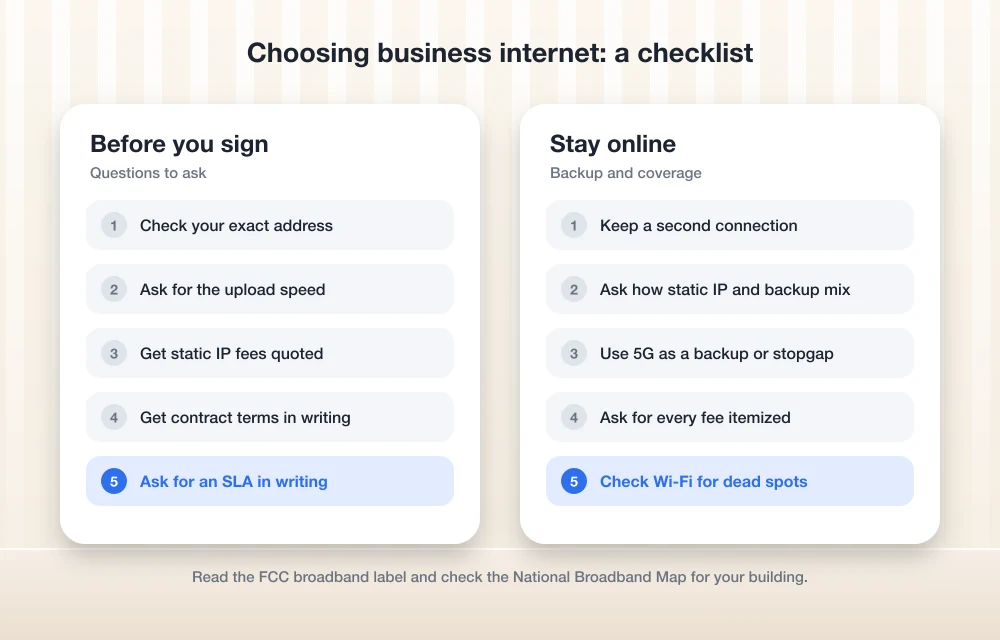
Fiber vs cable vs 5G: what’s the difference for a business?
Fiber sends data as light through thin strands of glass. The big win for a business? Symmetric speed. Your upload matches your download, and AT&T says its Business Fiber plans work that way. People tend to underestimate this one. If your team is on video calls all day, backing files up to the cloud or shipping big design files off to clients, upload speed matters a lot.
Cable runs over coaxial (coax) wiring, same kind of line your cable TV comes through. Spectrum calls its network “Fiber-Powered,” but the last bit into your building is still coax, so it’s cable service. Neither Comcast nor Spectrum listed matching upload speeds on the pages I looked at, so ask for the upload number before you sign anything.
5G fixed wireless uses a box in your office that grabs a cellular signal, the same type of network your phone runs on. No digging, no pulling cable, so setup is quick. The trade-off is that your speed depends on the signal at your exact spot. And T-Mobile doesn’t publish typical speeds on its business page.
I already broke these three down for homes in my 5G home internet vs cable vs fiber comparison, and most of that thinking carries right over to a small office.
The best business internet providers in the US
1. AT&T Business Fiber
If AT&T Fiber reaches your building, start here. AT&T lists tiers from Business Fiber 300 all the way up to 2 GIG and 5 GIG, and every single one is symmetric. It’s only sold in AT&T Fiber-ready buildings though, so check your address first on AT&T’s Business Fiber page.
The part I like most is the install. A technician comes out and sets up the internet, the gateway and a 5G Wireless Backup right there on site. So you’ve got a fallback connection without having to go sort one out yourself.
Price-wise, AT&T’s offers page lists 300 Mbps at $70/mo plus taxes and fees. No data caps, no equipment fees, no annual contract. If you add an eligible AT&T business wireless plan, there’s a $30/mo discount that gets it down to $40/mo. I couldn’t find clean prices for the faster tiers, so if you’re after 1 GIG or more, ask for a quote.
There’s a catch. It’s small, but it’s real. AT&T’s own FAQ says a static IP does not fail over to the 5G backup. So if you run anything that depends on that fixed address, it won’t be reachable there while you’re on backup.
What I liked
- Symmetric speeds on every tier, all the way up to 5 GIG
- The technician sets up a 5G Wireless Backup for you
- No annual contract, data caps or equipment fees on the 300 Mbps offer
What could be better
- You only get it in AT&T Fiber-ready buildings
- Static IP won’t fail over to the 5G backup
- Couldn’t find clear prices for the faster tiers
2. Verizon Business (Fios)
Fios is Verizon’s fiber service, and where it’s available it’s the obvious rival to AT&T. My problem is finding a price I can actually stand behind. Verizon’s Fios business page says “starting at $59/mo,” but that page looks to be about two years old, so I’m not calling it a 2026 price. The same page mentions a router you can buy or rent, plus an activation fee on Internet Only plans. Those amounts might have changed too.
What I can confirm: Verizon gives bundle credits when you pair Fios with a Business Unlimited wireless plan. Handy if your team’s phones are already on Verizon. Verizon also publishes FCC Broadband Facts labels, and honestly that’s the most reliable place to see the current price for your address.
Verizon sells 5G Business Internet too. I just couldn’t find its plans or prices on an official page, so I’ve left it out.
What I liked
- It’s fiber, where you can get it
- Bundle credits if you’ve got Business Unlimited wireless plans
- Puts out Broadband Facts labels
What could be better
- Couldn’t confirm current 2026 pricing
- Router and activation fees come from an older page
- No 5G business plans on an official page that I could find
3. Comcast Business
Of the cable options, Comcast Business has the clearest price ladder. You pick either 1-year pricing or a 5-year price lock guarantee, and every plan comes with a 30-day money-back guarantee. This is what the offers page lists:
| Plan | Speed | 12-month price | 24-month price |
|---|---|---|---|
| Internet Essential | 300 Mbps | $49/mo | $40/mo |
| Internet Performance | 500 Mbps | $69/mo | $60/mo |
| Internet Ultimate | 1 Gbps | $99/mo | $85/mo |
Internet Essential comes with an Ethernet gateway and no data caps, and static IP is listed as available. Performance throws in a security suite, static IP availability and priority support. Ultimate gets you a dedicated fiber option and a 24/7 support line.
Something here confused me, I’ll admit. Comcast’s page shows “1 year agreement” right next to “No contract.” So which is it? I can’t tell you the contract terms for sure. Get the sales rep to spell it out in writing. And prices depend on where you are, too.
What I liked
- You can lock your price in for 5 years
- Every plan has a 30-day money-back guarantee
- Even the entry plan has no data caps and static IP available
What could be better
- The contract wording on the page contradicts itself
- It’s cable, and there were no upload speeds listed
- Pricing changes depending on location
4. Spectrum Business
Spectrum is basically selling freedom. No contracts and no data caps on its business internet plans, and the support is 24/7 and based in the US. Speeds go up to 1 Gig, and 2 Gig in select markets.
The small business page lists 500 Mbps at $50/mo for 1 year as an online-only offer. But $65/mo shows up right next to it, so check which one you’d actually pay. 750 Mbps is listed at $95/mo and 1 Gig at $115/mo. Some packages come with a 3-year price guarantee.
A couple of extras caught my eye. Sign up for two or more services and Spectrum will buy out your current provider’s contract, up to $1,000. Business Voice is listed at $20/mo when you add it on to internet. There’s Wireless Internet Backup as well, but only if you also have Static IP or Business WiFi from Spectrum (a bit annoying, if you ask me).
What I liked
- No contracts, no data caps
- Up to $1,000 contract buyout with two or more services
- 24/7 support based in the US
What could be better
- It’s cable into the building, not fiber
- Not clear if the 500 Mbps plan is $50 or $65
- You need Static IP or Business WiFi to get wireless backup
5. T-Mobile Business Internet (5G)
T-Mobile has the cheapest listed price of the bunch. With one condition. That $35/mo comes from a $30 monthly bill credit, and you need a qualifying postpaid voice line to get it. Without one? I couldn’t confirm what the standalone price is.
The terms are pretty friendly though. It’s month-to-month, no annual contract, no early termination fees. There’s a 5-Year Price Guarantee on the 5G internet data price as long as you stay on an eligible plan (taxes and fees aren’t included in that). T-Mobile also lists priority data, 24/7 business support, static IP, firewall, VPN and content filtering. Heads up, SuperBroadband and its managed services may need a contract, so read carefully if someone tries to upsell you.
Here’s the thing that makes me hesitate most. T-Mobile doesn’t publish typical speeds on its business page. For a small shop with a few devices, it might be all you need. For a busy office, I’d treat it as a backup line, or something to get you by until fiber shows up.
What I liked
- $35/mo if you’ve got an eligible voice line
- Month-to-month with no early termination fees
- Lists static IP, firewall, VPN and content filtering
What could be better
- No typical speeds published
- Couldn’t confirm the price without a voice line
- Some add-on services might need a contract
Business internet providers compared
| AT&T Fiber | Verizon Fios | Comcast | Spectrum | T-Mobile 5G | |
|---|---|---|---|---|---|
| Connection | Fiber | Fiber | Cable (fiber option on 1 Gbps) | Cable | 5G fixed wireless |
| Symmetric upload | Yes | Not confirmed | Not listed | Not listed | Not listed |
| Top listed speed | 5 GIG | Not confirmed | 1 Gbps | 1 Gig (2 Gig in select markets) | Not published |
| Lowest listed price | $70/mo ($40 with eligible wireless plan) | Not confirmed for 2026 | $49/mo for 12 months | $50/mo for 1 year | $35/mo with voice line |
| Annual contract | No | Not confirmed | Unclear | No | No, no ETFs |
| Data caps | None | Not confirmed | None | None | Not listed |
| Price guarantee | Not listed | Not confirmed | 5-year lock option | 3-year on some packages | 5-year on data price |
| Static IP | Yes | Not confirmed | Yes | Yes | Yes |
| Wireless backup | 5G backup installed | Not confirmed | Not listed | With Static IP or Business WiFi | It is wireless |
| Published SLA | Not found | Not found | Not found | Not found | Not found |
Verizon’s column looks pretty empty, I know. That’s only because I couldn’t confirm current details from an official 2026 page, not because the service itself is bad.
Starting prices listed on official pages
AT&T Business Fiber 300
Plus taxes and fees. $40/mo with an eligible AT&T business wireless plan.
- 300 Mbps, symmetric
- No annual contract
- No data caps or equipment fees
Comcast Internet Essential
For 12 months, or $40/mo on 24-month pricing. Varies by location.
- 300 Mbps
- Ethernet gateway included
- 30-day money-back guarantee
Spectrum 500 Mbps
For 1 year, online-only offer ($65/mo also shown on the page).
- No contracts
- No data caps
- Business Voice +$20/mo
T-Mobile 5G Business Internet
After a $30/mo bill credit; needs a qualifying postpaid voice line.
- Month-to-month, no ETFs
- 5-Year Price Guarantee on data price
- Static IP available
I checked these prices on Nov 8, 2026 on each provider’s official pricing page. They vary by address, might be promotional and change a lot. Verizon isn’t here because its listed price looked out of date.
Do you need a static IP address?
Most internet connections get a dynamic IP address, and that can change every so often. A static IP doesn’t change. You’ll want one if you host a server or website in the office, connect remotely to security cameras or a storage drive, or run certain VPN and phone setups. Moving your office phones over to the internet? My guide to small business VoIP phone systems goes over what to check first.
AT&T, Comcast, Spectrum and T-Mobile all say static IP is available. None of them showed a clear monthly price on the pages I checked though, so get it quoted before you sign.
AT&T explains one detail that catches a lot of people out. Static IPs come in blocks, and 3 addresses in every block are reserved. So a block of 8 gives you 5 usable addresses, a block of 16 gives you 13, and a block of 32 gets you 29.
SLAs and uptime guarantees
An SLA (service level agreement) is a written promise about uptime, along with what you get back when the provider doesn’t hit it, usually bill credits. I couldn’t find SLA terms on the official pages for any of these five small business plans. With fiber, SLAs often come with dedicated internet service rather than regular business broadband. But I couldn’t confirm that for these particular products either.
So my advice is simple. If downtime costs you real money, ask every provider for its SLA in writing before you sign. And if they don’t have one for the plan you’re buying? Well, that tells you something too.
The FCC helps a little on pricing. Under the FCC’s broadband label order, providers have to show a broadband label at the point of sale. Enterprise and custom business services don’t need one, though. So if you’re getting a custom quote, ask them to itemize every fee.
Which business internet provider should you pick?
If you can get AT&T Business Fiber at your address, I’d just go with it. Symmetric speeds, no annual contract and a 5G backup on install day cover most of what a small business actually needs. If your fiber option is Verizon Fios instead, get a current quote and look at its Broadband Facts label before you compare anything.
No fiber where you are? Then it’s cable. Comcast Business makes sense if you want a price you won’t have to fight over again for years, because of that 5-year lock option. Spectrum Business fits better if you hate contracts, or you’re already stuck in one, since it’ll buy out up to $1,000 when you take two or more services.
T-Mobile 5G Business Internet is worth a look if your phones are already on T-Mobile, or you need internet quickly in a new space. Or maybe you just want a cheap second line for when the main one goes down.
Before you sign anything, put your address into each provider’s checker. The FCC’s National Broadband Map is handy too, for seeing who claims to serve your building. And once the line’s in, don’t assume the provider’s gateway will cover the whole office (it often won’t). If you’ve got dead spots, my mesh Wi-Fi vs regular router guide will help you work out what to add.
Frequently Asked Questions
Is fiber or cable better for a small business?
Usually fiber, if you can get it. AT&T Business Fiber, for example, has symmetric speeds, so your uploads match your downloads, and that really helps with video calls and cloud backups. Cable from Comcast or Spectrum can work fine too. Their pages just didn’t list upload speeds, so ask before you sign.
What’s the cheapest business internet in the US right now?
Out of the official prices I checked on Nov 8, 2026, T-Mobile 5G Business Internet came in lowest at $35/mo. But that’s only with a qualifying postpaid voice line. AT&T Business Fiber 300 goes down to $40/mo with an eligible AT&T business wireless plan. Prices change by address and change often, so check yours on each provider’s site.
Do I need a static IP address for my business?
Only if something has to reach your office at a fixed address, like a server, remote camera access, a storage drive or certain VPN and phone setups. AT&T, Comcast, Spectrum and T-Mobile all list static IP as available. I couldn’t confirm the monthly price for any of them though, so get a quote.
Do these business internet plans come with an uptime SLA?
Not that I could find. There were no SLA terms on the official pages for any of the five providers’ small business plans. If downtime would hurt your business, ask each provider for its SLA in writing before you sign up.
Can 5G business internet replace cable or fiber?
For a small shop with a few devices, it might. It’s quick to set up too, since nobody has to run cable. But T-Mobile doesn’t publish typical speeds on its business page, so for a busy office I’d use 5G as a backup, or a stopgap until fiber shows up.
Featured image: Denny Müller on Unsplash.
You might also like
5G Home Internet vs Cable vs Fiber: Which Is Cheapest in the US? (2026)
I compared 5G home internet, cable, fiber and Starlink using official US provider pages, covering prices, data caps, price locks, fees and contracts, so you can pick the cheapest option that works at your address.

How to Promote your Small Business Online?
Promoting your startup or small business in not an easy task, especially if you are a beginner in the field. It takes a lot of sweat, time, and patience to be successful. If you are struggling to promote small business online, we have a small guide for you. In this article, we will be listing…

How to setup VPN on PS4
PS4 is a fantastic gaming console and loved by millions of users. To improve the ping rate, access the players in different regions, and to protect the online play from online attacks, many users prefer VPN on PS4. Unfortunately, there is no straightforward process for the VPN setup on PS4. However, every popular VPN service…
The week in tech, minus the noise.
New reviews, fixes and the stories that matter — once a week, straight to your inbox.
We only use your email to send the newsletter. Unsubscribe any time. See our privacy policy.
Comments