

How to Spot Fake Flight Cancellation Texts Before Thanksgiving Travel
Thanksgiving week is the busiest stretch of the year for travel scams, and fake flight cancellation messages are one of the nastiest. A text arrives saying your flight was canceled, it uses your airline’s name and sometimes a real-looking flight number, and it gives you a number to call or a link to “rebook.” The…

Image: AAA
Thanksgiving week is the busiest stretch of the year for travel scams, and fake flight cancellation messages are one of the nastiest. A text arrives saying your flight was canceled, it uses your airline’s name and sometimes a real-looking flight number, and it gives you a number to call or a link to “rebook.” The person on the other end sounds like an airline agent. By the time you realize it wasn’t, you’ve paid for a ticket that doesn’t exist or handed over your card details.
With AAA projecting 81.5 million Americans traveling for Thanksgiving, including 5.96 million flying domestically, scammers have plenty of targets. This guide shows how to tell a real airline alert from a fake one, what to do if you get one, and how to report it.
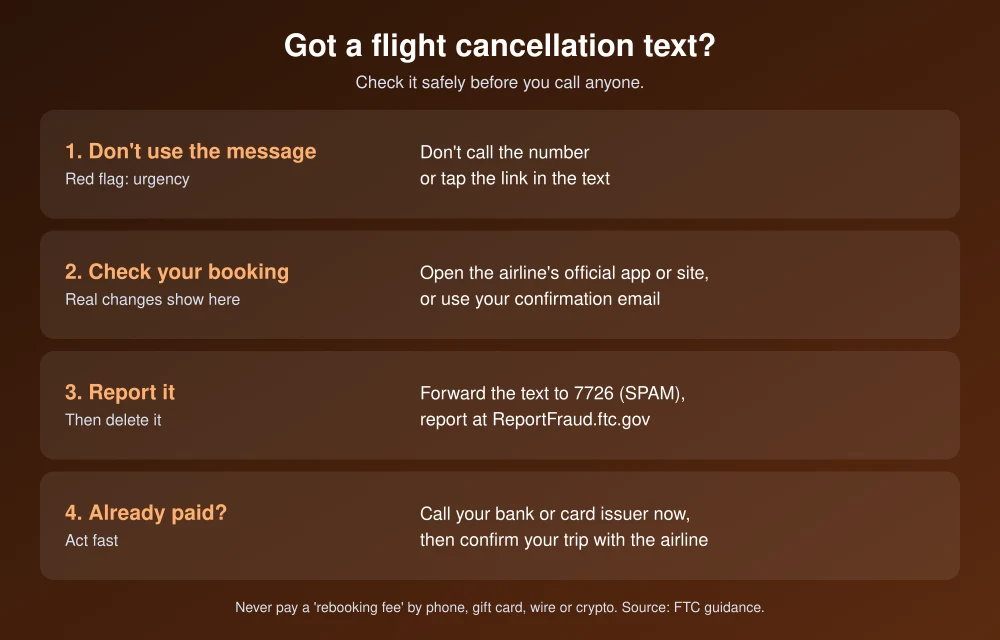
Quick answer: Don’t call the number or tap the link in an unexpected flight cancellation text. Open your airline’s official app or website, or call the number on the back of your confirmation email, and check your trip there. Real cancellations show up in your booking. Forward the scam text to 7726 (SPAM), report it at ReportFraud.ftc.gov, and if you paid a scammer, call your bank or card issuer right away.
How the fake flight cancellation scam works
The pattern has been reported repeatedly over past holiday seasons, and it usually goes like this:
- The hook: a text or call that looks like it’s from your airline says your flight was delayed or canceled. Scammers use airline names, logos and flight numbers to look legitimate.
- The pressure: phrases like “act fast” or “your seat will be canceled” push you to respond before you think.
- The switch: you call the number in the message, or click through to a site that looks like the airline’s, and a fake agent offers to rebook you.
- The payment: you’re asked to pay a “change fee” or fare difference, or to confirm your card and personal details. That money and data go to the scammer.
Some people find the fake number without any text at all, by searching for their airline’s customer service number and calling a sponsored result. In one widely reported case, a traveler who believed they were talking to their airline was rebooked onto fake tickets and charged thousands of dollars.
7 signs a flight cancellation text is fake
- It came out of nowhere. If you didn’t opt in to text alerts with that airline, be suspicious.
- It gives a phone number to call. Airlines usually rebook you automatically or in their app. A message that pushes you to a random number is a red flag.
- The sender is a regular 10-digit number or email address, not the short code your airline normally uses.
- The link doesn’t match the airline’s real website. Look for extra words, odd spellings or unfamiliar domains.
- It rushes you. Real disruptions are stressful, but airlines don’t threaten to cancel your seat in minutes if you don’t call.
- It asks for payment by phone, gift card, wire transfer, crypto or payment app. The FTC warns not to pay anyone who insists on those methods.
- Your booking doesn’t show a change. The single best test: if the airline’s own app still shows your flight on time, the text is fake.
What to do if you get one
- Don’t reply, call or tap anything in the message. The FTC’s advice for unexpected texts is simple: don’t click on any links.
- Check your trip the safe way. Open the airline’s official app, type the airline’s website address yourself, or use the number in your original booking confirmation. Not the contact details in the text.
- Forward the text to 7726 (SPAM). According to the FTC, this helps your wireless carrier spot and block similar messages.
- Report it at ReportFraud.ftc.gov, and use the “Report junk” or “Report spam” option in your messaging app.
- Delete it once it’s reported.
If you already paid or shared details
- Call your bank or card issuer immediately using the number on your card. Ask them to block the charge and issue a new card.
- Contact the real airline to confirm your actual booking is still valid.
- Change passwords for your airline account and email if you shared them, and turn on two-factor authentication.
- Watch your credit. If you gave out your Social Security number or ID details, follow our data breach checklist and consider a credit freeze.
- Report it to the FTC and your state attorney general, as the FTC’s travel scam guide recommends.
Watch for hotel booking scams too
On November 13, the American Hotel and Lodging Association warned travelers about deceptive hotel booking websites that copy real hotel sites, with misleading prices, hidden fees and fake reservations. Its advice is to book directly through the hotel’s official website, app or reservation line, and to call the hotel to confirm. That applies to rental cars and vacation rentals too.
A real disruption? Do this instead
Thanksgiving weather and system outages do cause real cancellations. If your flight is genuinely canceled, the change will appear in your airline’s app, and that’s where you’ll find rebooking options. Know what you’re owed before you talk to anyone: our guide to the recent United Airlines outage covers refunds and meal vouchers, and the same principles apply to other airlines.
FAQs
Do airlines send flight cancellation texts?
Yes, if you signed up for alerts. But a real alert matches what’s in the airline’s app or website. If the app still shows your flight on schedule, treat the text as a scam.
Should I call the number in a flight cancellation text?
No. Call the airline using a number from its official website, app or your booking confirmation. Scam texts often include fake customer service numbers.
Where do I report a fake airline text?
Forward it to 7726 (SPAM) to alert your carrier, report it at ReportFraud.ftc.gov, and use the report junk option in your messaging app.
What if I already paid a fake airline agent?
Call your bank or card issuer right away to dispute the charge and block the card, then confirm your real booking directly with the airline and report the scam to the FTC.
Featured image: AAA.
Disclosure: TheTechHacker has no paid relationship with AAA, any airline or any company mentioned here.
More in Guides
Black Friday 2026 Tech Buying Guide: What’s Worth Buying and What to Skip
Black Friday 2026 is November 27, eight days after GTA 6 launches. Here’s my practical guide to which phones, laptops, consoles, storage, earbuds, smart home gear and TVs are worth buying, and how to avoid fake discounts.

Black Friday 2026 Tech Deals: Sale Dates at Amazon, Best Buy and Walmart
Black Friday 2026 is on Friday, November 27, but the big tech sales have already started. Amazon and Best Buy both launched their main Black Friday events on November 19, and Walmart’s starts online on November 23. Here are the official dates for each retailer, when the best tech deals drop, and how to make…
Best Business Phone Systems (VoIP) for Small Businesses in 2026
A guide to choosing a small business VoIP phone system in 2026, covering RingCentral, Nextiva, Dialpad, Zoom Phone, Google Voice, Teams Phone, Grasshopper and Quo, plus the 10DLC, E911 and porting details most buyers miss.
The week in tech, minus the noise.
New reviews, fixes and the stories that matter — once a week, straight to your inbox.
We only use your email to send the newsletter. Unsubscribe any time. See our privacy policy.
Comments