

How to Spot a Fake Hotel Booking Site Before You Pay
You search for your hotel, click the top result, and book. The site looks just like the hotel’s own. Then you arrive to find no reservation, a higher price than you were quoted, or a “non-refundable” booking you never agreed to. A November 12, 2026 survey for the American Hotel & Lodging Association (AHLA) found…
Image: AHLA
You search for your hotel, click the top result, and book. The site looks just like the hotel’s own. Then you arrive to find no reservation, a higher price than you were quoted, or a “non-refundable” booking you never agreed to. A November 12, 2026 survey for the American Hotel & Lodging Association (AHLA) found that about half of consumers mistook deceptive booking sites for official hotel websites. Holiday travel is when people book in a hurry. This guide covers the warning signs, a 2-minute check before you pay, and what to do if you’ve already been caught.
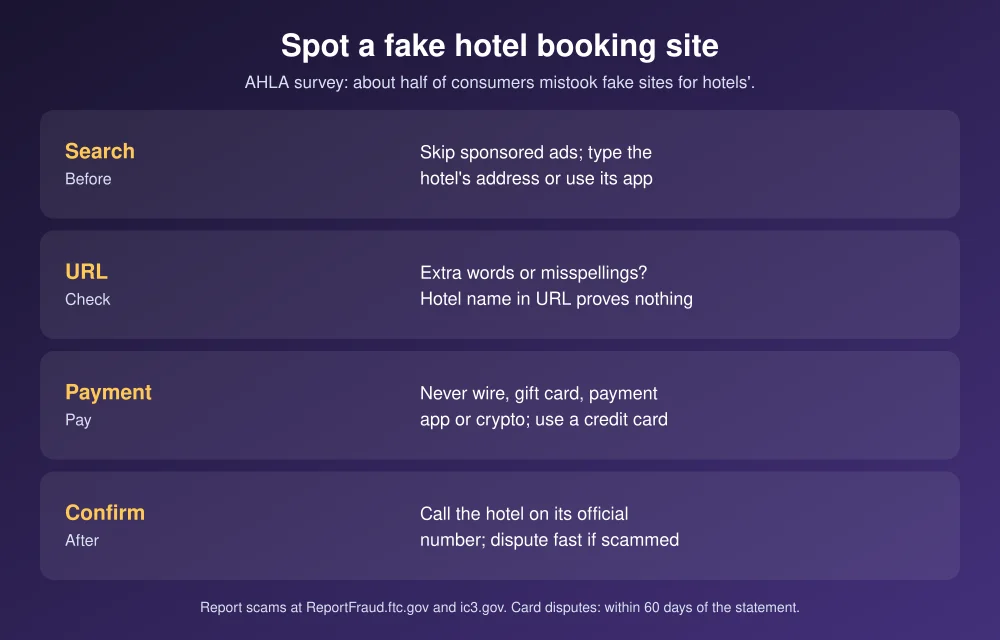
Quick answer: To avoid a fake hotel booking site, skip the ads at the top of search results, type the hotel chain’s web address yourself or use its app, and check the URL for extra words or misspellings. Having the hotel’s name in the address proves nothing. Be wary of rates far below the hotel’s own site, pressure like “Only 3 rooms left!”, and fees that appear only at checkout. Never pay by wire transfer, gift card, Zelle or another payment app, or crypto. After booking, call the hotel on the number from its official site to confirm the reservation exists. If you were scammed, dispute the charge with your card issuer and report it at ReportFraud.ftc.gov.
How fake and lookalike booking sites work
There are two kinds, and both cost you money.
- Outright scams take your payment for a room that doesn’t exist, or steal your card details. Some run fake “reservation” phone lines. The FTC says scammers “use paid ads and put their number alongside a well-known company’s name.”
- Lookalike third-party sites are real businesses, but they’re dressed to look like the hotel. They often charge more, add fees, or apply strict cancellation terms, and the hotel may not be able to change the booking because it doesn’t own it. In AHLA’s survey, 22% said they’d booked through a site they thought was the hotel’s, then found out another company ran it.
Regulators are paying attention. Reuters reported in October that the FTC is preparing action against Priceline owner Booking Holdings. The case concerns ads that appeared to lead to hotels’ own sites but sent people to a third-party booking site, according to the report. Booking Holdings’ latest quarterly filing says FTC staff intend to recommend a complaint over “disclosures, fees, customer support, and billing practices,” and that no settlement has been agreed. In July, the travel app Hopper agreed to pay $35 million to settle FTC fee allegations.
7 red flags before you pay
- It came from an ad. AHLA’s Look Before You Book guide warns that misleading sites appear “at or near the top of search results.” Look for the “Sponsored” label and scroll past it.
- The URL is off. Watch for extra words such as “reservations,” “booking” or “deals,” misspellings, or odd characters. Having the hotel’s name in the address doesn’t mean the hotel runs the site.
- The price is far lower than on the hotel’s own site, or the total jumps at checkout. Since May 2025, the FTC’s fees rule requires hotel prices to be advertised with the total upfront.
- Pressure tactics such as countdown timers and “Only 3 rooms left!”
- Odd payment requests. The FTC says only scammers insist on wire transfer, gift cards, payment apps or crypto.
- No hotel confirmation number. Ask whether you’ll get one directly from the hotel.
- A padlock you trust too much. The https lock just means the connection is encrypted. Scam sites have one too.
The 2-minute check
| Step | What to do |
|---|---|
| 1. Go direct | Type the chain’s address (for example, the brand’s .com) or open its app, instead of clicking a search result. |
| 2. Compare | If you found a better price elsewhere, check the same dates, room and cancellation terms on the hotel’s site. |
| 3. Read the terms | Find the cancellation and refund policy before paying, and untick pre-selected add-ons, as the FTC advises. |
| 4. Pay safely | Use a credit card for the strongest dispute rights. |
| 5. Confirm | Call the hotel on the number from its official site, not the number in your confirmation email, and ask whether your reservation is in its system. |
Third-party sites aren’t all bad, since legitimate online travel agencies can save money. The point is to know who you’re paying, and to see the full price and cancellation rules before you click Book.
What to do if you’ve been scammed
- Call your card issuer now. The CFPB says you have 60 days after the statement showing the charge to send a written billing-error dispute, and you don’t have to pay the disputed amount during the investigation.
- Paid by payment app, wire or gift card? Contact the app, bank or gift card company immediately and report fraud. These are hard to recover, so speed matters.
- Call the hotel to see whether any booking exists, and book directly if you still need the room.
- Change passwords you entered on the site, and watch your card for new charges.
- Save evidence: screenshots, emails and receipts.
- Report it at ReportFraud.ftc.gov, to the FBI at ic3.gov, and to your state attorney general.
Other holiday travel scams to watch
Hotel scams arrive alongside fake airline texts and payment-page tricks. Learn how to spot fake flight cancellation texts. If you’re flying without a REAL ID, pay only through official channels, as our TSA ConfirmID guide explains. The same checks work for Black Friday shopping too: see how to check if an online store is legit.
FAQs
How can I tell if a hotel booking site is fake?
Check the URL for extra words or misspellings, avoid sponsored search ads, be wary of rates far below the hotel’s own site, and never pay by wire, gift card, payment app or crypto. Confirm the booking by calling the hotel on the number from its official site.
Is it safer to book directly with the hotel?
Booking on the hotel’s own site or app means you know who has your reservation and can change it with the hotel. Legitimate travel agencies can be fine, but check the total price and cancellation terms first.
Can I get my money back from a fake booking site?
If you paid by credit card, dispute the charge with your issuer. The CFPB says to send a written dispute within 60 days of the statement. Payments by wire, gift card or crypto are much harder to recover.
Where do I report a hotel booking scam?
Report it to the FTC at ReportFraud.ftc.gov, to the FBI at ic3.gov, and to your state attorney general.
Featured image: American Hotel & Lodging Association.
Disclosure: TheTechHacker has no paid relationship with AHLA, Booking Holdings, Hopper or any company mentioned here. This is general consumer information, not legal advice.
More in Guides

How to Spot Fake Flight Cancellation Texts Before Thanksgiving Travel
Thanksgiving week is the busiest stretch of the year for travel scams, and fake flight cancellation messages are one of the nastiest. A text arrives saying your flight was canceled, it uses your airline’s name and sometimes a real-looking flight number, and it gives you a number to call or a link to “rebook.” The…
How to Track Black Friday Price Drops and Spot Fake Discounts (Google, Chrome, Amazon)
Every Black Friday listing says “deal,” but plenty of them aren’t. A TV marked “$300 off” might have sold at the sale price for months, and a “was” price can come from a list price almost nobody paid. The good news is you don’t need a browser extension or a spreadsheet to see through it.…
How to Check If an Online Store Is Legit Before You Buy on Black Friday
Black Friday is November 27, and fake online stores are already running ads. They look like real shops, with polished product photos, AI-written descriptions, five-star reviews and prices that are hard to ignore. You pay, and the order never arrives, or a cheap knockoff does. Most fake stores share the same warning signs, and checking…
The week in tech, minus the noise.
New reviews, fixes and the stories that matter — once a week, straight to your inbox.
We only use your email to send the newsletter. Unsubscribe any time. See our privacy policy.
Comments