

Neuralink Gets FDA Approval for LINK, Its First Pivotal Brain Implant Trial for ALS
Neuralink's LINK pivotal trial for people with ALS has FDA approval. What a pivotal trial is, what it tests, how the implant works and how to join.
Neuralink has FDA approval to start what it calls the first pivotal trial of an implantable brain-computer interface in the US. The study, named LINK, will test whether people with ALS can control digital devices using thought alone, and whether the implant is safe over the long term.
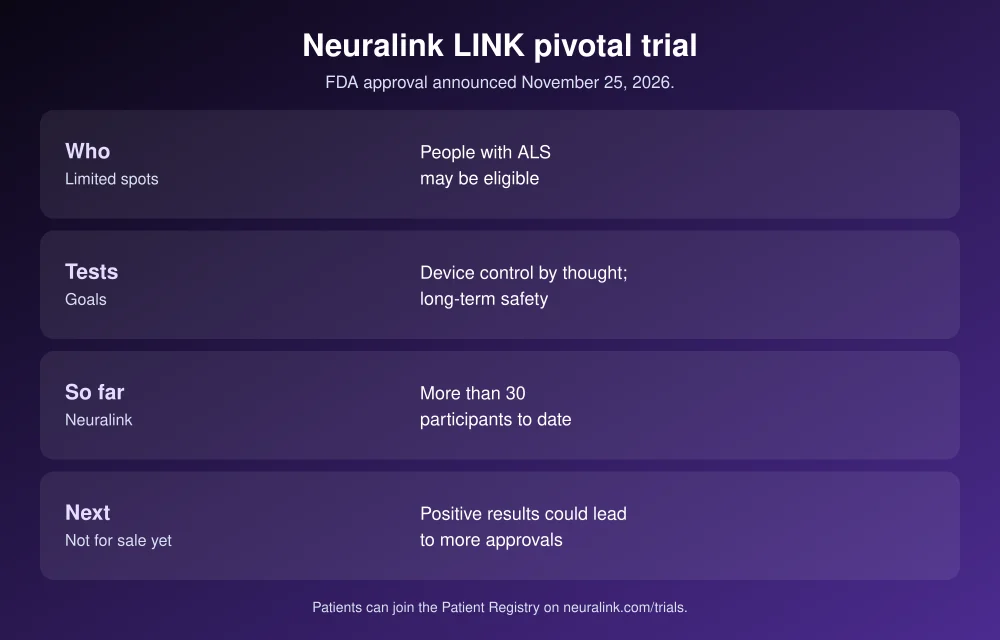
Quick answer: Neuralink announced on November 25 that the FDA approved its LINK pivotal trial for its brain implant. It’s open to a limited number of people with ALS. Neuralink hasn’t published other eligibility rules or the number of participants. The company says it has worked with more than 30 participants so far. People with ALS can join Neuralink’s Patient Registry on its clinical trials page.
What Is a Pivotal Trial?
A pivotal trial is a larger, later-stage study meant to show whether a device works and is safe enough for regulators to consider approving it for wider use. It’s a step beyond the early feasibility studies Neuralink has run so far. FDA approval to start the trial isn’t approval to sell the implant.
What the Trial Will Test
- How well people with ALS can control computers and other digital devices by thought, “with a focus on functional outcomes that improve independence in daily life,” Neuralink said.
- Long-term safety and reliability of the system.
How the Neuralink Implant Works
The N1 implant sits in the skull. Neuralink’s R1 surgical robot inserts thin, flexible electrode threads into the brain. Software reads movement-related brain activity and turns it into commands for a computer or phone, Engadget explains.
Who Can Join
- People with ALS may be eligible for LINK, Neuralink said.
- Neuralink’s clinical trials page also lists an active trial for hands-free control of a computer and robotic arm for people with quadriplegia from ALS, brain stem stroke or spinal cord injury.
- Interested patients can join the Patient Registry linked from that page. Talk to your neurologist before applying.
Why It Matters
ALS damages the nerve cells that control voluntary muscles, and many patients lose the ability to speak or type. Neuralink’s first ALS participant, Bradford Smith, was able to communicate using brain signals alone, the company reported last year. If LINK succeeds, Neuralink could apply for further approvals and eventually bring the device to market. More about the company is on Neuralink’s website.
Earlier coverage: how Neuralink’s brain threads were first announced and Neuralink’s 2023 updates. For more on AI and health data, see what Siri AI can read in iOS 27.3.
FAQs
What did the FDA approve for Neuralink?
Permission to start LINK, a pivotal trial of its implantable brain-computer interface in people with ALS.
Can I sign up for the Neuralink trial?
People with ALS may be eligible. Neuralink’s clinical trials page links to a Patient Registry.
Is the Neuralink implant approved for sale?
No. The trial approval lets Neuralink test it, not sell it.
How many people have Neuralink implants?
Neuralink says it has worked with more than 30 participants so far.
Featured image: Neuralink.
Disclosure: TheTechHacker has no paid relationship with Neuralink.
More in News

Best Social Media Management Tools for Small Businesses (2026): Buffer vs Hootsuite vs Sprout Social vs Later vs Meta Business Suite
I compare Buffer, Meta Business Suite, Sprout Social, Hootsuite and Later on scheduling, analytics, inbox and pricing to help a small business pick the right social media tool, with clear notes on what I could and couldn’t confirm.

Best Construction Management Software in 2026: Procore, Buildertrend, Autodesk and More
Comparing construction management software for 2026: a custom ERP option, Procore, Buildertrend (now including CoConstruct), Autodesk Construction Cloud and Contractor Foreman, with honest notes on estimating, scheduling, change orders and pricing.

Best Project Management Software for Small Teams: Asana vs monday vs ClickUp vs Trello (2026)
Asana, monday.com, ClickUp, Trello, Notion and Basecamp suit different kinds of small teams. Here’s what to compare, which tool fits which team type, and how to roll one out so people use it.
The week in tech, minus the noise.
New reviews, fixes and the stories that matter — once a week, straight to your inbox.
We only use your email to send the newsletter. Unsubscribe any time. See our privacy policy.
Comments