

Best Fleet Management and GPS Tracking Software for Small Businesses (2026)
Compare fleet management and GPS tracking software for US small businesses, with confirmed Azuga pricing, FMCSA ELD rule basics, contract questions, driver privacy and how to choose by fleet size and industry.

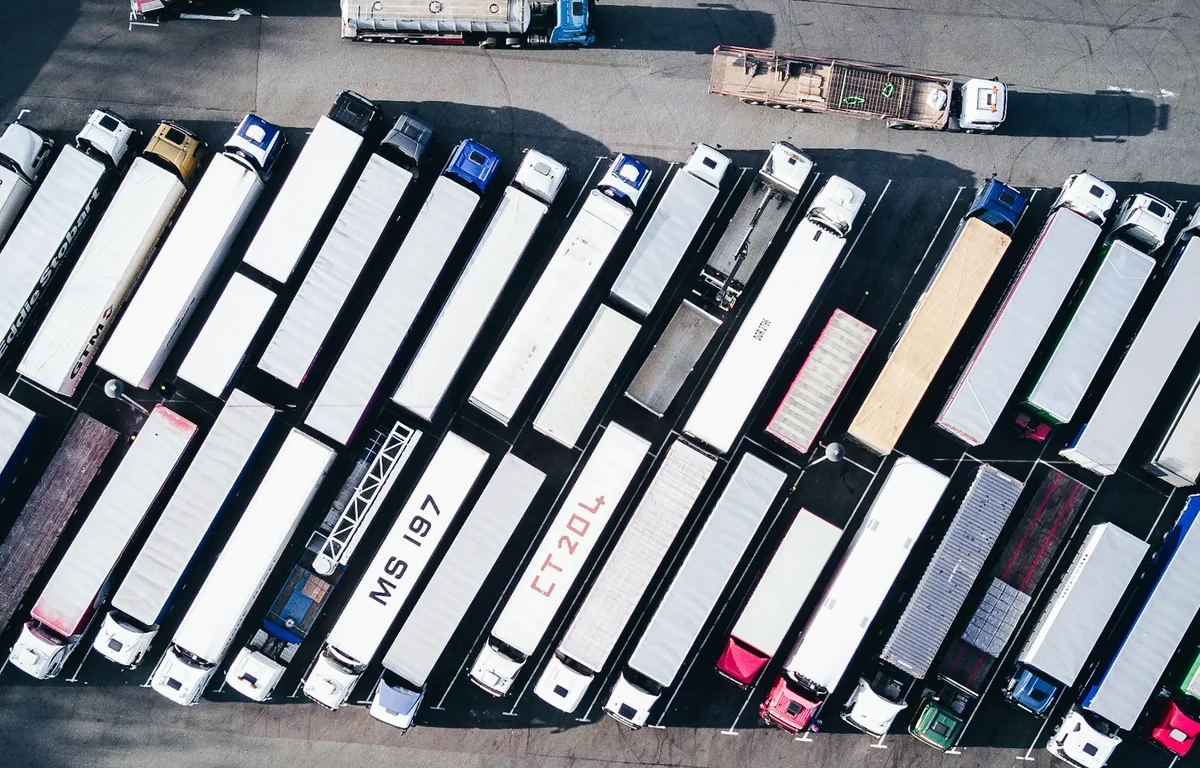
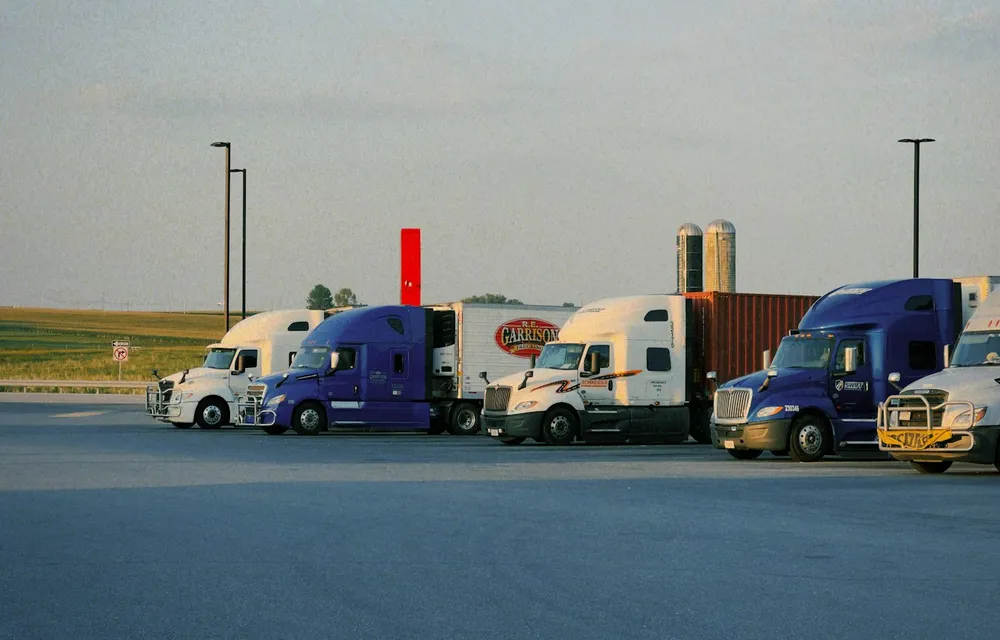
Photo by Nigel Tadyanehondo on Unsplash
If you run a few vans, a couple of service trucks or a small trucking outfit, I’m guessing you’ve had this moment. A customer calls asking where the technician is, and you honestly have no idea. Or a driver mentions the brakes have felt soft for a week (a whole week!) and nobody wrote it down anywhere.
That’s the gap fleet management software is supposed to fill. At the most basic level, it’s a GPS tracker in every vehicle and a map that shows you all of them. Most platforms do a lot more than that though, and which extras you actually need really depends on what your vehicles are doing all day.
Quick note on how I put this together, because I want to be upfront. I worked from official vendor and government pages. For several of the big names I couldn’t confirm pricing or current features on an official page, and where that happened I just say so instead of guessing. Prices change too. So treat every number here as a starting point for your own quote, nothing more.
Quick answer: First, work out whether your drivers have to keep records of duty status, because if they do, you need an ELD from FMCSA’s registered list. Of the off-the-shelf tools here, Azuga is the only one whose pricing I could confirm on an official page: $25 to $35 per vehicle per month, plus an optional AI dash cam. Samsara and Motive didn’t show public prices on any official page I could reach, so plan on requesting quotes, and look at Fleetio if maintenance is your main headache. If you run logistics or distribution and want vehicles tied to loads, orders and invoices, a custom logistics ERP like ours is worth a conversation.
What fleet management software actually does
The phrase covers a lot of ground, honestly. The heart of it is live GPS tracking. There’s a small device called a telematics unit (basically a tracker that also reads vehicle data and sends it out over a cellular connection), and it reports where each vehicle is and what it’s doing. You see all of it on a map, in a web dashboard or a phone app.
Routing and dispatch come next. So instead of a dispatcher texting addresses to everyone, the software helps plan the stops and send jobs out to drivers. Some businesses that have in-house developers build their own routing on top of mapping tools like Google Maps Platform’s Route Optimization API. For most small fleets though? A ready-made platform is the quicker path.
For trucks, ELD and HOS compliance is often the whole reason people buy in the first place. ELD is short for electronic logging device. HOS means hours of service, which are the federal limits on how long commercial drivers can drive and work. I’ll get into the rule more below.
Then you’ve got driver behavior and safety. Platforms usually flag stuff like speeding and harsh braking, and some of them turn that into driver scores. Dash cams add video on top, which can really help when there’s a dispute about what actually happened on the road.
On the money side, some platforms work with fuel cards, so you can match fuel purchases to specific vehicles. Maintenance reminders tell you when an oil change or inspection is due. And if your trucks run in more than one state, IFTA reporting matters. IFTA is the International Fuel Tax Agreement, and basically it means tracking how many miles you drove in each state for your fuel tax filings. Doing that by hand from paper logs? Nobody’s idea of fun, trust me.
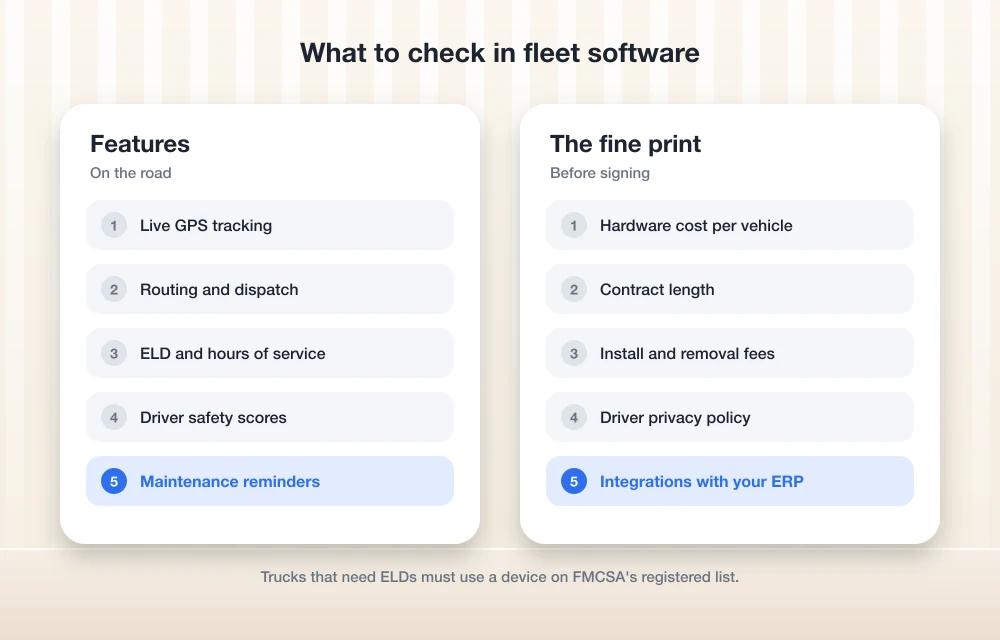
The FMCSA ELD rule: what small fleets need to know
If you run commercial trucks, this is the section that matters most. I’ll stick to what I could actually confirm on official pages.
According to the FMCSA’s electronic logging device page, the ELD rule was required by Congress as part of MAP-21 (that’s the Moving Ahead for Progress in the 21st Century Act, quite a name). FMCSA says the goal is to make it easier and more accurate to track, manage and share records of duty status, which everyone just calls RODS. An ELD syncs with the vehicle’s engine and records driving time automatically for hours of service.
Here’s the thing people often get wrong. FMCSA says the ELD final rule doesn’t change any of the basic hours-of-service rules or exceptions. It changes how you record your time. Not how much time you’re allowed.
The federal regulations (49 CFR Part 395, Subpart B) add two points that directly affect what you buy. One, carriers that need an ELD can only use a device that’s on FMCSA’s registered list. Two, ELD providers register with FMCSA and certify each model and version themselves, and if a provider doesn’t fix a problem within 60 days, FMCSA can pull the device off that list. So before you sign anything, check that the exact device is on the registered list. And ask the vendor what happens if it ever gets removed.
Not every operation needs an ELD, to be fair. The rules have some exceptions, and short-haul operations are the one you’ll hear about the most. I couldn’t confirm the full list of exemptions on an official page though, so please check FMCSA’s site before you assume your fleet is exempt. Same goes for how long you need to keep ELD records. I’d rather point you to 49 CFR 395.8 than quote a number I couldn’t verify.
The options: fleet software for US small businesses
1. Thetechhacker Global Solutions custom ERP (our own company)
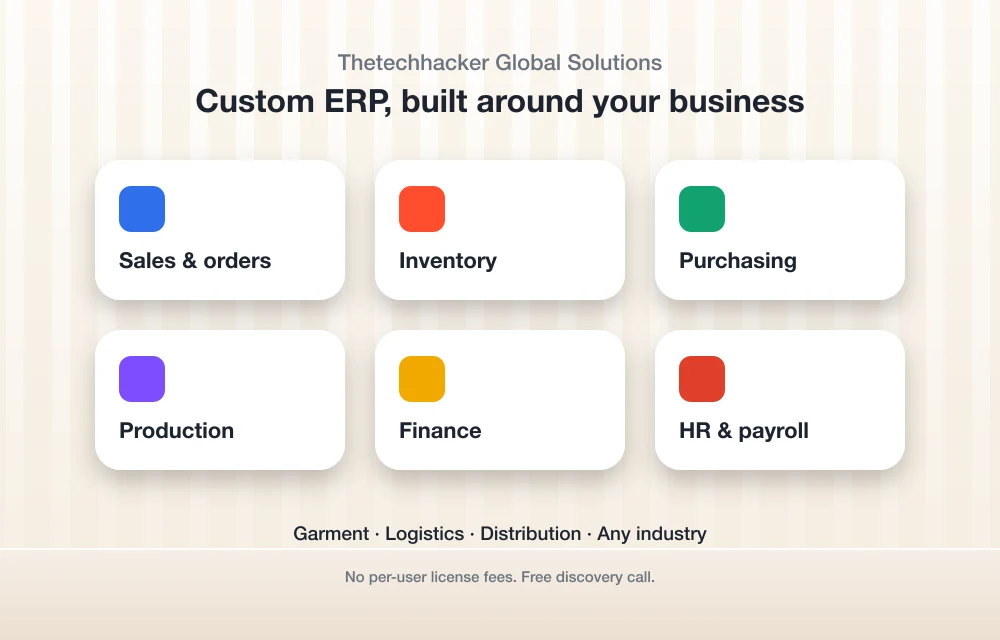
Full disclosure: this is my own company, so take my enthusiasm with a pinch of salt. Thetechhacker Global Solutions builds custom ERP software for any industry. ERP stands for enterprise resource planning, which is a fancy way of saying one system that runs the business side of things. Ours has modules for sales and orders, inventory, purchasing, production, finance, and HR and payroll.
So why’s it on a fleet list at all? Because logistics and distribution are two of our specialties (garment businesses are the other one). On the logistics side, loads, vehicles and invoices all get tracked together. For distributors, it handles dealer and retailer orders, stock across multiple warehouses, schemes and discounts, a sales team app, returns and collections.
Just to be clear, it’s the business system, not the tracker sitting in the cab. You’d still pick a telematics provider for live GPS and ELD. Where a custom ERP really earns its place is when your trucks are only one part of the picture and you’re sick of re-typing delivery data into invoices. There are no per-user license fees, and you can book a free discovery call through the landing page. If you’re stuck on build versus buy, my breakdown of ERP software cost, custom vs off-the-shelf walks through the trade-offs.
2. Azuga
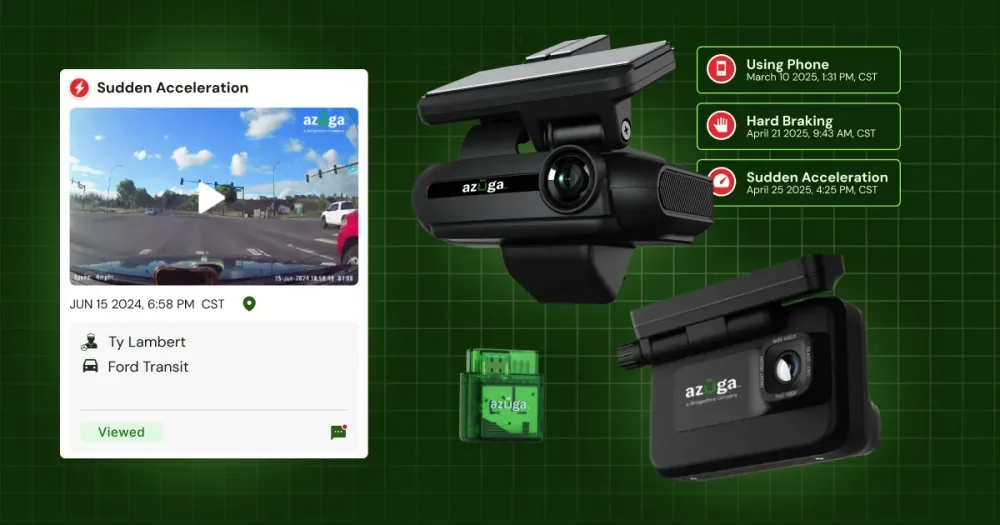
Azuga is the easiest one to budget for, simply because it publishes its prices. According to Azuga’s official pricing page, BasicFleet is $25 per vehicle per month. For that you get GPS tracking, alerts and notifications, driver scores, driver rewards, reports, TrackMe, scheduled maintenance and geofencing. (Geofencing just means drawing a virtual boundary on the map so you get an alert when a vehicle goes in or out of it.)
SafeFleet is $30 per vehicle per month and piles safety features on top, including SpeedSafe, distracted-driving prevention and panic alerts. Then there’s a third tier at $35 per vehicle per month that adds tailored services. Azuga’s other pages call that one CompleteFleet.
The SafetyCam AI dash cam is an add-on at $41.99 per month. The pricing page doesn’t actually say if that’s per vehicle or per camera, so ask. Azuga’s custom quote tool covers trucks, vans, cars, buses, semis, trailers and construction equipment, and it lists dash cams, ELD/eLogs, route optimization, maintenance and field service features.
What I couldn’t confirm? Contract length, hardware costs and installation fees. Get those in writing before you sign anything.
3. Samsara
You’ll bump into Samsara pretty quickly once you start shopping around. When I was researching this, I couldn’t get to an official pricing page, and I couldn’t verify the current feature list on samsara.com either. From what I can tell, pricing is by quote. When you ask, be specific about GPS tracking, ELD, dash cams and maintenance tools, and confirm which of those cost extra.
4. Motive

Same story with Motive, honestly. I couldn’t find public pricing on an official page, so treat it as quote-based. I also couldn’t confirm its features from gomotive.com for this piece. If ELD compliance is your big priority, make sure the specific Motive device you’d be getting is on FMCSA’s registered list.
5. Verizon Connect

Verizon Connect is another name that shows up on most shortlists. I couldn’t see official pricing, contract terms or fees while I was researching, so I’m not going to describe its plans. Head to verizonconnect.com and ask for a quote with the hardware and contract details spelled out.
6. Geotab

Geotab puts out a fair amount of educational material on ELDs, which is good reading if the rule is new to you. I couldn’t confirm its pricing or how it sells, though. My understanding is it often sells through partners rather than directly, but that’s unconfirmed, so check geotab.com.
7. GPS Insight
I wanted GPS Insight in here, but I couldn’t check its official pages for this article. And I’m not going to describe features or prices I can’t stand behind. So I’ll just say it’s worth adding to your quote list, and ask it the same questions you’d ask everyone else.
8. Fleetio (for fleet maintenance)

Fleetio is on this list for a different reason. It’s the one I’d look at if your headache is maintenance rather than location, so service schedules, repair history and keeping vehicles on the road. I couldn’t confirm its current plans or prices, so check fleetio.com/pricing directly. Plenty of fleets pair a dedicated fleet maintenance software tool with a separate GPS tracker, by the way.
Side-by-side summary
| Option | What I could confirm on official pages | Published pricing |
|---|---|---|
| Thetechhacker custom ERP (ours) | Custom ERP for any industry; logistics and distribution specialties | No per-user license fees; free discovery call |
| Azuga | GPS, driver scores, maintenance, geofencing; safety tier; dash cam add-on | $25, $30 or $35 per vehicle per month; dash cam $41.99/month |
| Samsara | Not confirmed | Not found; request a quote |
| Motive | Not confirmed | Not found; request a quote |
| Verizon Connect | Not confirmed | Not found; request a quote |
| Geotab | Publishes ELD educational material | Not confirmed |
| GPS Insight | Not confirmed | Not confirmed |
| Fleetio | Not confirmed (listed here for maintenance) | Not confirmed |
Hardware vs software costs and contracts
When people ask me about fleet GPS tracking cost, they usually mean the monthly software fee. That’s only part of the bill. Azuga’s published tiers show the common model, which is a monthly price per vehicle for the software. On top of that you might be paying for the tracking device itself, dash cams, an in-cab tablet or display for ELD logs, and somebody to install all of it.
Most vendors don’t publish those extras, so your quote is where the real number lives. These are the questions I’d ask every single vendor:
- Is the hardware bought, leased, or just included in the monthly fee?
- Who installs it, and is there a charge for installation?
- How long is the contract, and what does it cost me to leave early?
- Is pricing per vehicle, per device or per camera?
- If I cancel, what happens to the hardware and my data?
- Does the price go up at renewal?
A cheaper monthly fee doesn’t mean much if you’re stuck in a long contract you can’t get out of when your fleet shrinks.
Driver privacy: sort this out before you install anything
Nothing kills a rollout faster than drivers finding a tracker nobody told them about. I’d write a short policy first. Say what’s being tracked, why you’re tracking it and who gets to see the data. If drivers take vehicles home, decide upfront how off-duty or personal use is handled.
Dash cams need extra thought, especially the driver-facing ones. Explain what triggers a recording and how long footage is kept. My understanding is the federal ELD rules also include protections against drivers being harassed using ELD data, but I couldn’t confirm the exact text on an official page, so check FMCSA’s site if this applies to you.
I’m not a lawyer (obviously), and the rules on monitoring employees can differ from state to state. A quick chat with an employment attorney is cheap insurance.
How to pick by fleet size and industry
Small service fleets (a handful of vans or cars)
If you’re running HVAC, plumbing, cleaning or sales vehicles, you probably care most about live location, dispatch and maintenance reminders. You might not need an ELD at all if your drivers aren’t required to keep RODS. A published per-vehicle price like Azuga’s gives you a handy benchmark when the other quotes start coming in. And since dispatch pretty much lives on the phone, it’s worth sorting out your calls too. My guide to small business VoIP phone systems covers that side of it.
Trucking fleets
For any ELD mandate small fleet situation, the registered list is non-negotiable. Period. After that, look at IFTA reporting, dash cams and driver safety tools. Get every vendor to confirm in writing which device you’ll actually receive and that it’s registered with FMCSA.
Construction and mixed equipment
Got trailers and equipment alongside your trucks? Ask each vendor how they handle assets that don’t have an engine. Azuga’s quote tool lists trailers and construction equipment, which suggests it’s set up for mixed fleets, but confirm the details for your own gear.
Logistics and distribution businesses
Here the tracker is only half the job. The other half is tying deliveries to orders, warehouse stock and invoices. That’s where a custom logistics ERP makes sense, running alongside your telematics provider.
Maintenance-heavy fleets
If breakdowns cost you more than late arrivals do, start with a maintenance tool like Fleetio and add tracking later if you need it.
Which one I’d pick
I’ll be real, there’s no single best fleet management software for every small business, and anyone telling you otherwise is probably selling one. If I were setting up a small fleet tomorrow, I’d sort out the ELD question first. Then I’d shortlist two or three vendors and get written quotes with hardware, installation and contract terms spelled out. I’d also ask if I could pilot it on a couple of vehicles before committing the whole fleet.
Azuga’s the easiest place to start for budgeting since its prices are public. For the quote-based platforms, the quote is the comparison, really. And if your fleet is actually one piece of a bigger logistics or distribution business, talk to us about how a custom ERP could pull the rest of it together.
Frequently Asked Questions
Do small fleets need an ELD?
It depends on whether your drivers have to keep records of duty status (RODS). If you’re a carrier that needs an ELD, it has to be one from FMCSA’s registered list. There are some exceptions, like certain short-haul operations, but check FMCSA’s official ELD page before you assume your fleet is exempt. FMCSA also says the ELD rule doesn’t change the basic hours-of-service rules. It only changes how driving time gets recorded.
How much does fleet GPS tracking cost?
Azuga’s official pricing page lists $25, $30 and $35 per vehicle per month for its three tiers, and there’s a SafetyCam AI dash cam add-on at $41.99 per month. Samsara, Motive and several others didn’t show public prices on any official pages I could reach, so you’ll need a quote. Hardware, installation and contract terms can push the total up, and prices change.
Can I use any ELD device for compliance?
Nope. Under the federal rules, carriers that need an ELD can only use a device that’s on FMCSA’s registered list. Providers certify their own devices, and if a problem isn’t fixed within 60 days, FMCSA can remove the device from the list.
What’s the difference between fleet tracking and fleet maintenance software?
Fleet tracking is about where your vehicles are and how they’re being driven, using GPS and telematics. Fleet maintenance software is about service schedules and repair history. Some platforms throw in basic maintenance reminders, and some fleets pair a tracker with a separate maintenance tool like Fleetio.
Does a custom ERP replace GPS tracking software?
No, it doesn’t. A custom ERP, like the one Thetechhacker Global Solutions (our own company) builds, handles the business side of things such as loads, vehicles, orders, inventory and invoices. You’d still use a telematics provider for live GPS and ELD.
Featured image: Nigel Tadyanehondo on Unsplash.
You might also like

Best Employee Scheduling and Time Tracking Software (2026)
These are the employee scheduling and time tracking apps I’d shortlist for US small businesses in 2026, with the FLSA overtime and recordkeeping basics and how to choose for restaurants, retail, field service and offices.

10 of the Best QuickBooks Alternatives
It’s no secret that Quickbooks is one of the most popular accounting programs. QuickBooks is one of the most well-known small and medium-level business accounting solutions, especially in the US. With certain packages, it offers simple inventory management tools for small businesses. However, like with any system, there are advantages and disadvantages to selecting QuickBooks…

Best CRM Software for Small Businesses in the US
Making sure that your customers are happy is probably the most crucial thing you can do as a business owner. Making them unhappy is digging your own hole. To keep them satisfied, you need the help of a perfect CRM tool. Not only to maintain better customer relationship, but a good CRM software will also…
The week in tech, minus the noise.
New reviews, fixes and the stories that matter — once a week, straight to your inbox.
We only use your email to send the newsletter. Unsubscribe any time. See our privacy policy.
Comments