

2027 Roth IRA Income Limits: New IRS Phase-Out Ranges and Contribution Limits
The IRS has set the 2027 income limits for contributing to a Roth IRA, and they are higher than this year’s. If you were close to the cutoff in 2026, the new ranges may let you contribute directly again. The agency announced the figures on November 12, 2026, alongside a higher 401(k) limit and an…

Photo by Napendra Singh on Unsplash
The IRS has set the 2027 income limits for contributing to a Roth IRA, and they are higher than this year’s. If you were close to the cutoff in 2026, the new ranges may let you contribute directly again. The agency announced the figures on November 12, 2026, alongside a higher 401(k) limit and an IRA contribution limit that stays at $7,500.
Quick answer: For 2027, the Roth IRA phase-out range is $158,000 to $173,000 of modified adjusted gross income (MAGI) for single and head-of-household filers, and $250,000 to $260,000 for married couples filing jointly. Below the range you can contribute the full $7,500 ($8,600 if you are 50 or older). Inside it, your limit shrinks. Above it, you cannot contribute directly.
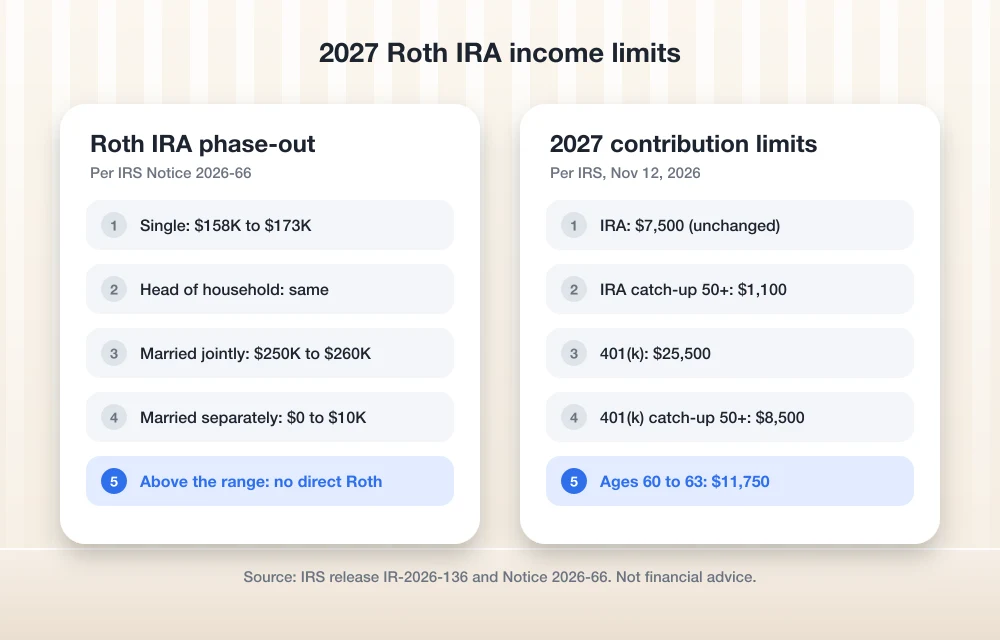
2027 Roth IRA Income Limits by Filing Status
According to the IRS announcement (IR-2026-136) and Notice 2026-66, these are the MAGI phase-out ranges for Roth IRA contributions:
| Filing status | 2026 range | 2027 range |
|---|---|---|
| Single or head of household | $153,000 to $168,000 | $158,000 to $173,000 |
| Married filing jointly | $242,000 to $252,000 | $250,000 to $260,000 |
| Married filing separately | $0 to $10,000 | $0 to $10,000 |
The married-filing-separately range is not adjusted for inflation, so it stays the same every year.
How the Phase-Out Works
Your income decides how much you can put into a Roth IRA:
- Below the range: you can contribute the full annual limit.
- Inside the range: your allowed contribution drops gradually as income rises. The IRS has a worksheet for the exact amount in Publication 590-A.
- Above the range: you cannot contribute directly to a Roth IRA for that year.
For example, a single filer with $150,000 of MAGI in 2027 is below $158,000 and can contribute the full amount. A single filer at $175,000 is above $173,000 and cannot contribute directly.
2027 Contribution Limits
- IRA (traditional and Roth combined): $7,500, unchanged from 2026.
- IRA catch-up, age 50 and older: $1,100, so the total is $8,600.
- 401(k), 403(b), most 457 plans and the Thrift Savings Plan: $25,500, up from $24,500.
- 401(k) catch-up, age 50 and older: $8,500, up from $8,000.
- Catch-up for ages 60 to 63: $11,750 in those plans.
Traditional IRA Deduction Limits for 2027
If you or your spouse has a workplace retirement plan, your traditional IRA deduction also phases out by income. For 2027, the IRS lists $83,000 to $93,000 for single filers covered by a workplace plan, and $133,000 to $153,000 for married couples where the contributing spouse is covered. If only the other spouse is covered, the range is $250,000 to $260,000.
What to Do Now
- Estimate your 2027 MAGI and compare it with the new range for your filing status.
- Remember the deadline: you can make 2027 IRA contributions until the 2028 tax filing deadline.
- Self-employed? If you are setting up a business, our guides to forming an LLC and running payroll cover the basics before you think about retirement plans for yourself or employees.
Planning money moves online? See how ChatGPT Wallet handles payments.
This article explains IRS rules and is not personalized financial or tax advice. Check with a tax professional about your situation.
FAQs
What is the Roth IRA income limit for 2027?
The phase-out range is $158,000 to $173,000 for single and head-of-household filers and $250,000 to $260,000 for married couples filing jointly, according to the IRS.
How much can I contribute to a Roth IRA in 2027?
Up to $7,500, or $8,600 if you are 50 or older, as long as your income is below the phase-out range.
Did the IRA contribution limit change for 2027?
No. The IRS kept the IRA limit at $7,500 and the age-50 catch-up at $1,100.
What is the 401(k) limit for 2027?
The employee contribution limit rises to $25,500, with an $8,500 catch-up for workers 50 and older.
Featured image: Napendra Singh on Unsplash.
Disclosure: TheTechHacker has no paid relationship with any financial institution mentioned here.
More in Guides

How to Run Payroll for a Small Business in the US: Step-by-Step Guide (2026)
Hiring your first employee is a big step, and payroll is usually the part that makes new owners nervous, because of the federal forms, tax rates and deposit deadlines that start the moment someone joins. Miss a deposit and the IRS can add penalties, even if you paid the full amount a few days late.…

How to Form an LLC in 2026: Step-by-Step Guide for US Small Businesses
Forming an LLC is one of the first real decisions most US small business owners make, and it’s easier than it sounds. You can usually do it online in an afternoon, often for less than $200 in state fees. Where people get into trouble is the part after filing: missing the annual report, paying a…

How To Optimize uTorrent For Best Downloading Speed – Guide
uTorrent is the most popular desktop torrent downloading client as we all know. After installation, the uTorrent runs in an optimized mode to get best downloading speeds. The uTorrent runs in a set of incoming and outgoing connection settings to reach the highest possible download speeds. But some people complaining the limited speed of the…
The week in tech, minus the noise.
New reviews, fixes and the stories that matter — once a week, straight to your inbox.
We only use your email to send the newsletter. Unsubscribe any time. See our privacy policy.
Comments