

How to Form an LLC in 2026: Step-by-Step Guide for US Small Businesses
Forming an LLC is one of the first real decisions most US small business owners make, and it’s easier than it sounds. You can usually do it online in an afternoon, often for less than $200 in state fees. Where people get into trouble is the part after filing: missing the annual report, paying a…

Photo by Olena Kholina on Unsplash
Forming an LLC is one of the first real decisions most US small business owners make, and it’s easier than it sounds. You can usually do it online in an afternoon, often for less than $200 in state fees. Where people get into trouble is the part after filing: missing the annual report, paying a website for an EIN that’s free, or forgetting to register in the state where they actually do business.
This guide walks through the full process in order, from picking a state to the ongoing filings that keep your LLC in good standing. It also covers what changed recently, including the end of federal beneficial ownership reporting for US companies.
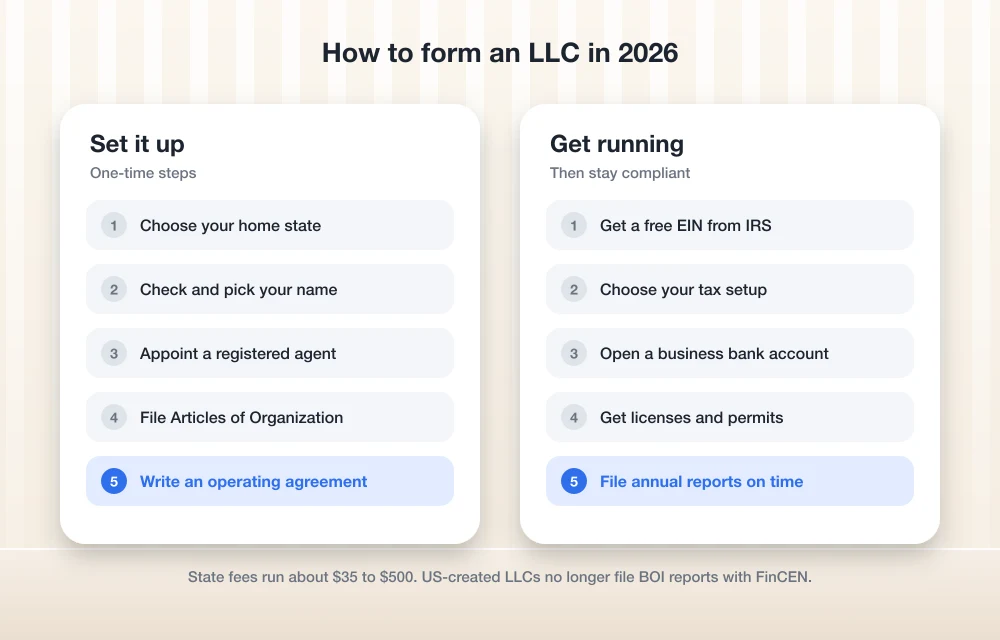
Quick answer: To form an LLC, choose your state (usually the one where you operate), pick a name that includes “LLC,” appoint a registered agent, and file Articles of Organization with your state’s business filing office. Then write an operating agreement, get a free EIN from the IRS, open a business bank account, and get any licenses your business needs. State filing fees range from about $35 to $500. Since August 2026, LLCs created in the US no longer have to file beneficial ownership reports with FinCEN.
Is an LLC right for your business?
A limited liability company separates your personal assets from your business debts and lawsuits, as long as you keep the two properly apart. It’s simpler to run than a corporation, and by default it doesn’t pay its own federal income tax. Profits pass through to the owners.
| Structure | Personal liability protection | Paperwork | Default federal tax |
|---|---|---|---|
| Sole proprietorship | No | Minimal | Owner’s personal return |
| LLC | Yes | Moderate | Pass-through to owners |
| S corporation | Yes | Higher | Pass-through, with payroll for owners |
| C corporation | Yes | Highest | Corporate tax, then tax on dividends |
For most freelancers, consultants, online sellers and local service businesses, an LLC is the practical middle ground. If you plan to raise venture capital, investors usually expect a C corporation instead, so talk to an attorney first.
Step 1: Choose your state
For most small businesses, the right state is simply the one where you live and operate. You’ll often see advice to form in Delaware or Wyoming for lower fees or privacy. The catch is that if you form elsewhere but do business in your home state, you’ll also have to register there as a “foreign LLC.” That means two sets of fees, two annual reports and two registered agents.
Forming out of state can make sense for businesses that operate nationally or plan to raise outside investment. For a bakery in Ohio or a consultant in Arizona, form at home.
Step 2: Pick and check your name
Your LLC’s name must be unique in your state and must include “Limited Liability Company,” “LLC” or “L.L.C.” (the exact options vary slightly by state). Most states also restrict words like “Bank” or “Insurance” unless you’re licensed.
Search your state’s business entity database, usually on the Secretary of State website, to see if the name is taken. It’s also worth checking:
- Whether the matching domain name is available
- The USPTO trademark database, so you don’t build a brand you’ll be forced to change
- Social media handles
Many states let you reserve a name for a small fee if you’re not ready to file yet. If you want to trade under a different name than your legal LLC name, you’ll file a “doing business as” (DBA) name separately.
Step 3: Appoint a registered agent
Every state requires an LLC to have a registered agent: a person or company with a physical address in the state who accepts legal papers and official notices during business hours. You can be your own agent if you have an in-state street address and are usually available there.
Many owners pay a commercial registered agent service, typically a yearly fee, to keep their home address off public records and make sure lawsuits or state notices don’t get missed. If you form in one state and register as a foreign LLC in another, you need an agent in each.
Step 4: File your Articles of Organization
This is the filing that actually creates your LLC. Most states call it Articles of Organization, while some, including Delaware and Texas, call it a Certificate of Formation. You’ll typically provide:
- The LLC’s name and principal address
- Your registered agent’s name and address
- Whether the LLC is member-managed or manager-managed
- The organizer’s name and signature
Most states accept online filing. Fees vary widely, from about $35 at the low end to $500 at the high end, and some states charge extra for faster processing. Some states also have ongoing costs that matter more than the filing fee. California, for example, charges LLCs an $800 minimum annual franchise tax. Always check your Secretary of State’s current fee schedule before you file.
New York has an extra step: within 120 days of forming, an LLC must publish a notice of formation in two newspapers and file proof with the state. That publication can cost far more than the filing fee in New York City counties, so budget for it.
Step 5: Write an operating agreement
An operating agreement sets out who owns what percentage, how decisions get made, how profits are split, and what happens if a member leaves or dies. You usually don’t file it with the state, but a few states, including New York, require LLCs to have one, and banks often ask for it when you open an account.
Even a single-member LLC should have one. It helps show courts and banks that the LLC is a real, separate business, which supports the liability protection you formed it for. For multi-member LLCs, it’s the document that prevents most partner disputes, so it’s worth paying an attorney to review it.
Step 6: Get an EIN from the IRS
An Employer Identification Number is your business’s federal tax ID. You need one to open a bank account in most cases, to hire employees, and to file business tax returns. Multi-member LLCs and LLCs with employees must have one.
The IRS online EIN application is free and gives you the number immediately if you’re approved. A few things to know:
- The IRS says to register your LLC with the state first, or your application may be delayed.
- You’ll need the Social Security number or ITIN of the “responsible party.”
- You must finish in one session, and the form times out after 15 minutes of inactivity.
- The tool runs Monday to Friday from 6 a.m. to 1 a.m. ET, Saturday from 6 a.m. to 9 p.m. ET, and Sunday from 6 p.m. to midnight ET.
- The IRS issues only one EIN per responsible party per day.
The IRS warns about websites that charge for EINs. You never have to pay for one.
Step 7: Understand your tax options
By default, the IRS treats a single-member LLC as a “disregarded entity,” so you report business income on Schedule C with your personal return. A multi-member LLC is taxed as a partnership and files Form 1065, with each member getting a Schedule K-1.
An LLC can also choose to be taxed as a corporation, or as an S corporation by filing Form 2553. Once profits reach a level where paying yourself a reasonable salary and taking the rest as distributions saves on self-employment tax, an S corporation election can make sense. It also adds payroll, so our guide on how to run payroll for a small business becomes relevant. This is a decision to make with a CPA, not on your own.
Don’t forget state taxes. Depending on your state, you may need to register for sales tax, employer withholding or a state-level entity tax.
Step 8: Open a business bank account
Keep business money separate from day one. Mixing personal and business funds is one of the main reasons courts set aside an LLC’s liability protection. Most banks will ask for your EIN, your filed Articles of Organization and, often, your operating agreement.
Once the account is open, connect it to accounting software so your books stay clean for tax season. Our roundup of the best accounting software for small businesses compares the main options.
Step 9: Get licenses and permits
An LLC is not a business license. Depending on what you do and where, you may need a general city or county business license, a state professional license, a sales tax permit, zoning approval or a health permit. Certain activities, such as selling alcohol or firearms or transportation businesses, also need federal licenses. Your city or county website and your state’s business portal are the places to check.
Step 10: Stay compliant every year
Forming the LLC is a one-time job. Keeping it in good standing is ongoing:
- Annual or biennial report: Most states require a periodic report and fee. Miss it and the state can administratively dissolve your LLC.
- State taxes and fees: Franchise taxes, like California’s $800 minimum, are due even if the LLC made no money.
- Registered agent: Keep it current, and update the state if you change agents.
- Records: Keep your operating agreement, meeting notes for big decisions, and separate books.
Put every deadline in a shared calendar the day you form. Once you’re up and running, a simple site helps customers find you, and our guide to the best website builders for small businesses covers the easiest options.
What changed: no more BOI reports for US LLCs
Under the Corporate Transparency Act, many small companies were told to file beneficial ownership information (BOI) reports with FinCEN. That’s no longer the case for US businesses. According to FinCEN’s beneficial ownership page, all entities created in the United States and their beneficial owners are now exempt. A final rule issued in August 2026 made that exemption permanent.
The requirement still applies to companies formed outside the US that register to do business here. If an email or letter tells your new US LLC it must file a BOI report or pay a penalty, treat it as a likely scam.
Should you use a formation service?
You can do every step above yourself on your state’s website, and many owners do. Paid formation services mostly save time: they file the paperwork, act as your registered agent and remind you of annual deadlines. That can be worth it if you’re forming in another state or you know you’ll miss deadlines. It’s rarely worth paying extra for an EIN, since the IRS gives it out free in minutes.
FAQs
How much does it cost to form an LLC?
State filing fees range from about $35 to $500, depending on the state. Add any registered agent fees, annual report fees, and state taxes such as California’s $800 minimum franchise tax. The EIN from the IRS is free.
How long does it take to form an LLC?
Online filings in many states are approved within a few business days, and some states offer same-day processing for an extra fee. Mailed filings can take several weeks. Your EIN is issued immediately online once the LLC exists.
Do I need to file a BOI report for my new LLC?
Not if your LLC was created in the United States. FinCEN now exempts all US-created entities and their owners from beneficial ownership reporting. The rule still applies to foreign companies registered to do business in the US.
Can I form an LLC by myself without a lawyer?
Yes. Most states let you file Articles of Organization online, and you can get your EIN directly from the IRS. Consider an attorney for multi-member operating agreements, and a CPA before making tax elections such as S corporation status.
This article is general information, not legal or tax advice. Check your state’s requirements and consult a professional for your situation.
Featured image: Olena Kholina on Unsplash.
Disclosure: TheTechHacker has no paid relationship with any company or service mentioned here.
More in How-to

How to Run Payroll for a Small Business in the US: Step-by-Step Guide (2026)
Hiring your first employee is a big step, and payroll is usually the part that makes new owners nervous, because of the federal forms, tax rates and deposit deadlines that start the moment someone joins. Miss a deposit and the IRS can add penalties, even if you paid the full amount a few days late.…

Here’s how to enable screen share in Discord for easy communication
Discord is a VoIP based messaging application. It supports the sharing of all forms of multimedia, such as text, image, audio, and video. It is a gaming community-centric app. Over the recent updates, it is quite popular among small businesses and for general multipurpose group chats. Server functionality in Discord makes it stand apart from…

How to easily collect payments on Google Forms?
Google Forms, a free and user-friendly tool from Google, has become a useful service for businesses, making tasks such as data collection, surveys, and feedback acquisition a breeze. With its intuitive interface, it’s an acceptable choice for many, allowing users to create customized forms with ease. Lately, my client encountered a challenge in India while…
The week in tech, minus the noise.
New reviews, fixes and the stories that matter — once a week, straight to your inbox.
We only use your email to send the newsletter. Unsubscribe any time. See our privacy policy.
Comments