

Uber Data Breach: 149,346 Drivers Notified After License Data Stolen at AI Vendor
Uber says 149,346 people had names, addresses, birth dates and driver license numbers stolen at an AI vendor. What happened and what drivers should do.

Uber is notifying 149,346 people, mostly drivers, that their names, addresses, dates of birth and driver’s license numbers were stolen in an October data breach at one of its technology vendors. Uber reported the breach to the Oregon Department of Justice on November 10, 2026, saying it happened on October 1 and was discovered on October 9. The vendor has been reported as Fireworks AI, an AI model platform that confirmed hackers accessed some of its systems.
Quick answer: If you drive for Uber and got a breach notice, your name, address, date of birth and driver’s license number may be in criminals’ hands. Uber says the breach happened at a third-party vendor, not Uber’s own systems. The best protection is free: freeze your credit at Equifax, Experian and TransUnion, enroll in any monitoring your letter offers, check your credit reports, and ignore unexpected messages asking you to “verify” your Uber account.
What happened
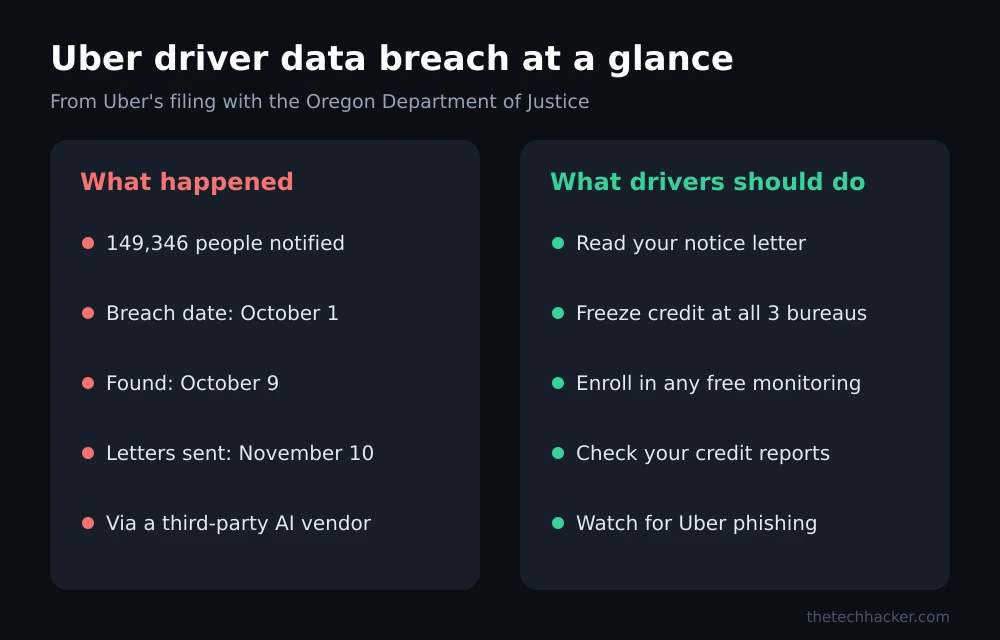
According to Uber’s filing on the Oregon Department of Justice data breach list, the key dates are:
| Detail | Per Uber’s Oregon filing |
|---|---|
| Date of breach | October 1, 2026 |
| Date discovered | October 9, 2026 |
| Notices sent | November 10, 2026 |
| People affected | 149,346 |
In notices filed with several state attorneys general, Uber said the vendor told it on October 9 that hackers had broken in and stolen internal credentials, which were then used to access Uber’s data, as reported by TechCrunch. Notices have also been filed in states including California, Illinois, Iowa, Massachusetts, Rhode Island, South Carolina, Texas and Vermont, according to the same report.
An Uber spokesperson said the notices relate to “a security incident impacting one of our third-party vendors, Fireworks.ai, which had access to some Uber data.” Fireworks confirmed unauthorized access to some of its systems that affected customer data. Notion and Cursor have also said they had data stolen in the Fireworks breach.
What was stolen
- Full names
- Home addresses
- Dates of birth
- Driver’s license numbers
That combination is exactly what criminals need to open accounts or pass identity checks in someone else’s name. Uber has not said that Social Security numbers or bank details were taken, and the company says it has not seen known misuse of the data so far, according to reports.
Why alarms did not go off
Uber said it had alerts set up to detect unauthorized access to its Fireworks environment, but because the attackers used Fireworks’ own internal credentials, “no alerts were triggered,” as reported by TechCrunch. It is a growing problem: as companies connect more AI vendors to their data, a breach at one provider can expose data from many of its customers at once. We saw a similar supply chain pattern this week in the Optimizely attack.
What Uber drivers should do now
- Read your notice letter carefully. It explains what was taken and any free credit monitoring offered, with an enrollment deadline. Make sure the letter came by mail and that any phone number or website in it matches Uber’s official contacts.
- Freeze your credit. The FTC explains how to place a free credit freeze or fraud alert with Equifax, Experian and TransUnion. A freeze stops new accounts from being opened in your name and does not hurt your credit score.
- Check your credit reports for accounts or inquiries you do not recognize.
- Watch for phishing. Expect fake “Uber security” texts and emails. Uber will not ask for your password or a verification code by message.
- Consider removing your data from broker sites. Our guide to data removal services explains how to cut down how much of your information is for sale online.
If you see signs someone is using your identity, report it at IdentityTheft.gov, the FTC’s official recovery site. Small businesses that rely on outside software vendors can also review our guide to endpoint security for small business.
FAQs
How many people were affected by the Uber data breach?
Uber reported 149,346 affected people in its filing with the Oregon Department of Justice.
What information was stolen in the Uber breach?
Names, addresses, dates of birth and driver’s license numbers, according to Uber’s notices.
Was Uber hacked directly?
No. Uber says the breach happened at a third-party vendor, reported to be Fireworks AI, whose internal credentials were used to access Uber data.
What should I do if I got an Uber breach letter?
Freeze your credit with all three bureaus, enroll in any free monitoring in your letter, check your credit reports and watch for phishing messages.
Featured image: Mikhail Mamaev on Unsplash.
Disclosure: TheTechHacker has no paid relationship with Uber, Fireworks AI or any company mentioned here.
More in News
DigiCert Breach: Company Discloses Unauthorized Access to Business System Holding Customer Data
DigiCert disclosed unauthorized access to a business system holding archived customer data. Here's what's confirmed, what's reported and what to do next.
What to Do After a Data Breach: Identity Theft Protection Explained (2026)
Got a data breach notice? Here’s the exact order I’d follow in the US: lock down your accounts, freeze your credit for free, get an IRS IP PIN, and decide whether a paid identity theft protection service is worth it.
Cyber Insurance for Small Businesses: What It Covers and What Insurers Require
A guide to cyber insurance for US small businesses: first-party vs third-party coverage, common exclusions, what insurers ask about on applications, and the questions to put to your broker.
The week in tech, minus the noise.
New reviews, fixes and the stories that matter — once a week, straight to your inbox.
We only use your email to send the newsletter. Unsubscribe any time. See our privacy policy.
Comments