

FBI Warns ARTEX AI Hacking Tool Can Breach Networks in Under Three Hours
The FBI says attackers use ARTEX, an AI hacking framework, to reach privileged access in under 3 hours. What it is, who is targeted and what to do.


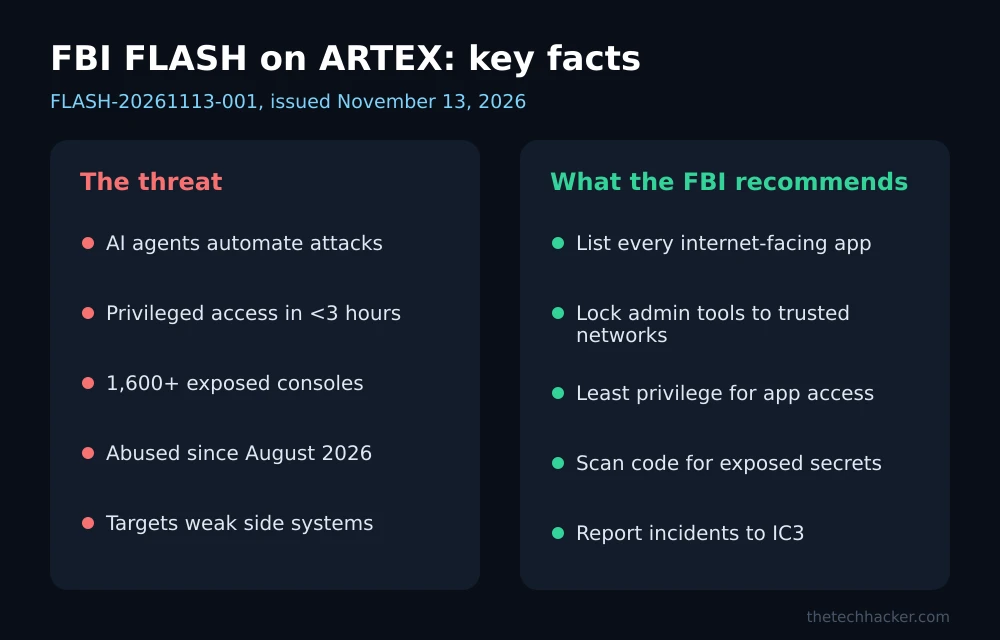
The FBI is warning organizations that cybercriminals and state-aligned hackers are using ARTEX, an open-source AI hacking framework, to automate break-ins from reconnaissance through data theft, in some cases reaching privileged access in under three hours. The warning comes in a FLASH alert issued on November 13, 2026, which says malicious actors have used the tool since at least August against targets in financial services, government, technology, defense, healthcare, energy, manufacturing, telecommunications and legal industries worldwide.
Quick answer: ARTEX is an open-source framework that uses AI agents connected to large language models to run multi-step cyberattacks with little human input. The FBI says attackers have weaponized it, that some intrusions went from first contact to privileged access in under three hours, and that more than 1,600 ARTEX consoles were publicly exposed in early November. The FBI urges organizations to inventory every internet-facing system, restrict admin tools to trusted networks, apply least privilege, scan for exposed secrets, and report incidents at IC3.gov.
What the FBI says ARTEX is
According to the FBI FLASH (FLASH-20261113-001), ARTEX is an autonomous, multi-agent penetration testing platform written in Go. A user describes a goal in natural language, and AI agents turn it into commands and carry them out, with minimal human involvement after the objective is set.
ARTEX has no AI model of its own. It connects to outside large language models, and the FBI lists both major US models and open-source or Chinese-origin models among those it can use. In attacker-controlled instances, the FBI says Chinese models are the most common, with the DeepSeek Flash family dominating because of its capability, low cost and lack of observable guardrails when requests are framed as penetration testing.
The tool was released on GitHub in July 2026. The developer said it was meant for authorized security testing and made the repository unavailable on October 8 after reports of abuse. The FBI says it still spreads through forks, archived copies and a commercial version called ARTEX PRO.
Attacks linked to ARTEX
- South Korean financial institutions: financially motivated attacks that exfiltrated personal information on about 67,000 people, according to the FBI.
- ConnectWise Cloud Backup supply chain compromise: attempted sign-ins to more than 2,250 downstream tenants, the FBI says.
- Exposure: over 1,600 publicly exposed ARTEX consoles as of early November, with the real number likely much higher once systems behind firewalls are counted.
The FBI says ARTEX is especially good at finding systems that get less security attention than a company’s main website: partner and supplier portals, mobile app backends, employee apps, legacy services and third-party integrations. That is the same weak-link pattern seen in recent vendor-driven incidents such as the Optimizely attack.
Why it matters
Automation changes the economics of hacking. The FBI says ARTEX lets threat actors with minimal expertise run complex campaigns against many targets at once, and that its speed leaves defenders little time to respond, even though the tool generates noisy traffic that can trigger alerts. A small criminal group can now do work that once needed a skilled team.
What the FBI recommends
The advisory’s recommendations are aimed at organizations, and they apply to small businesses as much as large ones:
- Know your attack surface. Inventory every internet-facing application, including partner portals, mobile backends and apps built by individual departments.
- Lock down admin access. Restrict cloud administration, device management, publishing interfaces and backup platforms to trusted networks, and move business apps behind Zero Trust access where possible.
- Apply least privilege. Limit permissions for multi-tenant apps and consent grants, and monitor new credentials, privilege changes and unusual app activity.
- Guard business APIs. Add rate limits and alerts for unusual volumes, especially on portals that expose customer records.
- Hunt for exposed secrets. Scan code repositories, configuration files and build pipelines for embedded passwords and keys, and rotate any that are exposed.
- Keep evidence. Preserve sign-in and audit logs, and don’t delay urgent containment while waiting for exports.
The FBI asks organizations to report suspicious activity to a local FBI field office or at the Internet Crime Complaint Center (IC3). For small teams without a security department, our guide to endpoint security for small business is a practical starting point.
What it means for consumers
ARTEX targets organizations, but the data stolen in those attacks belongs to customers and employees. If you get a breach notice from a company, our checklist on what to do after a data breach walks through the steps, starting with a free credit freeze.
FAQs
What is ARTEX?
ARTEX is an open-source, AI-driven penetration testing framework that uses AI agents connected to large language models to automate cyberattack steps. The FBI says threat actors have weaponized it.
How fast can ARTEX attacks happen?
The FBI says some ARTEX-assisted intrusions progressed from initial targeting to privileged access in under three hours.
Who is being targeted?
The FBI lists organizations worldwide in financial services, government, technology, defense, semiconductor, energy, healthcare, manufacturing, telecommunications and legal sectors.
How do I report an ARTEX-related attack?
The FBI asks organizations to contact their local FBI field office or report the incident at IC3.gov.
Featured image: Chris Yang on Unsplash.
Disclosure: TheTechHacker has no paid relationship with any company mentioned here.
More in News
Cyber Insurance for Small Businesses: What It Covers and What Insurers Require
A guide to cyber insurance for US small businesses: first-party vs third-party coverage, common exclusions, what insurers ask about on applications, and the questions to put to your broker.

How to Freeze Your Credit at Equifax, Experian and TransUnion: Step-by-Step Guide
A run of data breach disclosures in recent days, including stolen driver’s license data at Uber and a vendor-linked cyberattack at Expedia, has put the same question in front of millions of Americans: what do I do now that my personal details may be out there? Credit monitoring tells you after something has gone wrong.…
How to Fix ‘Your Computer Has Been Locked’ Scam Pop-Ups on Windows and Mac
A fake Microsoft or Apple warning took over your screen and wants you to call a number? Here’s how to close it safely on Windows and Mac, clean up your browser, and recover if you already called or paid.
The week in tech, minus the noise.
New reviews, fixes and the stories that matter — once a week, straight to your inbox.
We only use your email to send the newsletter. Unsubscribe any time. See our privacy policy.
Comments