

Mullvad vs Proton VPN 2026: Privacy, Jurisdiction, Audits and Pricing Compared
Mullvad and Proton VPN both promise strong privacy, but they handle signup, legal risk and pricing very differently. Here’s how they compare, using only what each company confirms on its own site.

Photo by Towfiqu barbhuiya on Unsplash
When the question is privacy and not streaming, two names come up more than any others: Mullvad and Proton VPN. Both are European. Both build their pitch around not keeping logs. But they get there by different routes, with Mullvad keeping as little about you as it can, and Proton leaning on Swiss jurisdiction and multi-hop routing.
Not sure you need a VPN at all? Start with my guide on whether a VPN is worth it for US users, then come back here.
Quick answer: Mullvad is the better pick if anonymity is your top priority. You sign up with a random account number (no email, no username, no password), and it’s published two independent security audits from late 2025. Proton VPN, based in Geneva, Switzerland, suits you if you like the Swiss legal setup and its Secure Core feature, which routes traffic through servers in Switzerland, Iceland or Sweden first. I couldn’t confirm current prices for either, so check both official pricing pages before you pay.
Mullvad vs Proton VPN at a glance
Every row below comes from the providers’ own websites. Where you see “Not confirmed”, I couldn’t verify the detail there, which isn’t the same as the feature being missing.
| Feature | Mullvad | Proton VPN |
|---|---|---|
| Company | Mullvad VPN AB, a subsidiary of Amagicom AB, both 100% owned by the founders | Proton AG (the same page also says Proton Technologies AG) |
| Based in | Sweden | Geneva, Switzerland |
| Signup | Random account number, no email, username or password | Not confirmed |
| What the account holds | Only the account number and time left | Not confirmed |
| Data retention law | Says no Swedish regulation can force VPNs to secretly collect traffic data | Says current Swiss law doesn’t require Proton VPN to retain data |
| Recent independent audits | Web app (Assured, Oct 2025); API and backend source code (X41 D-Sec, report Jan 2026) | Not confirmed on official pages |
| Multi-hop routing | Multihop (on Android since version 2025.1) | Secure Core via Switzerland, Iceland or Sweden |
| Quantum-resistant connections | On by default in all apps | Not confirmed |
| Reproducible builds | Android (since 2025.2) | Not confirmed |
| Pricing model | One flat price (check official page) | Check official page |
Mullvad wins a lot of rows. Read that with a caveat, though. Part of the gap is just that Mullvad documents its privacy details more thoroughly on its own pages, and Proton may well match it on some of the “Not confirmed” items.
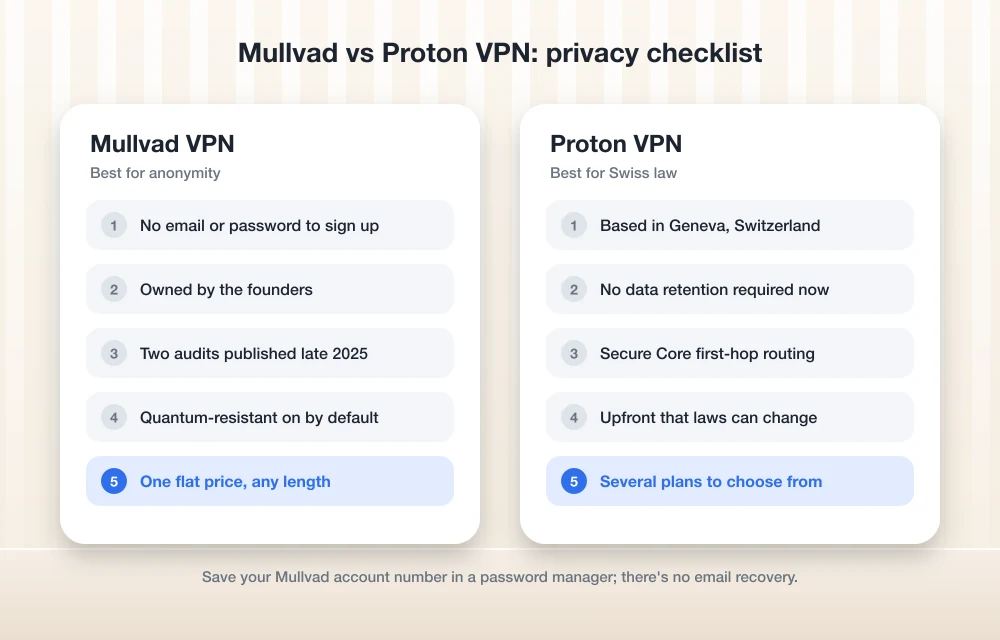
Jurisdiction: Sweden vs Switzerland
Jurisdiction is simply whose laws the provider has to follow. And that’s the government that can ask for, or force, a handover of data.
Mullvad is run by Mullvad VPN AB, a subsidiary of Amagicom AB. Both are fully owned by the founders, Fredrik Strömberg and Daniel Berntsson. No outside investors. No parent conglomerate. Mullvad says no Swedish regulation can force VPN providers to secretly collect traffic data, and it keeps a page about Sweden’s covert data surveillance law.
The more useful part is its stated exit condition. Mullvad says that if a government ever legally forced it to spy on users, it would stop operating in that jurisdiction, and that it has lawyers watching Swedish law for changes. It’s a promise about future behavior, so yes, you’re trusting them. Still, it’s written down and it’s specific.
Proton says it’s based in Geneva, Switzerland, and that Swiss law doesn’t currently require Proton VPN to retain any data. It also says plainly that today’s rules don’t guarantee anything about tomorrow, which is a more honest framing than the usual “Switzerland is untouchable” marketing line.
One inconsistency. Proton’s Swiss-based page names the owner as “Proton Technologies AG” but lists the legal name as Proton AG, which may be a leftover from an older company name. I couldn’t confirm that, so treat it as an open question.
Signing up: account numbers vs email
This is where Mullvad really stands apart. Signup asks for nothing personal: no username, no password, no email. You get a random account number, and that number is your only credential.
Per Mullvad’s no-logging data policy, an account has exactly two properties, the account number and the time remaining. You can make as many accounts as you like, and several people can share one. Mullvad also says payment processors like PayPal and Stripe never get your Mullvad account number, so the payment side can’t easily tie a charge to a specific VPN account.
So “anonymous VPN signup” comes down to this: the provider’s database holds less about you.
The catch is recovery. No email on file means no “forgot password” link. Lose the number and the account’s gone.
For Proton VPN, I couldn’t confirm from an official page whether signup requires an email address. Look at the signup screen yourself and decide if you’re fine with what it asks for.
No-logs audits: what’s actually published
A no-logs policy is a claim. An audit is an outside firm going through the code or systems and publishing what it found, so you’ve got something to check instead of something to take on faith.
What I could confirm for Mullvad:
- Web app audit: Security firm Assured finished an audit of Mullvad’s web app on Oct 23, 2025. No critical, high or medium issues turned up, and the one low-severity input-validation flaw it found has been fixed.
- API and backend audit: X41 D-Sec reviewed the source code of Mullvad’s API and backend from Oct 13 to Oct 31, 2025, and put out a public report dated Jan 20, 2026. The report notes that the Mullvad API doesn’t see any VPN traffic.
Watch the scope here. These are security audits of specific systems, not one audit stamping “no logs” on the whole service. But the X41 finding that the API never sees VPN traffic is directly relevant to privacy, and both reports are public.
Proton VPN’s no-logs audit history comes up a lot when people discuss the service. I couldn’t verify the reports, dates or auditors on Proton’s own pages before publishing, and I’m not going to repeat secondhand claims. Go to Proton’s official blog for its audit announcements and read the reports directly.
Pricing: Mullvad’s flat price vs Proton’s plans
Mullvad charges one flat rate. Pay for a month or a longer stretch and the rate doesn’t change, so nothing nudges you into a multi-year lock-in. No countdown timers. No “save 80%” banners.
I couldn’t reach Mullvad’s official pricing page for this article, so there’s no number here. Check the billing currency too: if it isn’t USD, what lands on your card will drift with exchange rates.
Proton VPN sells several plans. I couldn’t confirm current prices, device limits, free plan details or the refund policy from Proton’s official pricing page.
Privacy features in the apps
Both handle the basics. Where they split is the privacy extras, and Mullvad’s 2025 release notes make its changes much easier to check.
1. Mullvad VPN
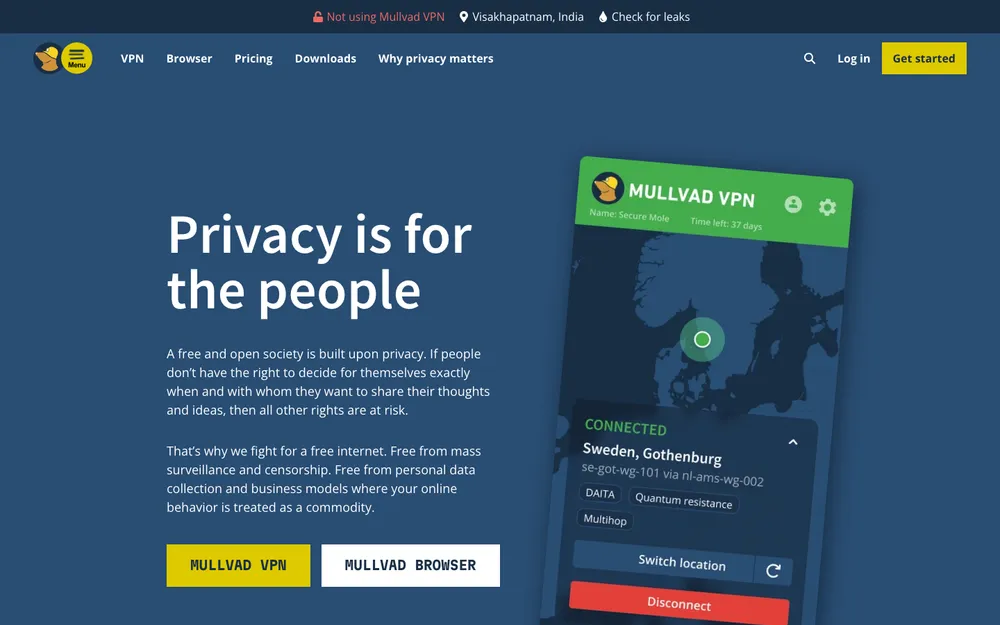
Version 2025.2 switched on quantum-resistant WireGuard by default on Windows, the last platform to get it, so every Mullvad app now ships with it on. WireGuard is the protocol that builds the encrypted tunnel. The “quantum-resistant” part is about the key exchange, which is built to hold up against future quantum computers that could break today’s encryption.
Multihop landed on Android in version 2025.1. Your traffic goes through two VPN servers instead of one, so no single server sees both where you’re coming from and where you’re going.
Android 2025.2 added reproducible builds: anyone can check that the app on their phone was compiled from Mullvad’s published open-source code, with nothing slipped in. And version 2025.8 brought QUIC obfuscation to iOS and Android, dressing VPN traffic up as ordinary QUIC web traffic, which can help on networks that block VPNs.
What I liked
- No email, username or password needed to sign up
- Owned by the founders, no outside parent company
- Two independent audits published from late 2025
- Quantum-resistant connections on by default in every app
- Reproducible Android builds you can verify yourself
What could be better
- Lose your account number and there’s no email to recover it with
- I couldn’t confirm the current price, device limit or refund window from the official page
2. Proton VPN
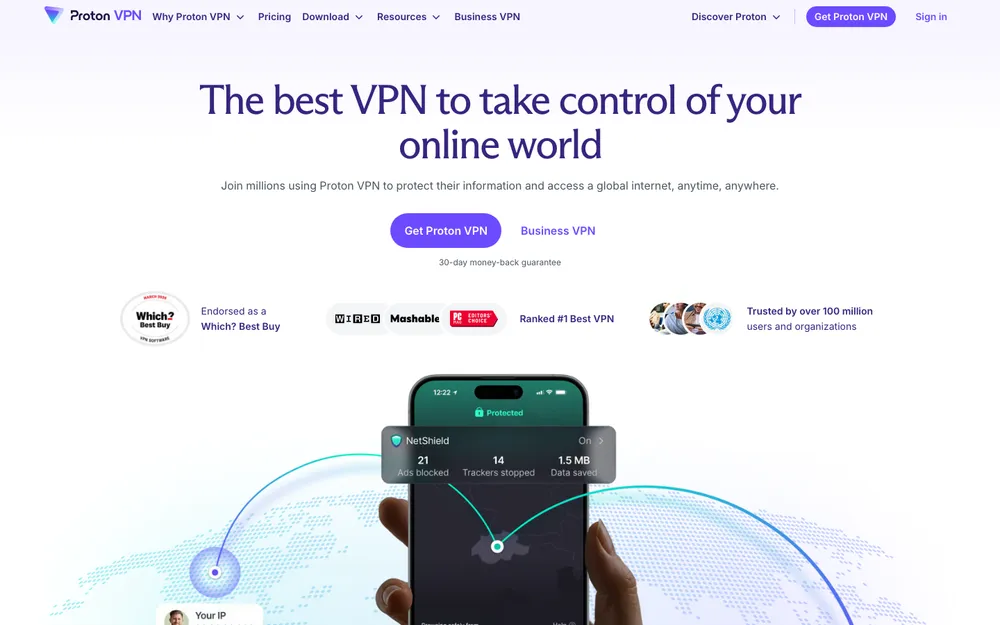
Proton’s headline privacy feature is Secure Core. Your traffic goes through a server in Switzerland, Iceland or Sweden before it exits to the internet. Same idea as multihop, really, except the first hop is pinned to a country Proton considers privacy-friendly.
You’ll see other Proton features mentioned a lot elsewhere: a free plan, the Stealth protocol, port forwarding, open-source apps. I couldn’t confirm those on Proton’s official pages for this article, so check its features page to see what each plan includes right now.
What I liked
- Based in Geneva, Switzerland, and per Proton, current law doesn’t require it to retain data
- Secure Core sends traffic through Switzerland, Iceland or Sweden first
- Proton is upfront that laws can change later
What could be better
- Two different company names on its Swiss-based page
- I couldn’t confirm audits, prices or signup requirements from official pages
- Vague, unofficial chatter about Swiss surveillance law changes
Proton explains its legal setup and Secure Core in its own words on its Swiss-based features page.
Which one should you pick?
Want the smallest possible footprint? Go with Mullvad. Account-number signup, founder ownership, flat pricing and recent public audits all point the same way, toward a provider that knows as little about you as it can.
If Switzerland’s legal setup and Secure Core matter more to you, Proton VPN is a strong option. Just check its pricing page and audit announcements first, since I couldn’t confirm those details here.
Mullvad VPN
No personal details at signup, plus recent public audits of its web app and backend.
Proton VPN
Based in Geneva, with Secure Core routing through Switzerland, Iceland or Sweden.
Why Mullvad edges it on documented privacy
Neither is a bad choice. Mullvad comes out ahead on privacy mostly because more of what it claims is written up on its own pages and backed by published audits. Proton’s legal position is solid, and I’d revisit this comparison once its pricing and audit details can be confirmed from its own site.
One limit worth remembering. A VPN hides your traffic from your ISP and whatever Wi-Fi you’re on, and that’s it; it won’t stop malware or a bad download. For that side of things, see my guide on whether you still need antivirus on Windows 11 and Mac.
Frequently Asked Questions
Is Mullvad or Proton VPN better for privacy?
For anonymity, Mullvad. It doesn’t need an email, username or password at signup, and it published independent security audits of its web app and backend from late 2025. Proton VPN is a good option if you’d rather have a Swiss-based provider with Secure Core routing.
Does Mullvad need an email address to sign up?
No. Mullvad generates a random account number, and that’s all you need to use the service. The account holds just two things: the number and the time left on it.
Where are Mullvad and Proton VPN based?
Mullvad is run by Mullvad VPN AB in Sweden, a subsidiary of Amagicom AB, and both are owned by the founders. Proton VPN says it’s based in Geneva, Switzerland.
What is Proton VPN Secure Core?
Secure Core sends your traffic through a server in Switzerland, Iceland or Sweden before it exits to the internet. So the exit server on its own doesn’t see where your connection started.
How much do Mullvad and Proton VPN cost?
Mullvad charges one flat price no matter how long you pay for, while Proton VPN sells several plans. Prices change, so check each company’s official pricing page for the current amount and renewal terms.
Featured image: Towfiqu barbhuiya on Unsplash.
Disclosure: TheTechHacker has no paid relationship with the companies in this article.
You might also like
Is a VPN Worth It in 2026? Best VPNs for US Users
A VPN hides your traffic from your ISP and public Wi-Fi and changes your apparent location, but it won’t make you anonymous or stop scams. Here’s when it’s worth paying for in the US, what to check before you buy, and which providers to compare.
Surfshark vs NordVPN (2026): Pricing, Devices, Refunds and Streaming Compared
Surfshark and NordVPN compared using only what each company officially says about plans, trials, refunds, device limits, apps, protocols and streaming. Where I couldn’t confirm something, I tell you.

VPN Beginner’s Guide – Why We All Need VPN?
Have you ever considered how anonymous you really are online? Although being able to track internet users is useful when it comes to criminals and the likes, are regular people who are doing no harm right to want to remain anonymous? Or, do you want to stay anonymous for a reason, such as accessing geo-blocked…
The week in tech, minus the noise.
New reviews, fixes and the stories that matter — once a week, straight to your inbox.
We only use your email to send the newsletter. Unsubscribe any time. See our privacy policy.
Comments